
Key Takeaways
- EMDR (Eye Movement Desensitization and Reprocessing) is a structured therapy that helps the brain reprocess distressing memories so they lose their emotional charge.
- It uses bilateral stimulation, such as eye movements, taps, or tones, while you briefly focus on a memory. You stay awake and in control the whole time.
- Treatment follows eight phases and starts with history and coping skills, not with painful memories.
- EMDR is included in PTSD treatment guidance from the World Health Organization, the American Psychological Association, and the VA/DoD.
- Sessions can be emotional, but they are carefully paced, and you can pause or stop at any time.
Some experiences stay with us long after they are over. A memory might still bring a racing heart, a wave of shame, or the feeling that you are back in that moment, even though you know you are safe now.
EMDR therapy was designed to help with exactly that. Instead of only talking about what happened, it helps your brain process the memory so it no longer carries the same intensity. Still, it is natural to have questions before you start: How does it work? What happens in a session? Does it actually help? Will it be too much?
This guide answers all of those questions in one place. You will learn what EMDR is and how it works, who it tends to help, what happens in each of the eight phases, what the evidence says, what sessions feel like and how counselors keep them manageable, and how EMDR compares with other trauma therapies.
What Is EMDR Therapy?
EMDR stands for Eye Movement Desensitization and Reprocessing. It is a structured psychotherapy developed by psychologist Francine Shapiro in the late 1980s, and it has been studied extensively since then.
The core idea is simple: some distressing experiences get stored in the brain in an unprocessed way. The original emotions, body sensations, and beliefs stay “stuck” to the memory, so reminders can trigger reactions that feel as strong as they did at the time. EMDR helps the brain finish processing that memory so it can be filed away as something that happened in the past.
How Does EMDR Work?
During processing, you briefly hold a memory in mind while engaging in bilateral stimulation, meaning rhythmic left-right input. Your counselor may use:
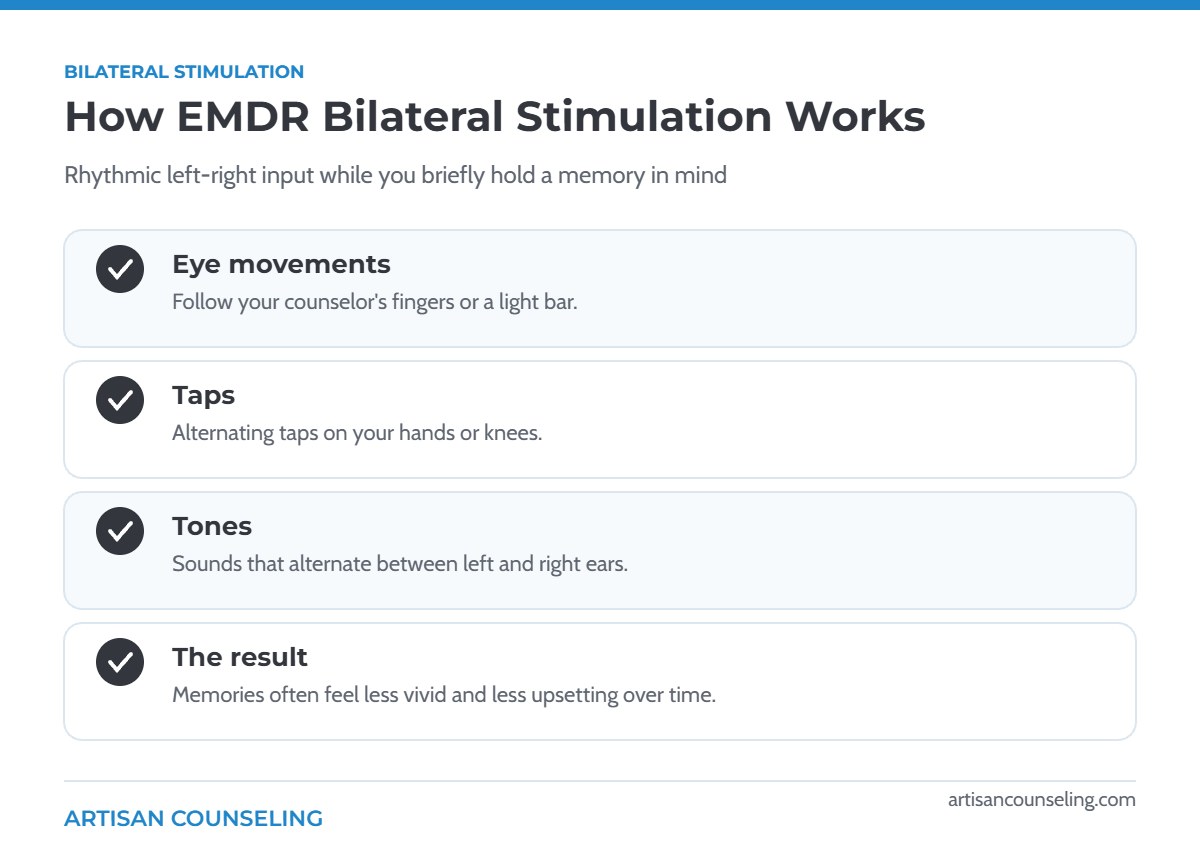
- Eye movements, following your counselor’s fingers or a light bar
- Alternating taps on your hands or knees, or handheld buzzers
- Tones that alternate between your left and right ears
Sets are short, often less than a minute. Between sets, you briefly share what you noticed, and then the next set begins. Over repeated sets, the memory typically becomes less vivid and less upsetting, and a healthier belief about yourself, such as “I survived” or “I can handle this now,” starts to feel true.
Researchers are still studying exactly why bilateral stimulation helps. Leading explanations involve how it taxes working memory, making the memory less vivid while you hold it, and how it supports the brain’s natural ability to integrate experiences. You will still remember what happened, but it tends to feel like the past rather than the present.
How Is EMDR Different From Talk Therapy?
In traditional talk therapy, much of the session involves discussing your experiences in detail. EMDR includes conversation too, especially early on, but the core processing work happens internally. You do not need to describe every detail of a memory out loud, and there is usually no detailed written homework between sessions. Many people find this a relief, especially when retelling their story feels exhausting.
Who Can EMDR Help?
EMDR is best established as a treatment for post-traumatic stress disorder (PTSD). Counselors also use it for a range of concerns rooted in painful experiences, including:
- Single-incident trauma, such as car accidents, assaults, natural disasters, or medical emergencies
- Childhood and repeated trauma, including complex trauma
- Anxiety and panic that trace back to specific experiences
- Phobias
- Grief and traumatic loss
- Negative core beliefs such as “I am not enough” or “I am never safe”
EMDR is often a strong fit if you have specific memories that still feel vivid or “stuck,” if you experience flashbacks, nightmares, or strong reactions to reminders, or if you know logically that you are safe but your body reacts as though you are not.
EMDR and Complex Trauma
People with repeated or childhood trauma can benefit from EMDR too. Treatment usually takes longer and spends more time on preparation and stabilization before processing begins. Complex PTSD is recognized as a diagnosis in the ICD-11, and treatment for it often blends EMDR with other approaches. You can learn more in our article on PTSD vs. CPTSD.
When EMDR May Need to Wait
EMDR is not the right starting point for every person at every moment. Your counselor may suggest building a foundation first if you are in an unsafe situation or ongoing crisis, if active substance misuse makes it hard to stay grounded, if you experience significant dissociation, or if you do not yet have ways to manage strong emotions between sessions. This does not rule EMDR out. It often means starting with stabilization skills, such as those taught in DBT therapy, and moving into processing when you are ready.
The 8 Phases of EMDR: What to Expect in a Session
EMDR follows a standard eight-phase protocol. Some phases happen once, while others repeat across many sessions. Here is what each one looks like.
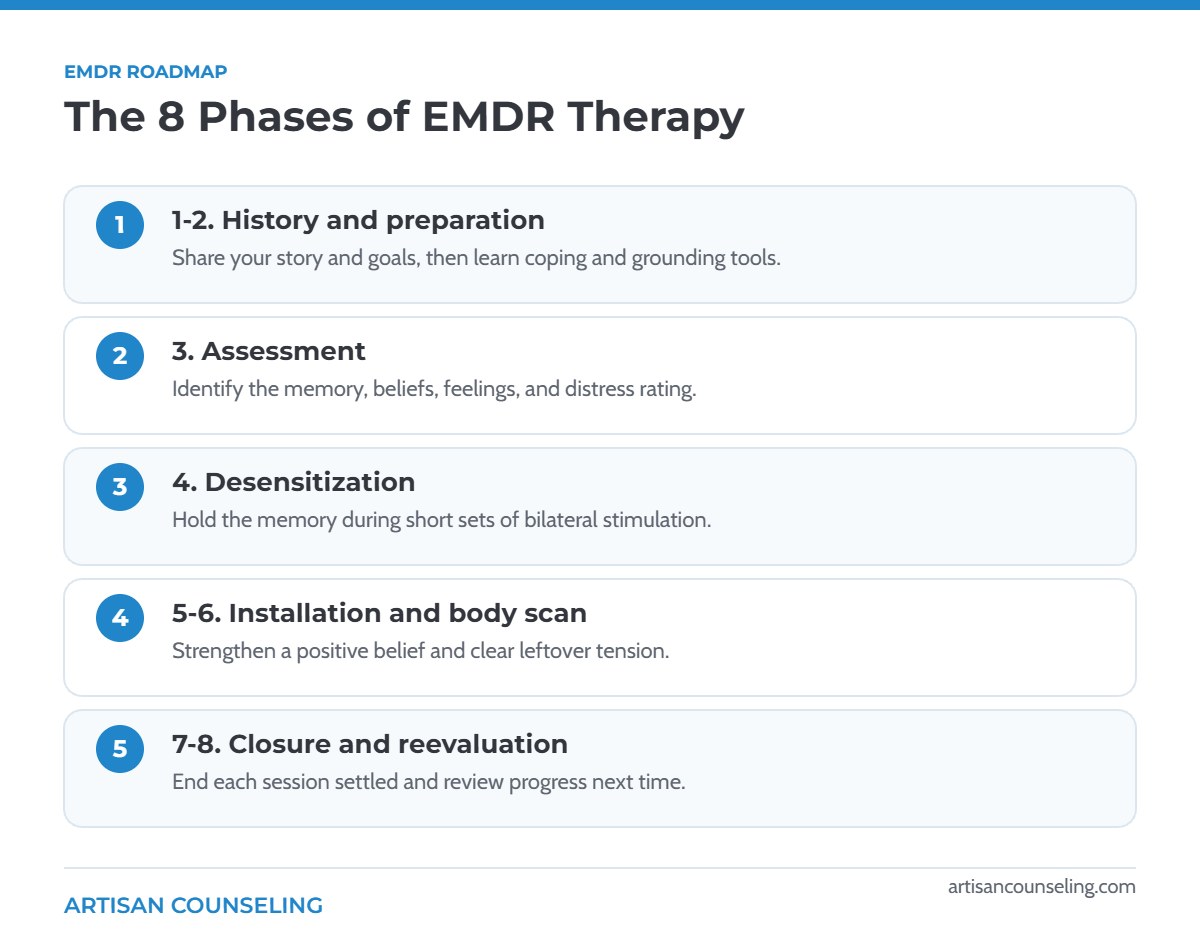
Phase 1: History and Treatment Planning
Your counselor learns about your background, current symptoms, and goals. Together you identify memories or themes that may become targets later. You do not need to go into painful detail at this stage.
Phase 2: Preparation
You learn what to expect and practice coping tools such as a calm-place visualization, grounding through your senses, and a “container” exercise for setting difficult material aside between sessions. This phase makes sure you can manage strong emotions before processing begins, and it can be extended as long as you need.
Phase 3: Assessment
You choose a specific memory and identify the image that represents it, the negative belief linked to it (“I am powerless”), the belief you would prefer (“I can handle this now”), and the emotions and body sensations involved. You rate your distress on a 0 to 10 scale.
Phase 4: Desensitization
This is the part most people picture. You hold the memory in mind during short sets of eye movements, taps, or tones. After each set, your counselor asks what you notice and guides you into the next set. This continues until the memory feels much less distressing.
Phase 5: Installation
Once distress has decreased, you focus on strengthening the positive belief so it feels more true when you think about the memory.
Phase 6: Body Scan
You check your body for any remaining tension or discomfort linked to the memory and process it if needed.
Phase 7: Closure
Every session ends with steps to help you feel calm and settled, even if processing is not finished. Your counselor may guide you through a calming exercise and talk about what you might notice in the coming days.
Phase 8: Reevaluation
At the start of the next session, you and your counselor review what changed and decide what to work on next.
How Many EMDR Sessions Will You Need?
There is no single answer. A single-incident trauma may need relatively few processing sessions after preparation, while childhood or repeated trauma usually requires a longer preparation phase and more sessions overall. Your stability, support system, and coping skills all affect pacing. Your counselor will check progress with you regularly, and our article on how long counseling takes covers the general factors that shape timelines.
Does EMDR Work?
EMDR has been evaluated in many clinical trials and reviews, and the evidence supports it as an effective treatment for PTSD. It is included among recommended PTSD treatments in guidance from the World Health Organization, the American Psychological Association, and the U.S. Department of Veterans Affairs and Department of Defense (VA/DoD). For general background on trauma treatment, the VA’s National Center for PTSD is a reliable resource.
Research generally finds EMDR performs similarly to other well-established trauma therapies, such as trauma-focused cognitive behavioral therapy. It is also being studied for anxiety, phobias, and depression, though the evidence for those concerns is less established than it is for PTSD.
That said, results are personal. The best outcomes tend to come from readiness, careful preparation, and a good fit with a clinician who has completed specialized EMDR training. People often describe processed memories as feeling “further away” or “just a memory,” but your counselor cannot promise a specific result or timeline.
What Does EMDR Feel Like? Is It Intense?
The honest answer is that EMDR can be emotional, but it is not designed to overwhelm you. Most people find it more manageable than they expected. You stay awake, aware, and in control the entire time. EMDR is not hypnosis, and you can stop whenever you want.
What You Might Feel During Processing
Experiences vary, but people commonly describe:
- A wave of emotion that peaks and then eases, sometimes within a single set
- Body sensations such as tightness, warmth, or tingling that shift and fade
- Memories or images changing, becoming blurrier, or feeling farther away
- Unexpected memories or connections coming up
- Sets where very little seems to happen, which is also normal
Strong emotion is not a sign that something is going wrong, and neither is a quiet, uneventful session. There is no wrong way to experience EMDR. You simply notice what comes up and report it.
How Therapists Keep EMDR Manageable
EMDR has safeguards built into its structure. A trained clinician will use several of these:
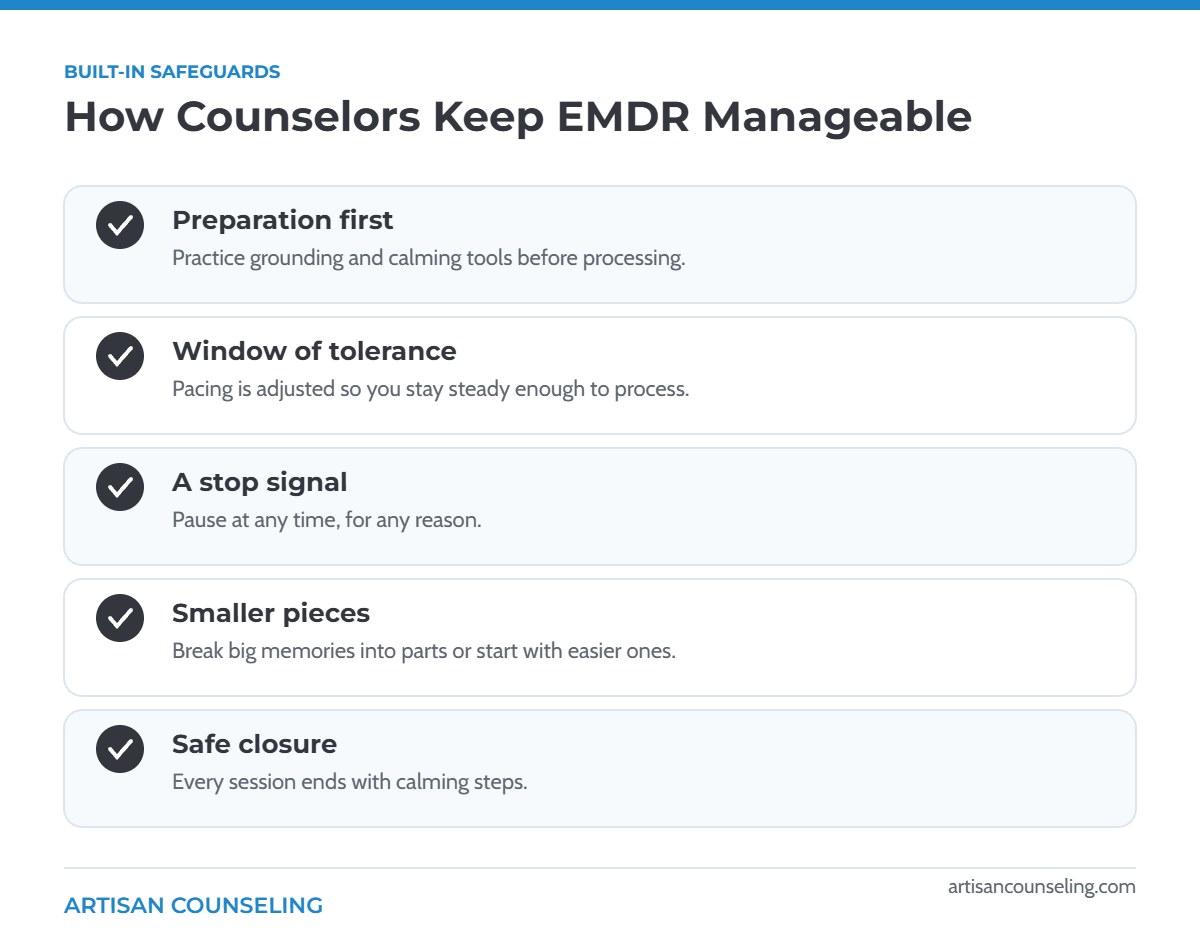
- Preparation first: you practice grounding and calming tools before touching difficult memories.
- Staying in your “window of tolerance”: your counselor watches for signs you are becoming too activated or shutting down, and adjusts the speed, length of sets, or focus.
- A stop signal: you agree on a simple hand signal that means pause, and you can use it at any time.
- Smaller pieces: large or complex memories can be broken into parts, or you can start with less distressing memories to build confidence.
- Safe closure: every session ends with calming steps so you leave feeling settled.
What Happens After a Session
Processing can continue for a day or two. You might feel tired or emotionally drained, have more vivid dreams, notice emotions or insights surfacing unexpectedly, or feel lighter than you have in a long time. These reactions are common and usually temporary.
Tip: When you can, plan a gentler schedule after processing sessions. Use the coping skills you practiced in preparation, jot down anything notable to share at your next appointment, and contact your counselor if reactions feel unmanageable.
EMDR vs. Other Trauma Therapies
EMDR is one of several well-supported approaches to trauma. Talk-based trauma therapies, such as trauma-focused CBT, work more directly with thoughts and beliefs through conversation and often include between-session practice. EMDR relies more on internal processing during bilateral stimulation and usually involves less detailed retelling.
Neither is right for everyone. Some people use both at different points, and many counselors blend EMDR with trauma-informed therapy or body-based approaches. For a fuller comparison, read EMDR vs. traditional trauma counseling.
If you are in crisis: call or text 988 to reach the 988 Suicide & Crisis Lifeline, available 24/7, or call 911 in an emergency.
Frequently Asked Questions
Is EMDR the same as hypnosis?
No. During EMDR you are fully awake, aware, and in control. You can stop the process at any time, and you remember everything that happens in session.
Does EMDR erase traumatic memories?
No. You will still remember what happened. The goal is for the memory to lose its emotional intensity so it no longer disrupts your sleep, relationships, or sense of safety.
Do I have to talk about my trauma in detail?
Not in the way some talk therapies require. You share enough for your counselor to identify the target memory, but most processing happens internally, and you choose how much to say between sets.
Can EMDR make you feel worse before you feel better?
Some people feel more emotional or tired for a day or two after processing sessions. This is common and usually temporary. Tell your counselor if it feels like too much so they can slow the pace or spend more time on preparation.
Can EMDR be done through telehealth?
Yes. EMDR can be adapted for online sessions using on-screen eye movement tools or self-tapping. Your counselor will help you decide whether telehealth is a good fit for your situation.
Who can provide EMDR therapy?
EMDR should be provided by a licensed mental health professional who has completed specialized EMDR training. It is completely appropriate to ask a counselor about their training and how they approach preparation.
Starting EMDR Therapy at Artisan Counseling
If past experiences still shape how you feel day to day, you do not have to sort through them alone. Artisan Counseling offers EMDR therapy with careful preparation and pacing, along with broader trauma-informed care.
You can meet our counselors and see us in person at our Newport News office or Suffolk office, or connect through telehealth across Virginia. When you are ready, contact us to ask questions or schedule a first appointment.