Key Takeaways
- Repetitive negative thinking, often called rumination or worry, happens because the brain is wired to focus on possible threats and unfinished problems.
- Common loops include replaying the past, rehearsing the future, self-judgment, and big existential worries.
- Suppressing, over-analyzing, and believing thoughts as facts tend to keep the loop going.
- Labeling thoughts, changing your physical state, writing worries down, and absorbing tasks can help interrupt the cycle.
- Persistent thought loops can be linked to anxiety, depression, OCD, or trauma, and therapy approaches like CBT are effective.
You replay an awkward conversation for the fifth time. You lie awake running through everything that could go wrong tomorrow. You tell yourself to stop thinking about it, and somehow the thought gets louder.
If this sounds familiar, you are not alone, and there is nothing wrong with you. Repetitive negative thinking is a common human experience. Understanding why it happens is the first step toward loosening its grip.
In this article, you will learn why the brain loops on negative thoughts, the most common patterns, what keeps those loops going, practical strategies that help, and when it may be time to talk with a counselor.
Why Does the Brain Repeat Negative Thoughts?
Your brain is built to keep you safe. Throughout human history, noticing danger mattered more for survival than noticing pleasant things. As a result, the mind tends to give extra weight to threats, mistakes, and unresolved problems. Psychologists call this the negativity bias.
When something feels unfinished or uncertain, the brain keeps returning to it, almost like an open browser tab it does not want to close. In small doses, this helps you learn and plan. When it becomes constant, it turns into rumination (dwelling on the past) or worry (dwelling on the future), and it often makes you feel worse without solving anything.
Common Types of Repetitive Negative Thoughts
Replaying the Past
You go over conversations, mistakes, or painful events, asking what you should have said or done differently.
Rehearsing the Future
You imagine worst-case scenarios in detail, trying to prepare for every possibility. This is a hallmark of anxiety. Our article on feeling anxious even when nothing is wrong explores this more.
Self-Judgment on Repeat
Thoughts like “I am such a failure” or “Everyone thinks I am annoying” play on a loop. These are often tied to low self-esteem.
Existential Worries
Big questions about health, death, meaning, or the future of the world can become sticky, especially during stressful periods.
What Keeps Negative Thoughts Stuck?
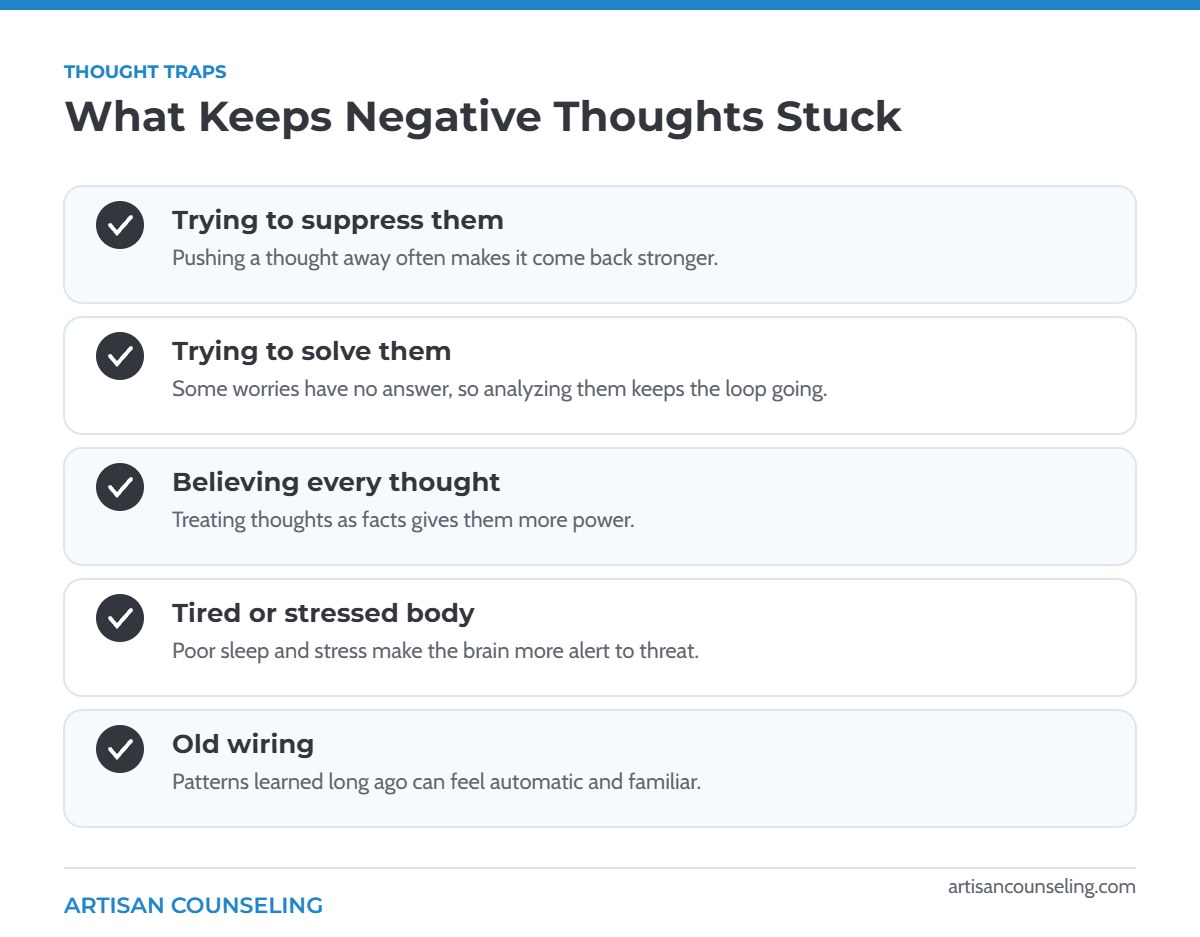
Thought loops are not just about the thoughts themselves. How you respond to them matters a great deal.
Trying Not to Think About Them
Telling yourself to stop thinking about something usually backfires. Suppression keeps the brain checking whether the thought is still there, which brings it right back.
Trying to Solve the Unsolvable
Some worries have a clear next step. Others, like what someone else thinks of you, have no definite answer. Analyzing them endlessly feels productive but keeps you stuck.
Believing Every Thought Is True
Thoughts are mental events, not facts. When you treat “I am going to fail” as a prediction rather than a passing thought, it carries much more emotional weight.
Your Physical State
Lack of sleep, hunger, illness, and chronic stress all make the brain more sensitive to threat. Loops are often louder at night or when you are depleted.
Old Wiring
If you grew up in an unpredictable or critical environment, constant scanning and self-blame may have helped you cope. Those habits can stay active long after they stop being useful.
How to Break the Cycle of Negative Thinking
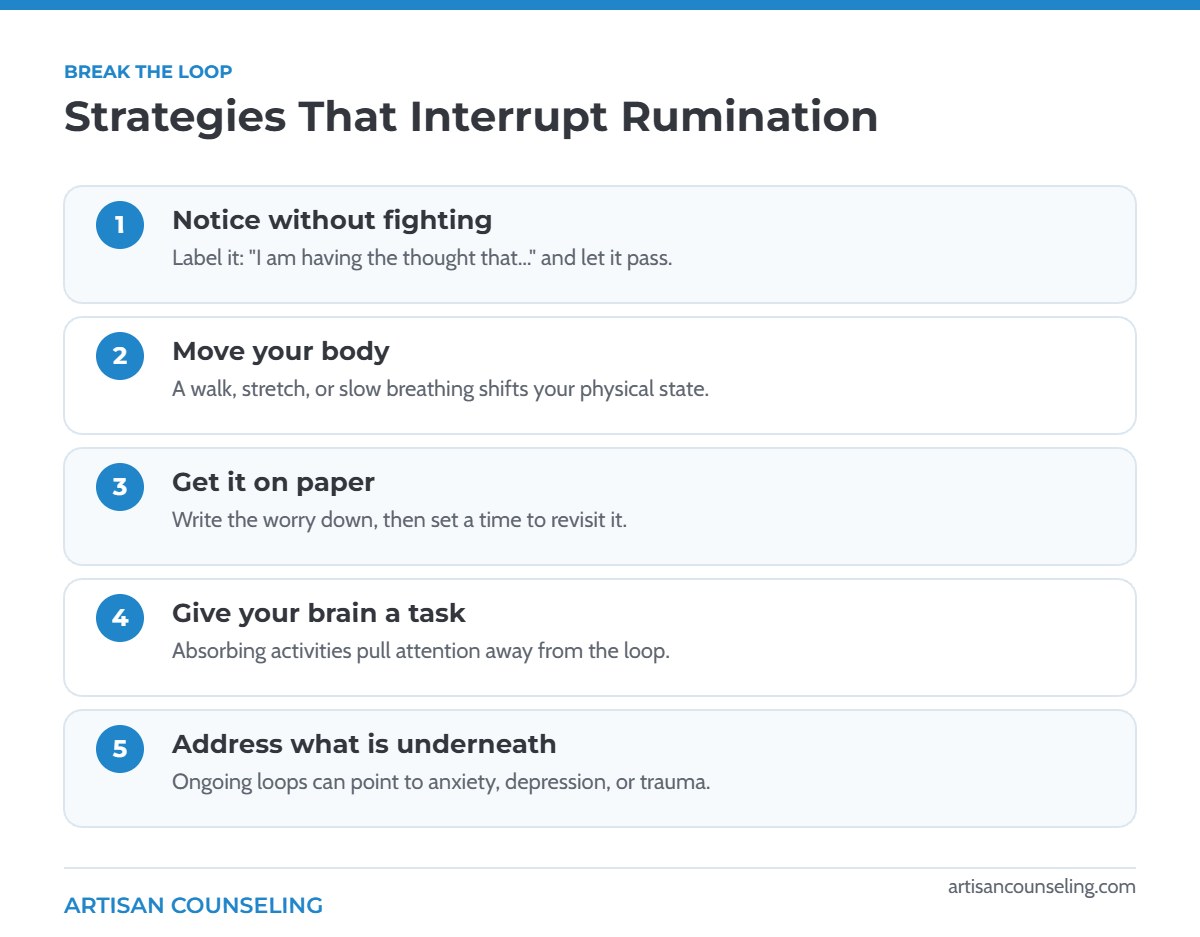
The goal is not to never have a negative thought again. It is to change your relationship with those thoughts so they pass through more easily.
Notice Without Fighting
Try labeling the thought: “I am having the thought that I messed up.” This small shift, a technique used in acceptance and commitment therapy, creates distance between you and the thought.
Break the Physical Loop
Changing your body state can change your mental state. Take a brisk walk, stretch, splash cool water on your face, or try slow breathing with a longer exhale than inhale.
Get It Out of Your Head
Write the thought down. If it is a solvable problem, list one next step. If it is not, try scheduling a short “worry time” later in the day and remind yourself the thought can wait until then.
Give Your Brain a Real Task
Activities that need focus, such as a puzzle, cooking a new recipe, a conversation, or a hands-on hobby, give your attention somewhere else to go.
Address the Underlying State
Persistent loops are often a symptom, not the root problem. Ongoing anxiety, depression, burnout, or unresolved trauma can all fuel repetitive thinking. Caring for sleep, movement, and connection helps, and so does professional support.
Ask yourself one simple question when a thought repeats: “Is thinking about this right now helping me take action, or just making me feel worse?” If it is the second, that is your cue to shift your attention.
When to Seek Help for Repetitive Thoughts
Consider reaching out to a professional if repetitive thoughts:
- Take up a large part of your day or keep you from sleeping
- Interfere with work, school, or relationships
- Come with persistent sadness, hopelessness, or loss of interest
- Feel intrusive and disturbing, or come with urges to repeat behaviors to feel relief (which can be a sign of OCD)
- Include thoughts of hurting yourself
If you are in crisis: call or text 988 to reach the 988 Suicide & Crisis Lifeline any time, day or night, or call 911 in an emergency.
Cognitive behavioral therapy is one of the most well-studied approaches for repetitive negative thinking. It helps you identify thinking patterns, test their accuracy, and build new responses. Acceptance and commitment therapy focuses on changing your relationship with thoughts rather than arguing with them.
Frequently Asked Questions
Why do negative thoughts get worse at night?
At night there are fewer distractions, and fatigue makes the brain more sensitive to stress. Writing worries down before bed, keeping a calming routine, and getting out of bed briefly if you cannot sleep can help.
Is rumination a sign of anxiety or depression?
Rumination is common in both. Worry about the future is often linked to anxiety, while dwelling on past failures and self-blame is often linked to depression. Only a licensed professional can determine whether a condition is present.
Can you stop negative thoughts completely?
No one can eliminate negative thoughts entirely, and trying to usually makes them stronger. The goal is to notice them sooner, believe them less, and let them pass without getting pulled into a loop.
What is the difference between intrusive thoughts and rumination?
Intrusive thoughts are unwanted thoughts or images that pop up suddenly and often feel out of character. Rumination is the ongoing process of dwelling on a thought. Both are common and can improve with therapy.
Find Support at Artisan Counseling
If your thoughts feel like they are running the show, our licensed counselors can help you understand the patterns and build practical tools to quiet them. We offer individual counseling in Newport News and Suffolk and telehealth throughout Virginia. Reach out today to schedule an appointment.