Key Takeaways
- Resilience is not about being unaffected. It is the ability to adapt and recover over time, and it can be strengthened at any age.
- After a difficult event, stress temporarily drains the energy you would normally use to cope, so feeling shaken is expected.
- Research suggests many people recover well after hardship, and connection, routines, and meaning-making are among the strongest supports.
- Counseling can help when distress lingers, interferes with daily life, or brings up past trauma.
A job loss, a serious illness, a divorce, an accident, the death of someone you love. Difficult life events can shake the ground beneath you and leave you wondering whether you will ever feel like yourself again.
You may have heard that resilient people “bounce back.” That phrase can feel discouraging when you are still struggling. In reality, resilience is less about bouncing and more about slowly finding your footing again.
In this article, you will learn what resilience really means, why it can feel harder to access after a big event, what helps people recover, practical ways to build resilience day by day, and when counseling can make a difference.
What Does Resilience Really Mean?
The American Psychological Association describes resilience as the process of adapting well in the face of adversity, trauma, tragedy, or significant stress. Notice the word process. Resilience is not a trait you either have or lack.
Being resilient does not mean:
- Not feeling sad, angry, or afraid
- Getting over things quickly
- Handling everything on your own
- Pretending you are fine
Instead, it means being able to feel the pain, keep going in small ways, and gradually rebuild. Resilience can grow through practice and support.
Why Does Resilience Feel Harder After a Big Event?
After a crisis, your nervous system often shifts into a protective state. Stress hormones rise, sleep may suffer, and your mind stays alert for more threats. That leaves less energy for the very things that usually help you cope.
You might also be grieving the life you expected, facing practical problems like finances or health, or noticing old wounds resurface. If you feel constantly on edge, our article on signs your nervous system is stuck in survival mode may help.
What Helps People Recover After Hardship?
Research on resilience suggests that many people recover well after difficult events, especially with support. Several factors consistently help:
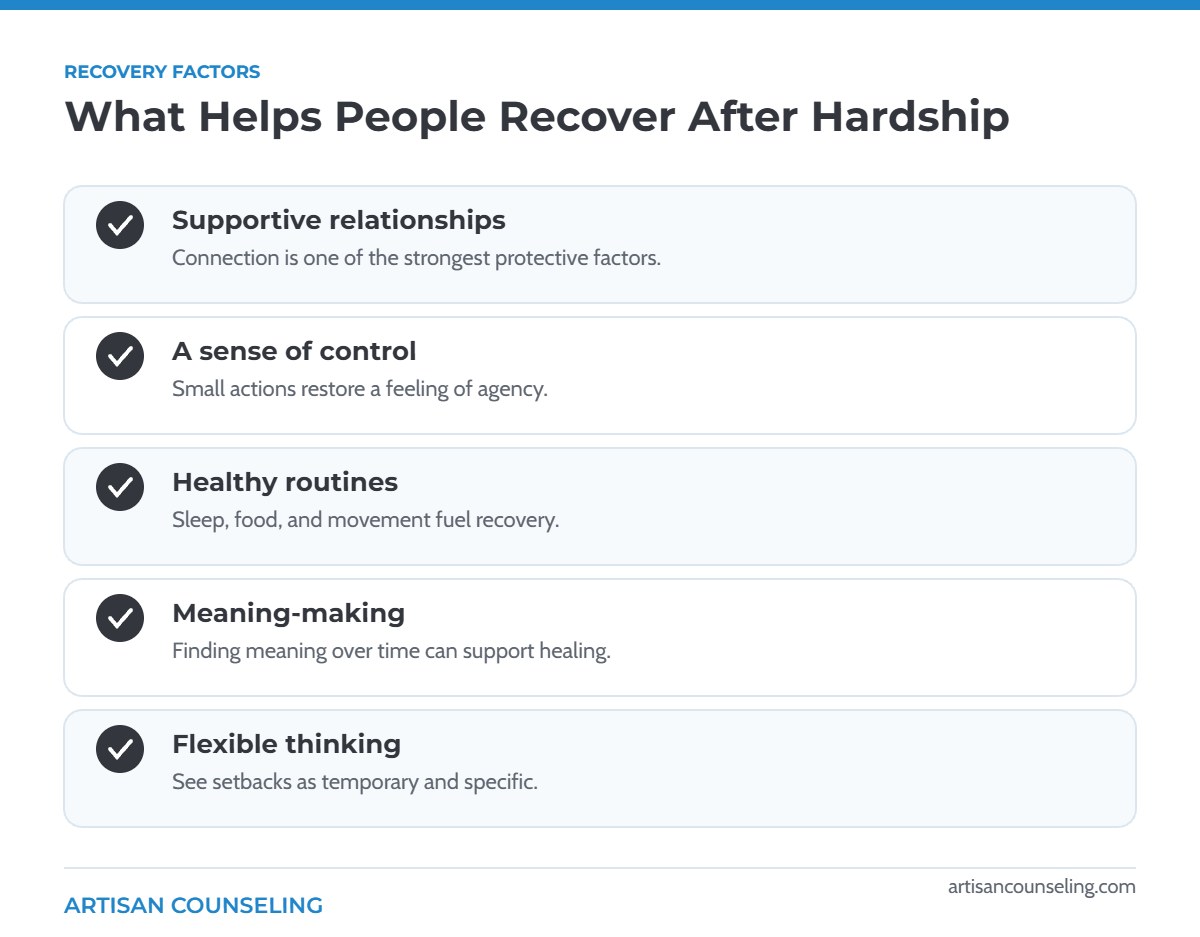
- Supportive relationships. Feeling connected to others is one of the strongest protective factors.
- A sense of control. Taking small actions, even tiny ones, restores a feeling of agency.
- Healthy routines. Sleep, nourishment, and movement give your body the resources to recover.
- Meaning-making. Over time, finding meaning or lessons in what happened can support healing, without needing to call the event “good.”
- Flexible thinking. Seeing a setback as temporary and specific, rather than permanent and all-encompassing.
Practical Ways to Build Resilience Day by Day
Resilience grows through small, repeated actions. Here are steps you can start with:
Take Care of the Basics
Aim for regular sleep, meals, and some movement. These are not luxuries; they directly affect mood and stress tolerance.
Lean on Your People
Let trusted friends or family know what you are going through. Ask for specific help, such as a meal, a walk, or a phone call.
Set Small, Achievable Goals
Instead of “get my life back together,” try “make one phone call today.” Small wins build confidence.
Practice Self-Compassion
Notice harsh self-talk like “I should be over this.” Replace it with something kinder and truer: “This was hard, and I am doing my best.”
Allow Your Feelings
Pushing emotions away often makes them stronger later. Journaling, talking, or creative outlets can help you process them. Learning what emotional regulation really means can also help.
Tip: At the end of each day, write down one thing you handled, however small. Over time, this list becomes evidence of your own strength.
How Long Does Recovery Take?
There is no standard timeline. Recovery often moves in waves, with steady stretches followed by harder days, especially around anniversaries or reminders. That is normal. Our post on why healing is not linear explains what recovery really looks like.
When Can Counseling Help You Build Resilience?
Consider talking with a counselor if:
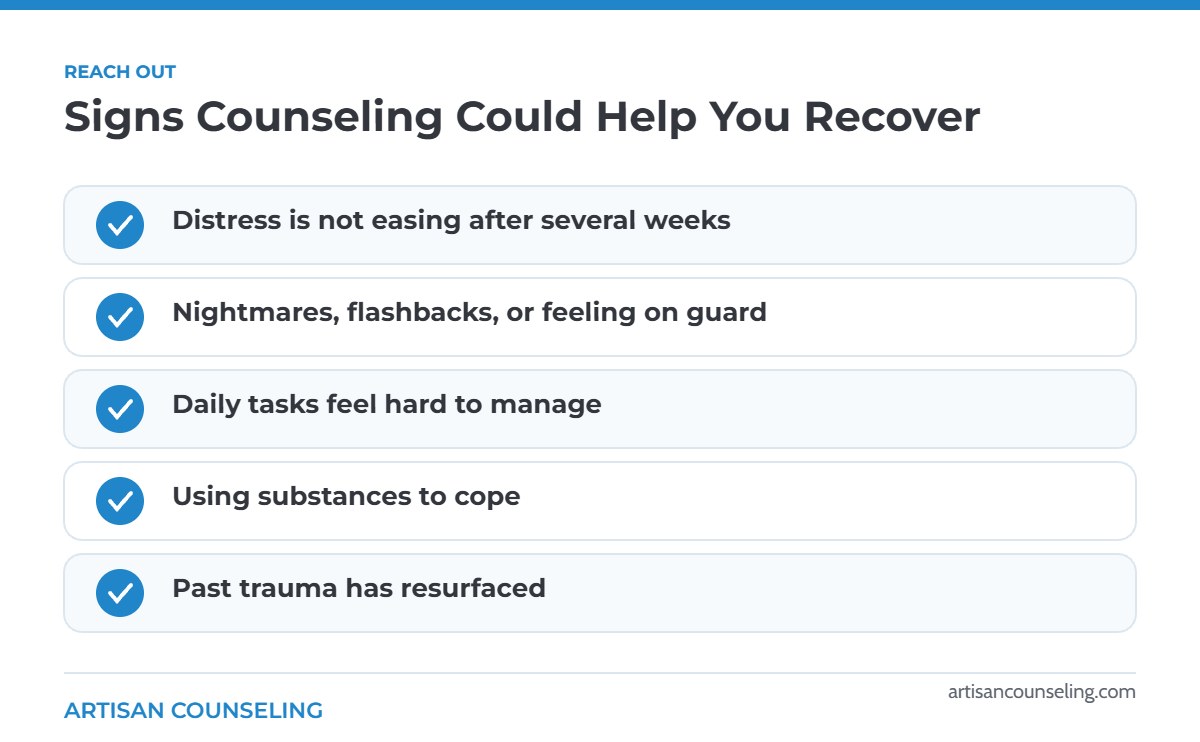
- Distress has not eased after several weeks, or is getting worse
- You are having nightmares, flashbacks, or feel constantly on guard
- It is hard to manage work, relationships, or daily tasks
- You are using alcohol or other substances to cope
- The event has stirred up past trauma
- You feel hopeless or have thoughts of not wanting to be here
A counselor can help you process what happened, strengthen coping skills, and rebuild a sense of safety. If trauma symptoms are present, approaches like EMDR therapy may help.
If you are in crisis: call or text 988 to reach the 988 Suicide & Crisis Lifeline, available 24/7, or call 911 in an emergency.
Frequently Asked Questions
Can resilience be learned?
Yes. Resilience is a set of skills and supports, not a fixed trait. Relationships, coping strategies, and healthy routines can all be strengthened over time.
Is it normal to struggle months after a difficult event?
Yes. Many people continue to feel the effects of a hard event for months, especially around reminders. If distress is intense or not improving, a counselor can help.
What is the difference between resilience and toxic positivity?
Resilience makes room for pain and works through it. Toxic positivity pushes painful feelings away and insists on staying upbeat, which can make healing harder.
How does therapy build resilience?
Therapy helps you understand your reactions, process difficult experiences, develop coping skills, and challenge beliefs that keep you stuck, all of which support long-term resilience.
Rebuilding After Hardship With Artisan Counseling
If you are finding it hard to move forward after a difficult event, our counselors offer individual counseling grounded in compassion and practical tools. Meet our team or get in touch to schedule in Newport News, Suffolk, or by telehealth.