Key Takeaways
- Couples counseling can help many relationships recover, especially when both partners are willing to participate honestly.
- Starting earlier, before resentment and contempt harden, usually leads to better outcomes.
- Counseling teaches skills for communication, conflict repair, and rebuilding trust, not just a place to vent.
- Sometimes counseling helps partners separate respectfully, and it is not appropriate when there is ongoing abuse.
When a relationship is struggling, one question tends to sit underneath everything else: can this actually be fixed? Maybe you argue constantly, feel more like roommates than partners, or are recovering from a betrayal. You may wonder whether couples counseling is worth the time, money, and vulnerability.
If this is affecting your relationship, couples counseling at our Newport News and Suffolk offices can help you and your partner work through it together.
The honest answer is that couples counseling helps many relationships, but it is not magic, and outcomes depend on a few key factors. In this article, you will learn what couples counseling can realistically accomplish, what makes it more likely to work, what happens in sessions, when it may not be the right fit, and how to get started.
Can Couples Counseling Really Save a Relationship?
For many couples, yes. Well-established approaches, such as the Gottman Method and Emotionally Focused Therapy, have been studied for decades and are widely used because they help couples reduce conflict and feel more connected.
That said, “saving” a relationship can mean different things. For some couples, it means recovering closeness they thought was gone. For others, it means finally understanding why they keep getting stuck and learning to stop. And for some, counseling brings clarity that the relationship should end, which can still be a healthy outcome when it allows both people to part with less pain and more respect.
What Makes Couples Counseling More Likely to Work?
Couples who see the most progress tend to share a few things in common. None of these require you to have a perfect relationship. They simply give the work room to take hold.
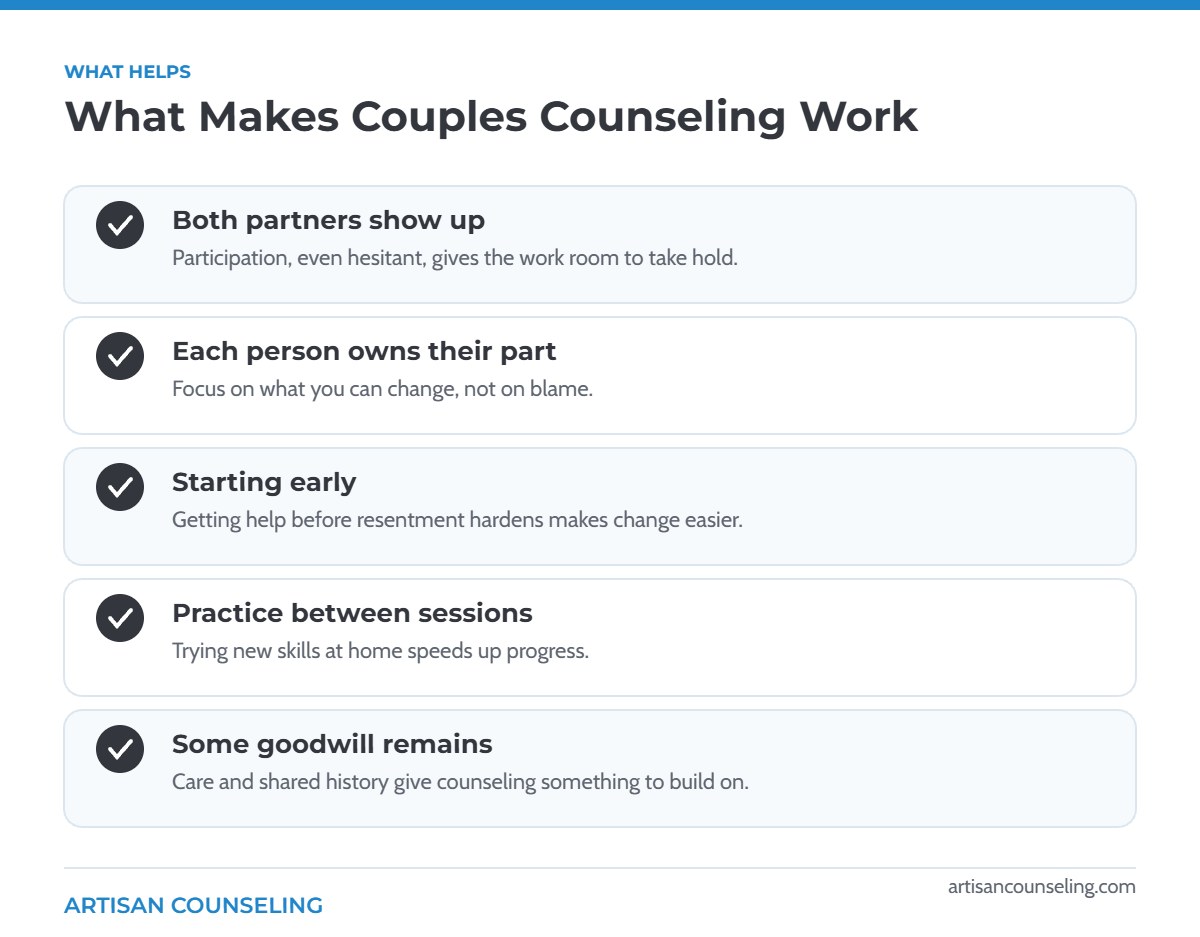
Both Partners Show Up
Counseling works best when both people attend and participate, even if one is more hesitant. A reluctant partner who is willing to listen can still make real progress. If one partner has already decided to leave, counseling often shifts toward helping the couple separate thoughtfully.
Each Person Looks at Their Own Part
It is natural to arrive hoping the counselor will help your partner see what they are doing wrong. Real change starts when each person can ask, “What am I contributing to this pattern?” This is not about blame. It is about finding the parts you have the power to change.
You Start Before Resentment Hardens
Many couples wait years before seeking help. By then, hurt can turn into contempt, eye-rolling, sarcasm, and a feeling that nothing will ever change. Starting earlier makes the work easier. If you are unsure about timing, our guide on when couples should seek counseling can help.
You Practice Between Sessions
One hour a week cannot undo patterns that play out the other 167 hours. Couples who try new skills at home, even imperfectly, tend to progress faster.
There Is Still Some Goodwill
You do not need to feel in love right now. But some remaining care, shared history, or desire to try gives the counselor something to build on.
Self-Check: Are You Ready to Start?
Before your first appointment, it can help to answer a few questions honestly, on your own or together:
- Am I willing to hear my partner’s experience, even when it is hard to hear?
- Can I name at least one thing I contribute to our conflicts?
- Do I want this relationship to improve, or am I mainly looking for permission to leave?
- Am I able to commit to regular sessions for a while, rather than one or two?
There are no wrong answers. Mixed feelings are common, and your counselor can work with ambivalence. Knowing where you stand simply helps you get more out of the process.
What Happens in Couples Counseling?
Couples counseling is not a place where a therapist picks a winner. Your counselor stays neutral and focuses on the relationship itself. Early sessions usually involve getting to know each of you, your history together, and what you want to change. Some counselors also meet with each partner individually.
From there, the work often includes:
- Identifying your cycle. Many couples fall into a predictable loop, such as one partner pursuing while the other withdraws. Naming the cycle makes it the problem, rather than each other.
- Slowing down conflict. Your counselor helps you have hard conversations without escalating, so each person feels heard.
- Learning practical communication skills. This includes softer ways to raise concerns, listening without defending, and taking breaks when you feel flooded. Read more in how counseling improves communication.
- Repairing hurts. Past wounds, including affairs or broken promises, can be addressed in a structured way that supports rebuilding trust.
- Reconnecting. Counseling also focuses on friendship, appreciation, affection, and intimacy, not just problems.
What This Can Look Like in Practice
For example, imagine a couple who argues every week about household chores. On the surface, the fight is about dishes. In session, the counselor helps them slow the conversation down. One partner realizes the real feeling is, “I feel alone carrying everything.” The other realizes their defensiveness comes from feeling constantly criticized. Once both people understand what sits underneath, the chores conversation becomes a problem to solve together rather than a battle over who is right.
Sessions often follow a rhythm: checking in about the past week, focusing on a recent conflict or an important topic, practicing a skill in the room, and agreeing on something small to try at home.
Tip: Before your first session, write down one or two specific changes you hope to see, such as “fewer arguments about money” or “feeling like a team again.” Clear goals help you and your counselor track progress.
Signs Counseling Is Helping
Progress is often gradual. Look for small shifts rather than overnight transformation.
- Arguments cool down faster or happen less often.
- You can name your pattern in the moment and step out of it.
- You feel more curious about your partner and less defensive.
- Small moments of warmth and humor return.
- You make repairs, such as apologizing or reaching out, after a disagreement.
How to Support the Work Between Sessions
What you do during the week matters as much as what happens in the counseling room. These habits help new skills stick:
- Schedule a short weekly check-in. Set aside 20 to 30 minutes to talk about how the week went, what felt good, and one thing to work on. Keep it calm and time-limited.
- Use a softer start-up. Instead of “You never help,” try “I’m feeling overwhelmed with the house this week. Could we figure out a plan together?”
- Agree on a pause signal. Choose a word or gesture that means “I need 20 minutes to calm down, and I will come back.” Returning to the conversation is the key part.
- Try a repair phrase. Simple lines like “I didn’t say that well, can I try again?” or “I can see this really hurt you” can stop an argument from spiraling.
- Notice what goes right. Say thank you for small things. Regular appreciation builds goodwill that makes harder conversations easier.
You will not do these perfectly, and that is fine. Bring the moments that did not go well to your next session. They are often the most useful material. For more ideas, see how to stop arguing about the same things.
When Couples Counseling May Not Be the Right Answer
Couples counseling is not recommended in every situation. It may not be appropriate, or may need to wait, when:
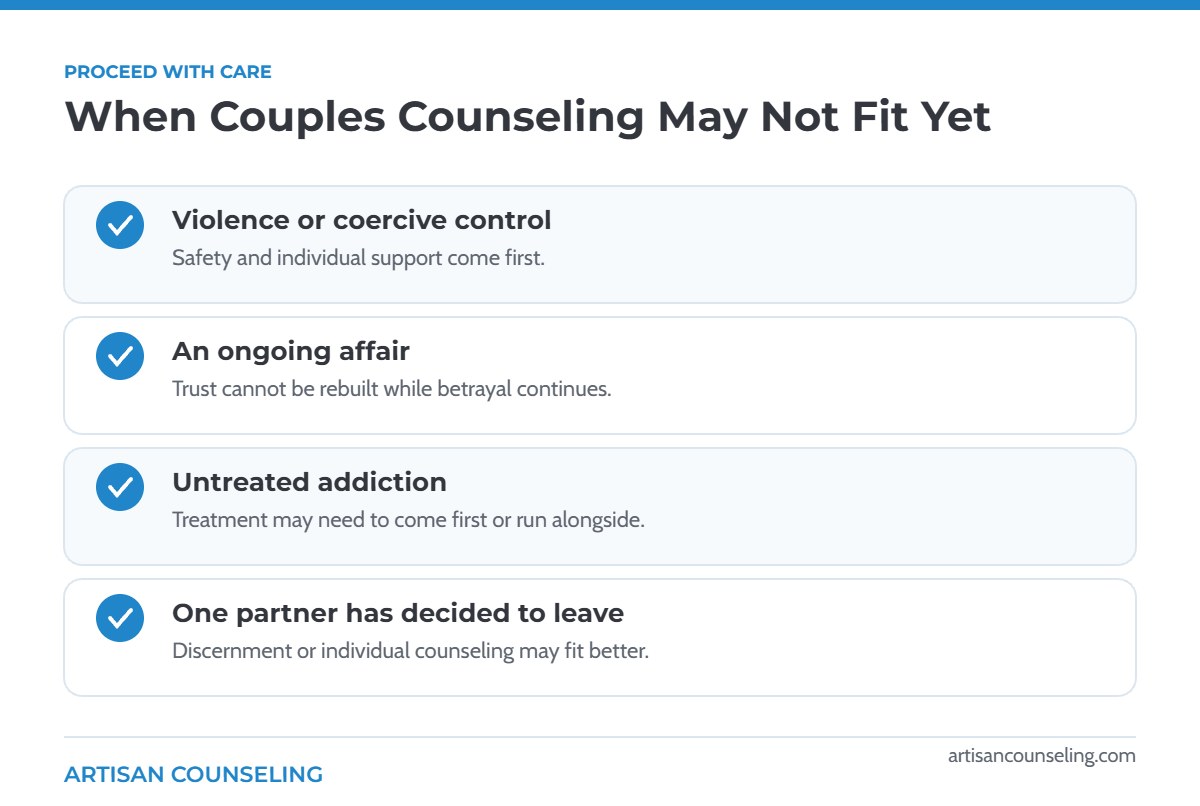
- There is ongoing physical violence, threats, or coercive control. Joint sessions can put the person being harmed at greater risk. Individual support and safety planning come first.
- An affair is still ongoing. Trust cannot be rebuilt while the betrayal continues.
- Active, untreated addiction is driving the conflict. Addiction treatment may need to come first or happen alongside counseling.
- One partner has firmly decided to leave. Discernment counseling or individual therapy may be a better fit.
If you are unsure whether your relationship is healthy, our article on how to recognize emotional manipulation may help you sort through what you are experiencing.
If you are in crisis: call or text 988 to reach the 988 Suicide & Crisis Lifeline, available 24/7, or call 911 in an emergency. If you are in an unsafe relationship, contact local emergency services or a domestic violence hotline.
Frequently Asked Questions
How long does couples counseling take to work?
It varies by couple and by the issues involved. Some couples notice changes within the first several sessions, while deeper issues such as recovering from infidelity often take longer. Your counselor will check in with you regularly about progress.
What if my partner refuses to go to couples counseling?
You can still start individual counseling. Changing your own responses often shifts the relationship, and some reluctant partners decide to join later once they see the process is not about blame.
Can couples counseling help after infidelity?
Yes, many couples rebuild trust after an affair with professional support. It usually requires that the affair has ended, honesty from the partner who strayed, and patience from both people.
Is it ever too late for couples counseling?
It is rarely too late to learn something useful. Even couples with years of distance can make progress if both people are willing to try. If one partner has already decided to leave, counseling may focus on clarity and a respectful separation instead.
Is couples counseling only for married couples?
No. Couples counseling is for any committed partners, whether dating, engaged, married, or living together, including LGBTQ+ couples.
Starting Couples Counseling at Artisan Counseling
If your relationship feels stuck, reaching out is a sign of strength, not failure. Our couples counseling services are available in person in Newport News and Suffolk and through telehealth across Virginia. You can learn about our licensed counselors to find someone who feels like a good fit. You can contact our team to ask questions or schedule your first session.