Key Takeaways
- Communication usually breaks down because of stress, old patterns, and emotional flooding, not because people lack intelligence or care.
- Counseling slows conversations down, names the patterns that keep repeating, and teaches concrete skills.
- Key skills include gentle start-ups, reflective listening, “I” statements, taking breaks, and repairing after conflict.
- Couples, families, and individuals can all benefit from communication-focused counseling.
“We just can’t talk to each other anymore.” It is one of the most common things counselors hear. Small disagreements turn into big fights, important topics get avoided, or one person talks while the other shuts down. Over time, poor communication can make even a loving relationship feel lonely.
If this is affecting your relationship, couples counseling at our Newport News and Suffolk offices can help you and your partner work through it together.
The good news is that communication is a set of skills, and skills can be learned. In this article, you will learn why communication breaks down, exactly how counseling helps, the specific techniques counselors teach, who benefits, and what to expect if you decide to start.
Why Communication Breaks Down
Most people know how to communicate when they feel calm. The trouble starts when emotions run high. When you feel criticized, dismissed, or afraid of losing connection, your body can shift into a stress response. Your heart rate rises, your thinking narrows, and you are more likely to attack, defend, or shut down.
Common reasons communication falls apart include:
- Stress and exhaustion from work, parenting, finances, or health issues.
- Different communication styles, such as one person who wants to talk things through right away and another who needs time to process.
- Patterns learned growing up, where conflict meant yelling or silence.
- Unresolved hurts that make every new disagreement feel loaded.
- Mind reading, or assuming you know what the other person meant without asking.
For a closer look at these dynamics in romantic relationships, see why communication breaks down in relationships.
How Counseling Improves Communication
A counselor acts as a neutral guide who helps you see what is happening between you and practice doing something different. Here is how that works in practice.
It Slows Things Down
At home, a disagreement can escalate in seconds. In session, your counselor can pause the conversation, help each person catch their breath, and make sure each point is actually heard before moving on. Slowing down alone often lowers the temperature.
For example, a couple might come in arguing about chores. As the counselor slows things down, it becomes clear that one partner feels unappreciated and the other feels constantly criticized. The chores were never the real issue.
It Names the Pattern
Many couples and families fall into a repeating cycle. One person criticizes, the other gets defensive. One pursues, the other withdraws. When a counselor helps you name the cycle, it becomes something you can work against together instead of a battle against each other.
It Uncovers What Is Underneath
Arguments about dishes or screen time are often about something deeper, such as feeling unappreciated, unimportant, or alone. Counseling helps you talk about those underlying feelings, which tends to bring people closer instead of further apart.
Underneath many repeated arguments are softer feelings, such as fear of being unimportant, loneliness, or worry about failing. When those feelings are spoken out loud in a safe setting, partners often respond with more compassion than they expected.
It Builds New Skills
Counseling is practical. You will learn and rehearse specific tools in session, then try them at home and talk about how it went.
Communication Skills You Can Learn in Counseling
Counselors draw on well-established approaches, including the Gottman Method and Emotionally Focused Therapy, to teach skills like these:
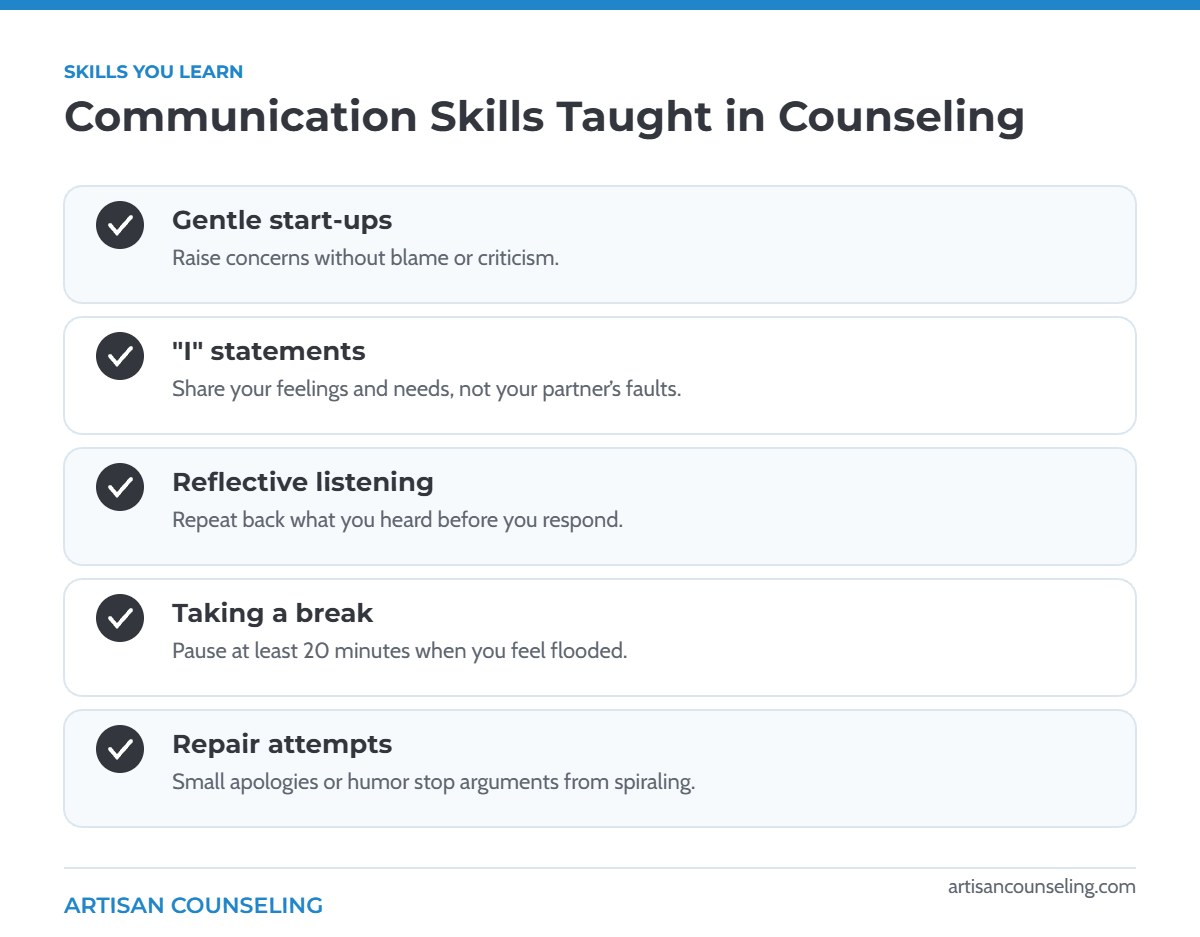
- Gentle start-ups. Raise a concern without blame. Instead of “You never help,” try “I’m feeling overwhelmed with the kitchen tonight. Could you help me with the dishes?”
- “I” statements. Describe your feelings and needs rather than your partner’s faults: “I feel worried when I don’t hear from you.”
- Reflective listening. Repeat back what you heard before responding: “So you’re saying you felt left out when I made plans without asking. Is that right?”
- Validation. You can understand someone’s feelings even if you see the situation differently. “That makes sense, given how your day went.”
- Taking a break. When either person feels flooded, agree to pause for at least 20 minutes, do something calming, and come back to the conversation.
- Repair attempts. A simple “I’m sorry, that came out harsh” or a moment of humor can stop an argument from spiraling.
Try this at home: Set aside 15 minutes a few times a week for a “stress-reducing conversation.” Each person takes a turn talking about their day while the other simply listens, asks questions, and offers support, without giving advice unless asked.
What These Skills Sound Like
Here are a few examples of how a conversation can shift with practice:
- Instead of “You never listen,” try “I would really like you to hear me out on this.”
- Instead of “That is ridiculous,” try “Help me understand why that matters to you.”
- Instead of walking away mid-argument, try “I need a break. Let’s pick this up in thirty minutes.”
These changes seem small, but they reduce defensiveness and keep the conversation open.
Who Benefits From Communication-Focused Counseling?
Communication skills matter in every close relationship, so many people benefit:
- Couples who argue about the same issues repeatedly or have stopped talking about what matters. Our guide on how to stop arguing about the same things offers more ideas.
- Families navigating tension between parents and teens, blended family adjustments, or major changes. Family counseling gives everyone a voice.
- Individuals who struggle to speak up, set boundaries, or manage anger in relationships at home or work.
Parents and teens, adult siblings, and even coworkers in family businesses can benefit as well. Communication skills are not only for romantic relationships. They help any time two people care about each other but keep missing each other.
How Can You Practice Between Sessions?
Progress happens faster when you practice at home. Some simple ways to start:
- Hold a weekly check-in. Set aside twenty to thirty minutes to talk about what went well and what felt hard, without phones.
- Practice reflective listening. Before responding, summarize what you heard: “So you felt left out when I made plans without asking?”
- Agree on a time-out signal. Choose a word or gesture that means “I need a pause,” and commit to returning.
- Notice one positive thing a day. Saying “Thanks for handling dinner” builds goodwill that helps during harder conversations.
What to Expect When You Start
Your first session typically focuses on understanding your concerns, your history, and your goals. Your counselor may ask about how conflicts usually start, what happens during them, and how they end.
Over the following sessions, you will:
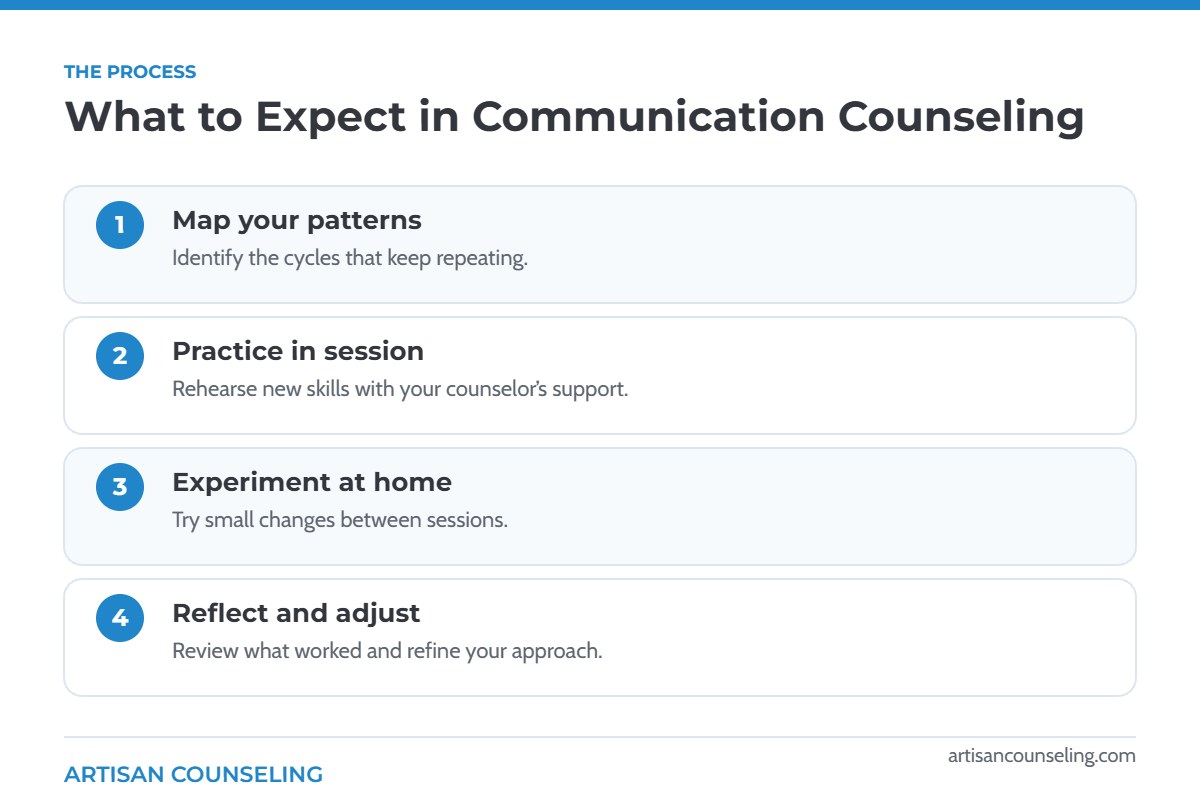
- Map out the patterns that keep repeating.
- Practice new skills in a supported setting.
- Try small experiments at home between sessions.
- Reflect on what worked and adjust.
Many people notice that conversations feel calmer within the first several sessions, although lasting change takes consistent practice. If you are curious about the timeline, read how long counseling takes.
When to Seek Help Sooner
Consider reaching out soon if arguments are escalating, if you or your partner feel afraid, or if you have stopped talking about important things altogether. If there is any physical violence or threats, focus first on safety and talk with a counselor individually. You can also read more about what makes relationships emotionally safe.
If you are in crisis: call or text 988 to reach the 988 Suicide & Crisis Lifeline, or call 911 in an emergency.
Frequently Asked Questions
Can counseling help if only one of us wants to improve communication?
Yes. When one person changes how they speak and respond, the whole pattern often shifts. Individual counseling can help you build skills, and your partner may choose to join later.
How is communication counseling different from just talking to friends?
Friends usually take your side. A counselor stays neutral, helps you see your own part in the pattern, and teaches specific, tested skills you can practice.
What if we yell or shut down during sessions?
That is okay and expected. Counselors are trained to help calm intense moments and use them as opportunities to practice new responses in real time.
Can counseling help with communication through telehealth?
Yes. Many individuals and couples work on communication through online sessions. Artisan Counseling offers telehealth across Virginia, which can make it easier to fit counseling into busy schedules.
How do we know if counseling is improving our communication?
You may notice that arguments cool down faster, that you repair sooner after conflict, or that hard topics feel more approachable. Your counselor can check in on these changes regularly so you can see progress together.
Build Better Communication With Artisan Counseling
If talking has started to feel like walking on eggshells, support can help. Our licensed counselors work with couples, families, and individuals in Newport News, Suffolk, and online across Virginia. Learn more about our couples counseling or get in touch to schedule a session.