
Key Takeaways
- You do not need to be in crisis to seek couples counseling. Earlier help is usually easier and more effective.
- Common signs include repeated arguments, communication breakdown, broken trust, growing distance, and major life changes.
- Counseling can also help healthy couples prepare for big transitions like marriage, a baby, or relocation.
- If there is violence or fear in the relationship, individual support and safety planning come first.
Many couples wait a long time before reaching out for help. Some hope problems will fade on their own. Others worry that counseling means the relationship is failing. By the time they book a first appointment, hurt and resentment may have been building for years.
If this is affecting your relationship, couples counseling at our Newport News and Suffolk offices can help you and your partner work through it together.
Couples counseling is not only for relationships on the brink. It is a tool for any couple that wants to understand each other better and handle challenges as a team. In this article, you will learn the most common signs it is time to seek counseling, what each sign can look like day to day, why timing matters, and how to bring up the idea with your partner.
Signs It May Be Time for Couples Counseling
Every relationship has rough patches. The signs below are worth paying attention to when they last for weeks or months, or when you feel stuck despite trying.
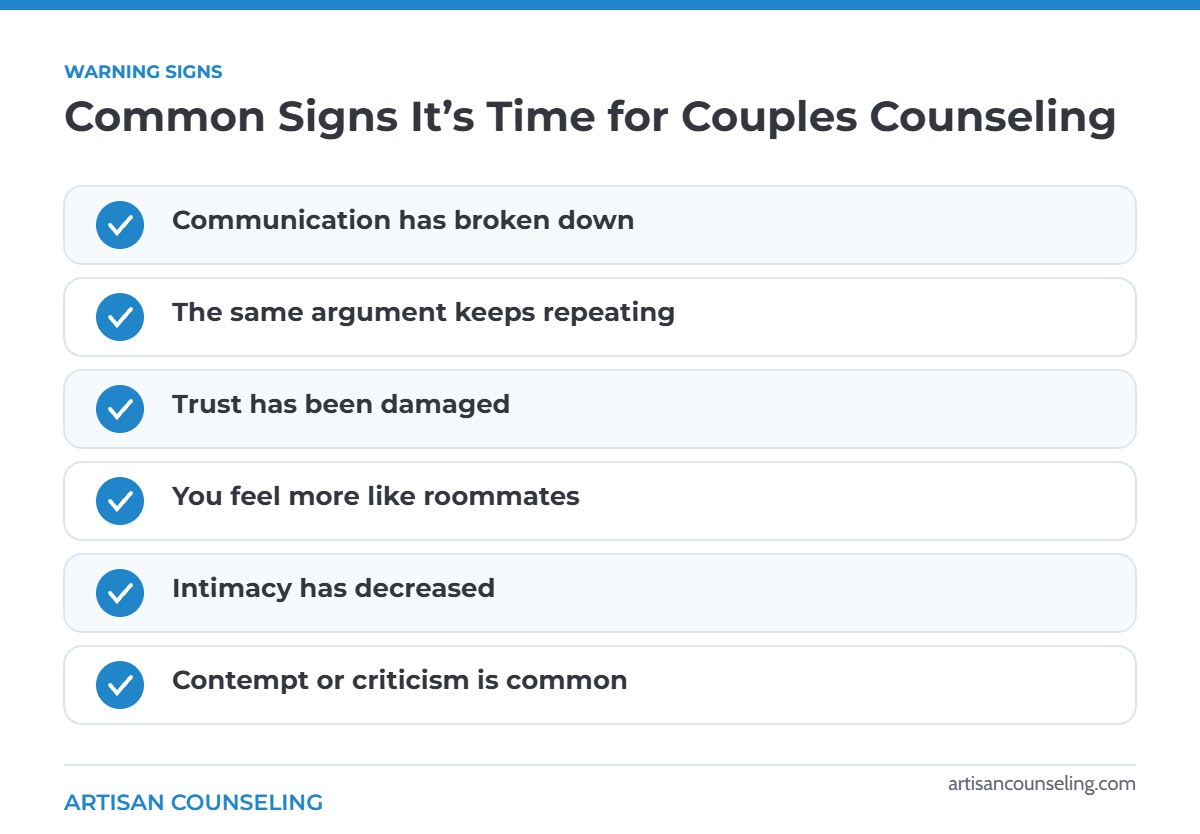
Communication Has Broken Down
You avoid certain topics because they always lead to a fight, or conversations feel like debates where nobody listens. Maybe one of you talks while the other goes silent. When everyday talk feels tense or empty, a counselor can help you rebuild safer ways to communicate. Learn more about why communication breaks down in relationships.
You Keep Having the Same Argument
The topic might be money, chores, in-laws, or time together, but the fight follows the same script every time and never gets resolved. Repeated arguments usually point to an underlying need or pattern that has not been addressed. See how to stop arguing about the same things for more.
Trust Has Been Damaged
Infidelity, lying, hidden spending, or broken promises can shake the foundation of a relationship. Rebuilding trust is possible, but it is hard to do alone. A counselor can guide honest conversations and set a clear path forward.
You Feel More Like Roommates
You share a home and responsibilities, but there is little affection, fun, or real conversation. Emotional distance often creeps in slowly, so it is easy to miss until it feels normal.
Intimacy Has Decreased
Changes in physical or emotional intimacy are common, especially after children, illness, or stress. When the change causes ongoing hurt or one partner feels rejected, it is worth addressing with support. Some couples also benefit from sex therapy with a specially trained counselor.
Contempt or Criticism Has Become Common
Eye-rolling, sarcasm, name-calling, or a steady stream of criticism are red flags. Relationship research by Drs. John and Julie Gottman identified contempt as one of the strongest predictors of relationship breakdown. The sooner these patterns are addressed, the better.
You Are Thinking About Leaving
If one or both of you has started imagining life apart, counseling can help you get clear. Some couples rediscover their commitment. Others decide to separate and use counseling to do so with less conflict, especially when children are involved.
Major Life Transitions Can Strain Even Strong Relationships
Big changes shift roles, routines, and priorities. Even happy changes add stress. Couples often seek support during:
- Engagement, marriage, or moving in together.
- Pregnancy, a new baby, infertility, or pregnancy loss. Our perinatal therapy can help during this season.
- Military deployment, relocation, or a job loss.
- Children leaving home, retirement, or caring for aging parents.
- Grief, serious illness, or blending families.
Our article on why life transitions can feel emotionally overwhelming explains why these periods hit so hard.
For example, a couple a few months after the birth of their first child may find that every conversation becomes about schedules and sleep. Small comments start to sting. Neither partner is the “problem,” but both feel unseen. A handful of sessions at this stage can help them name what is happening and divide the load more fairly before resentment sets in.
Why Seeking Help Earlier Matters
Many couples wait years after problems begin before getting help. During that time, small hurts can harden into resentment and negative assumptions about each other. Once that happens, every interaction gets filtered through a sense that “this is just how they are.”
When you start earlier, there is usually more goodwill to work with, the patterns are less entrenched, and change can happen faster. Think of counseling like seeing a doctor for a persistent symptom rather than waiting for an emergency.
Tip: You can also use counseling preventively. Premarital counseling or a few “check-up” sessions during a big change can help you build skills before problems grow.
A Quick Self-Check Before You Decide
If you are unsure whether counseling makes sense right now, take a few quiet minutes with these questions. There are no right answers. They are simply a way to notice what you have been feeling.
- When we disagree, do we usually reach some kind of resolution, or does the topic just go underground?
- Do I feel comfortable bringing up hard subjects, or do I hold back to keep the peace?
- Do I still feel like my partner is on my side, even when we are upset?
- Have we tried to fix the same problem more than a few times without lasting change?
- Do I spend more time thinking about what is wrong in the relationship than what is right?
- Would I want my closest friend to be in a relationship that feels like mine does right now?
If several of these questions brought up a heavy feeling, that is useful information. It does not mean the relationship is over. It means you both may benefit from a neutral space to talk things through with support.
What Couples Counseling Actually Looks Like
Many people picture a counselor taking sides or digging into every past mistake. In reality, the first few sessions usually focus on understanding your history as a couple, what brings you in, and what each of you hopes will change. The counselor may meet with you together and sometimes individually.
Over time, sessions often involve slowing down conflicts so you can see the pattern underneath them, practicing new ways to listen and respond, and trying small experiments at home between sessions. Some counselors draw on structured approaches such as the Gottman Method or emotionally focused therapy, depending on your goals.
How to Talk to Your Partner About Counseling
Bringing up counseling can feel risky. These steps can make the conversation easier:
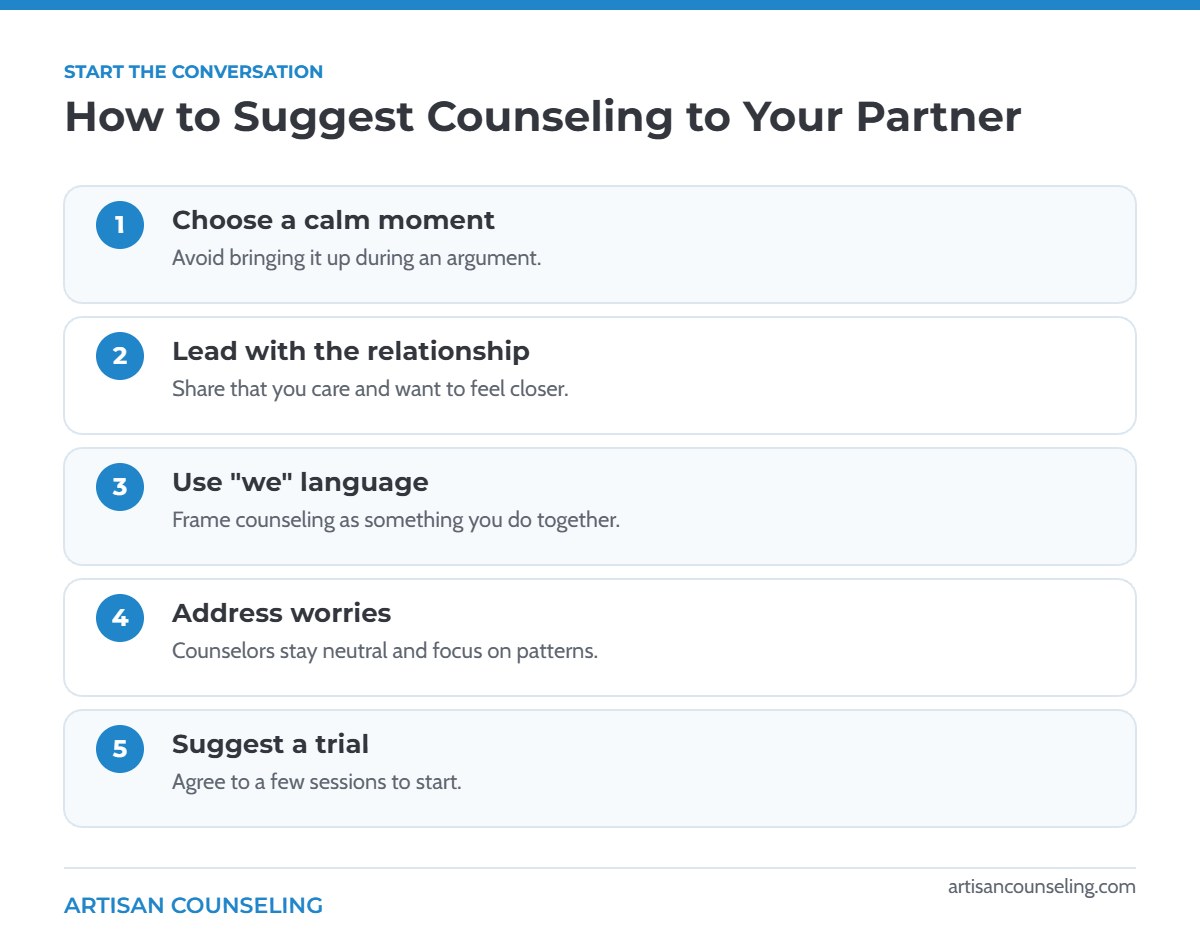
- Choose a calm moment. Avoid raising it during or right after an argument.
- Lead with the relationship. Try “I care about us and I want us to feel closer” instead of “You need help.”
- Use “we” language. Present counseling as something you do together, not a fix for one person.
- Address worries directly. Your partner may fear being blamed. Explain that counselors stay neutral and focus on patterns.
- Suggest a trial. Agreeing to a few sessions feels less overwhelming than an open-ended commitment.
If your partner says no, you can still start individual counseling to work on your own responses and decide your next steps.
When Couples Counseling Is Not the First Step
If there is physical violence, threats, stalking, or coercive control, joint sessions may not be safe. Individual counseling and safety planning come first. You deserve to feel safe in your relationship.
If you are in crisis: call or text 988 to reach the 988 Suicide & Crisis Lifeline, available 24/7, or call 911 in an emergency. If you are in an unsafe relationship, contact local emergency services or a domestic violence hotline.
Frequently Asked Questions
Is it normal to go to couples counseling early in a relationship?
Yes. Many dating and engaged couples use counseling to learn healthy communication and work through differences before they become ingrained patterns.
How do I know if our problems are serious enough for counseling?
If an issue has lasted for weeks or months, keeps coming back, or is affecting your happiness, it is serious enough. You do not need to wait for a crisis.
Can couples counseling make things worse?
Counseling can bring painful issues to the surface, which may feel harder at first. With a skilled counselor, that discomfort is usually part of moving toward real change.
What if my partner does not want to go to counseling?
You can still start on your own. Individual counseling can help you understand your part in the pattern, communicate more clearly, and decide what you need. Sometimes a partner becomes more open after seeing the changes, or after a calm, non-blaming invitation to join.
Reach Out to Artisan Counseling
If any of these signs sound familiar, support is available. Learn about our couples counseling in Newport News, Suffolk, and by telehealth across Virginia, or contact us to get started.
Reaching out does not commit you to anything beyond a conversation. When you contact us, our team can answer questions about scheduling, insurance, and which counselor may be a good fit for your concerns. Many couples say the hardest part was simply making the first call.