
Key Takeaways
- CBT for anxiety targets the cycle of anxious thoughts, physical alarm, and avoidance that keeps fear going.
- Core tools include cognitive restructuring, gradual exposure, and practical coping skills such as paced breathing.
- CBT is one of the most studied treatments for anxiety disorders and is widely recommended as a first-line option.
- Progress usually shows up as less avoidance and more confidence handling uncertainty, not as never feeling anxious again.
Anxiety is supposed to protect you. But when your mind treats an email, a social event, or a racing heartbeat as a serious threat, that protective system starts running your life. You may avoid things you care about, overthink every decision, or feel on edge without knowing why.
Cognitive behavioral therapy is one of the most effective, well-researched ways to break that pattern. It does not try to eliminate anxiety altogether. Instead, it helps you understand what fuels it and teaches skills to respond differently.
In this article, you will learn how CBT explains anxiety, what CBT for anxiety looks like in sessions, the specific techniques counselors use, who tends to benefit most, and how to tell if it is working.
How Does CBT Explain Anxiety?
CBT views anxiety as a cycle. A trigger leads to a threatening thought (“Something bad is going to happen”), which sets off physical symptoms like a fast heartbeat or tight chest. To feel relief, you avoid, escape, or seek reassurance.
Avoidance works in the short term, which is exactly why it is so sticky. But it also teaches your brain that the situation really was dangerous, so the anxiety returns stronger next time. CBT aims to interrupt this loop at several points.
Common Anxiety Patterns CBT Addresses
- Overestimating danger: assuming a bad outcome is very likely.
- Underestimating coping: believing you could not handle it if something did go wrong.
- Intolerance of uncertainty: needing to know for sure before you can relax.
- Safety behaviors: subtle habits, like over-preparing or always having an exit plan, that keep fear in place.
If you often feel anxious for no clear reason, you may relate to why you might feel anxious even when nothing is wrong.
What Does CBT for Anxiety Look Like in Sessions?
Early sessions focus on understanding your specific anxiety: what triggers it, what you tell yourself, how your body reacts, and what you do to cope. Your counselor will also explain how anxiety works, because understanding the cycle often brings relief on its own.
From there, sessions become active. You practice skills in session, then try them in real situations during the week. Each session reviews what happened and builds the next step.
Which CBT Techniques Help With Anxiety?
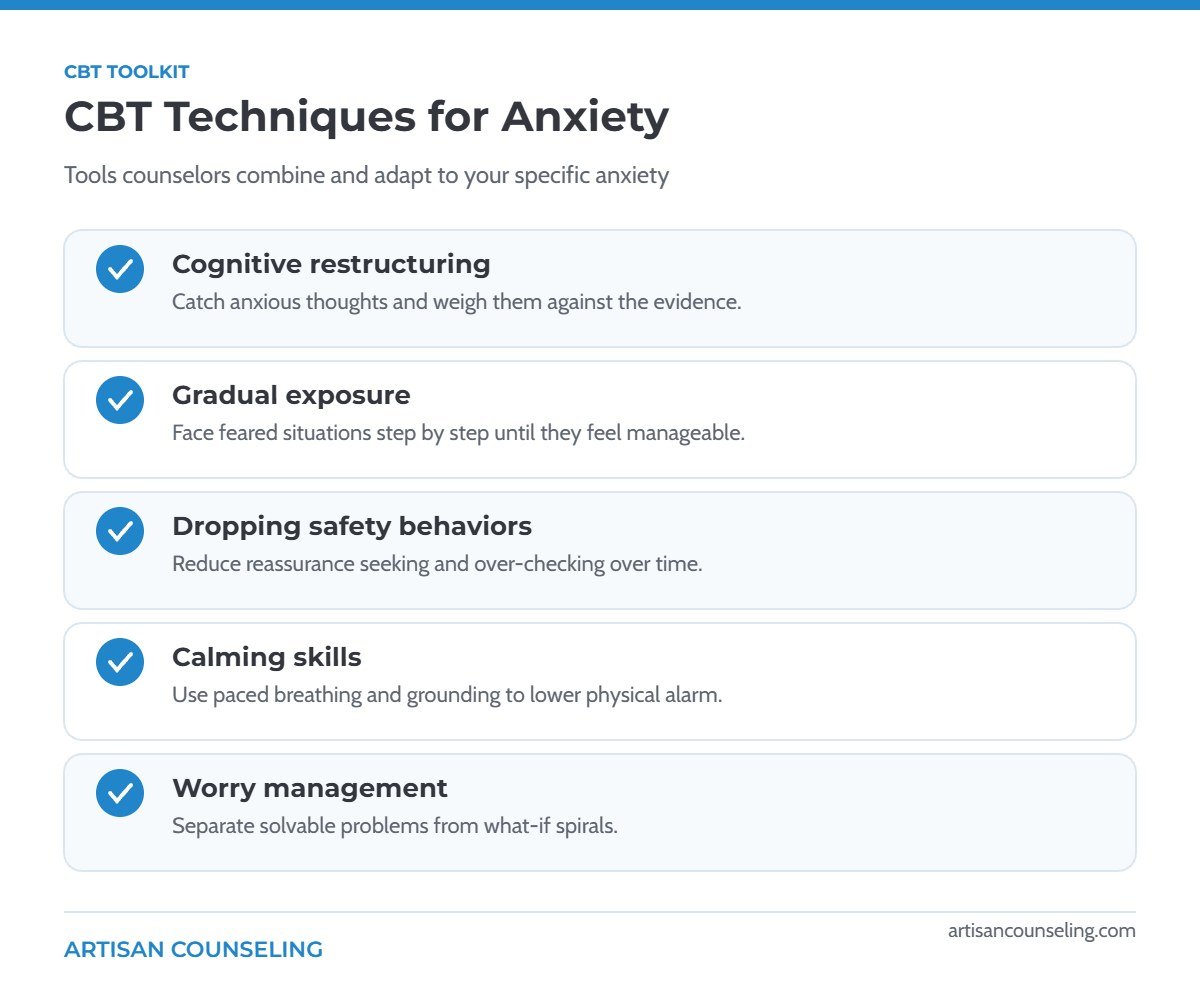
Most CBT plans for anxiety combine several tools. Your counselor will choose and adapt them to your situation.
Cognitive Restructuring
You learn to catch anxious thoughts and examine them. Questions like “What is the evidence?”, “What is a more likely outcome?”, and “How would I cope if it happened?” help you arrive at a more balanced view. Thought records are a common way to practice this.
Gradual Exposure
Exposure is one of the most powerful parts of CBT for anxiety. You and your counselor build a ladder of feared situations, from mildly uncomfortable to very challenging, and work up step by step. Staying in the situation long enough for anxiety to rise and settle teaches your brain that you are safe and capable.
Dropping Safety Behaviors
Reducing reassurance seeking, over-checking, or avoidance habits lets you learn that you can manage without them. This is often done gradually alongside exposure.
Calming and Grounding Skills
Paced breathing, progressive muscle relaxation, and grounding techniques help you lower physical arousal enough to think clearly. They are tools for riding out anxiety, not ways to avoid it.
Worry Management
For generalized worry, strategies like scheduled worry time and problem-solving help you separate solvable problems from “what if” spirals.
Try this: Breathe in slowly for about four counts and out for about six, for one to two minutes. A longer exhale can help signal your body to settle. It will not remove anxiety, but it can make the next step feel possible.
What Types of Anxiety Can CBT Treat?
CBT has been adapted for many forms of anxiety, including:
- Generalized anxiety disorder
- Panic disorder and panic attacks
- Social anxiety
- Specific phobias
- Health anxiety
- Obsessive-compulsive disorder, through exposure and response prevention (ERP)
It also helps with anxiety that does not fit a neat label, such as high-functioning anxiety or stress tied to life changes. Major professional bodies, including the National Institute of Mental Health, describe CBT as a well-established treatment for anxiety disorders.
Who Benefits Most From CBT for Anxiety?
CBT tends to work well if you want practical strategies, are willing to face fears gradually, and can practice between sessions. It suits people who feel stuck in overthinking, avoidance, or physical panic symptoms.
If anxiety is tangled up with intense emotions, trauma, or relationship patterns, your counselor may combine CBT with other approaches. You can read about how CBT compares with a related method in DBT vs. CBT.
How Do You Know CBT Is Working?
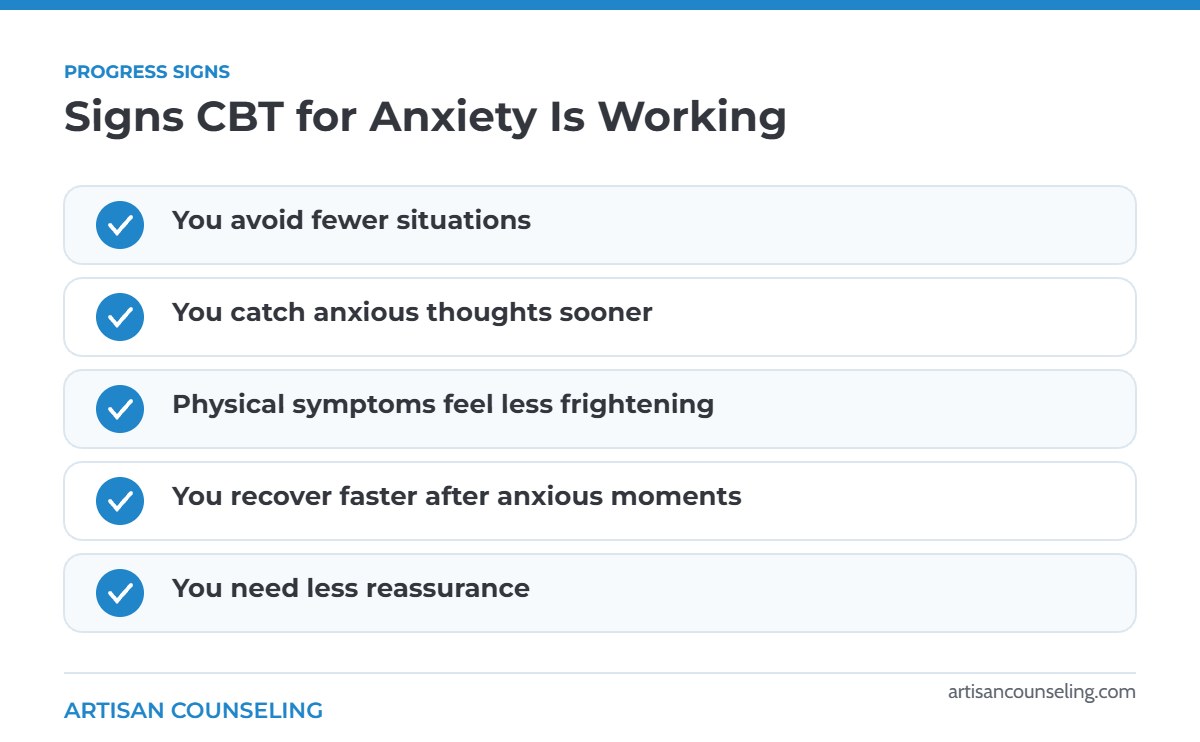
Progress in CBT for anxiety is usually gradual. Signs it is helping include:
- You avoid fewer situations and say yes to more things you value.
- You catch anxious thoughts sooner and can question them.
- Physical symptoms feel less frightening, even if they still show up.
- You recover more quickly after an anxious moment.
- You rely less on reassurance or safety habits.
If you are not noticing change after a reasonable period, talk openly with your counselor. Adjusting the plan is a normal part of therapy.
Frequently Asked Questions
How long does CBT for anxiety take?
Many people notice meaningful change within a few months of weekly sessions, though timing varies with the type and severity of anxiety. Your counselor will review progress with you regularly.
Will CBT make my anxiety worse at first?
Exposure can feel uncomfortable because you are facing things you have avoided. Steps are planned together and paced so they feel challenging but manageable.
Can CBT for anxiety be combined with medication?
Yes. Some people use CBT alone and others combine it with medication prescribed by a medical provider. Your counselor can coordinate with your prescriber if you wish.
Does CBT for anxiety work over telehealth?
CBT translates well to secure video sessions, and exposure exercises can often be practiced in your own environment, which can be an advantage.
Getting Help for Anxiety at Artisan Counseling
Our counselors use cognitive behavioral therapy to help adults and teens reduce avoidance, manage worry, and feel more confident. Browse our counselor profiles to find someone whose experience matches your needs.
Sessions are available in Newport News, in Suffolk, and through telehealth across Virginia. Contact our team when you are ready to take the first step.