

Key Takeaways
- CBT uses practical, structured techniques to help you change unhelpful thoughts and behaviors.
- Common techniques include thought records, spotting cognitive distortions, behavioral activation, exposure, and behavioral experiments.
- Your counselor chooses techniques based on your goals, whether you are working on anxiety, depression, or other concerns.
- Practice between sessions is what helps these skills become second nature.
Cognitive behavioral therapy, or CBT, is known for being practical. Rather than only talking about problems, you learn specific tools you can use in everyday life.
If you are starting CBT or considering it, you may wonder what those tools actually are. Knowing what to expect can make therapy feel less mysterious and help you get more out of each session.
In this article, you will learn the CBT techniques counselors most commonly use, what each one looks like in practice, the kinds of concerns they help with, and how they work together over time.
How Does CBT Work?
CBT is based on the idea that thoughts, feelings, and behaviors influence each other. When you are stressed, anxious, or depressed, your thoughts can become skewed in ways that make you feel worse and act in ways that keep the problem going.
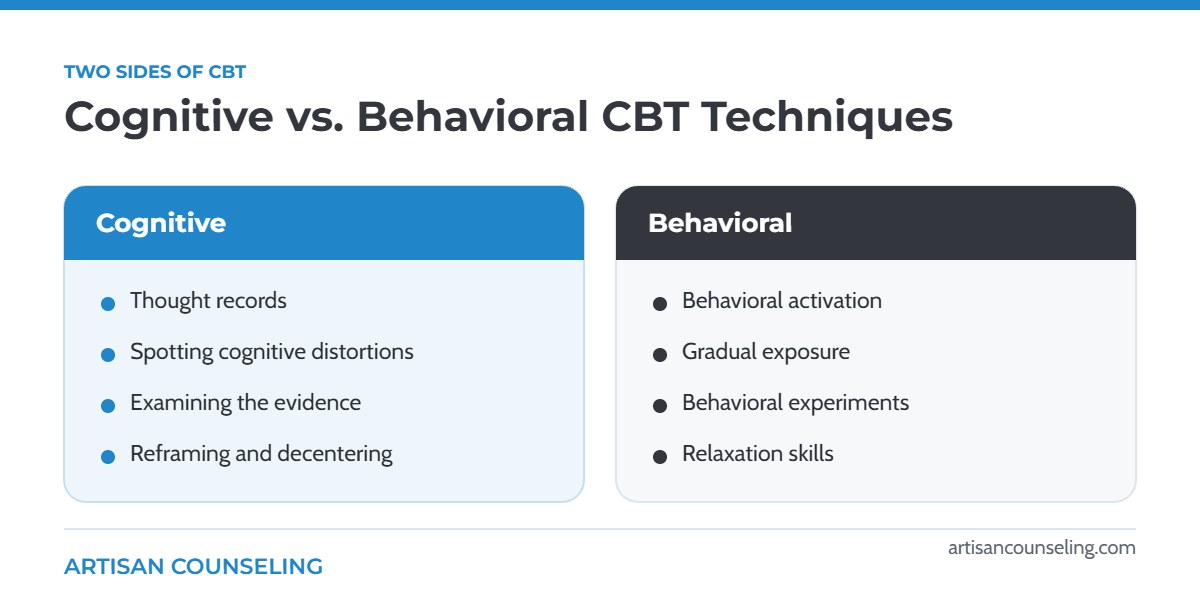
CBT techniques target this cycle from two sides: the cognitive side, which focuses on thoughts, and the behavioral side, which focuses on actions. Most people use a mix of both.
Cognitive Techniques: Working With Your Thoughts
These techniques help you notice, question, and reshape thoughts that are not serving you.
Thought Records
A thought record is a simple worksheet or journal entry. You write down a situation, the emotion you felt, the automatic thought that popped up, and then a more balanced response. Over time, this helps you catch unhelpful thoughts in real time.
Identifying Cognitive Distortions
Cognitive distortions are common thinking traps, such as:
- Catastrophizing: assuming the worst will happen
- All-or-nothing thinking: seeing things as total success or total failure
- Mind reading: assuming you know what others think
- Should statements: rigid rules about how you or others must act
Naming the distortion often takes away some of its power. Our article on why negative thoughts keep repeating explains why these traps can feel so automatic.
Examining the Evidence
With this technique, you treat a thought like a hypothesis. What facts support it? What facts do not? Is there another way to see the situation? The goal is accuracy, not forced positivity.
Reframing
Reframing means looking at a situation from a different angle. For example, “I failed that presentation” might become “That presentation was hard, and I learned what to prepare differently next time.”
Decentering
Decentering helps you step back and see thoughts as mental events rather than facts. Saying “I am having the thought that I am not good enough” creates space between you and the thought.
Behavioral Techniques: Changing What You Do
Changing behavior can shift how you feel, sometimes faster than changing thoughts alone.
Behavioral Activation
Often used for depression, behavioral activation involves scheduling small, meaningful or enjoyable activities, even when motivation is low. Action can lead to improved mood, rather than waiting to feel better first. Learn more in can CBT help with depression?
Exposure
Exposure is commonly used for anxiety, phobias, and obsessive-compulsive patterns. With your counselor’s guidance, you gradually and safely face situations you have been avoiding, starting small. Over time, your brain learns that the feared outcome is less likely or more manageable than it seemed.
Behavioral Experiments
A behavioral experiment tests a belief in real life. If you believe “If I speak up in a meeting, everyone will think I am foolish,” you might try sharing one comment and observe what actually happens.
Relaxation and Coping Skills
Many counselors also teach breathing techniques, progressive muscle relaxation, and problem-solving steps to help you handle stress in the moment.
Try this: The next time you feel upset, jot down three things: what happened, what you told yourself about it, and how you felt. This is the first step of a thought record, and it often reveals patterns you had not noticed.
Which CBT Techniques Help With Which Concerns?
Your counselor will tailor techniques to what you are working on. Common pairings include:
| Concern | Techniques Often Used |
|---|---|
| Depression | Behavioral activation, thought records, examining the evidence |
| Anxiety and worry | Exposure, cognitive distortions, relaxation skills |
| Phobias and panic | Gradual exposure, behavioral experiments |
| Low self-esteem | Reframing, decentering, examining the evidence |
If anxiety shows up as constant overthinking while you still appear to have it all together, you may relate to our post on high-functioning anxiety.
How Do These Techniques Work Together?
CBT techniques are not used in isolation. A counselor might help you identify a distorted thought, test it with a behavioral experiment, and then use what you learned to build a more balanced belief.
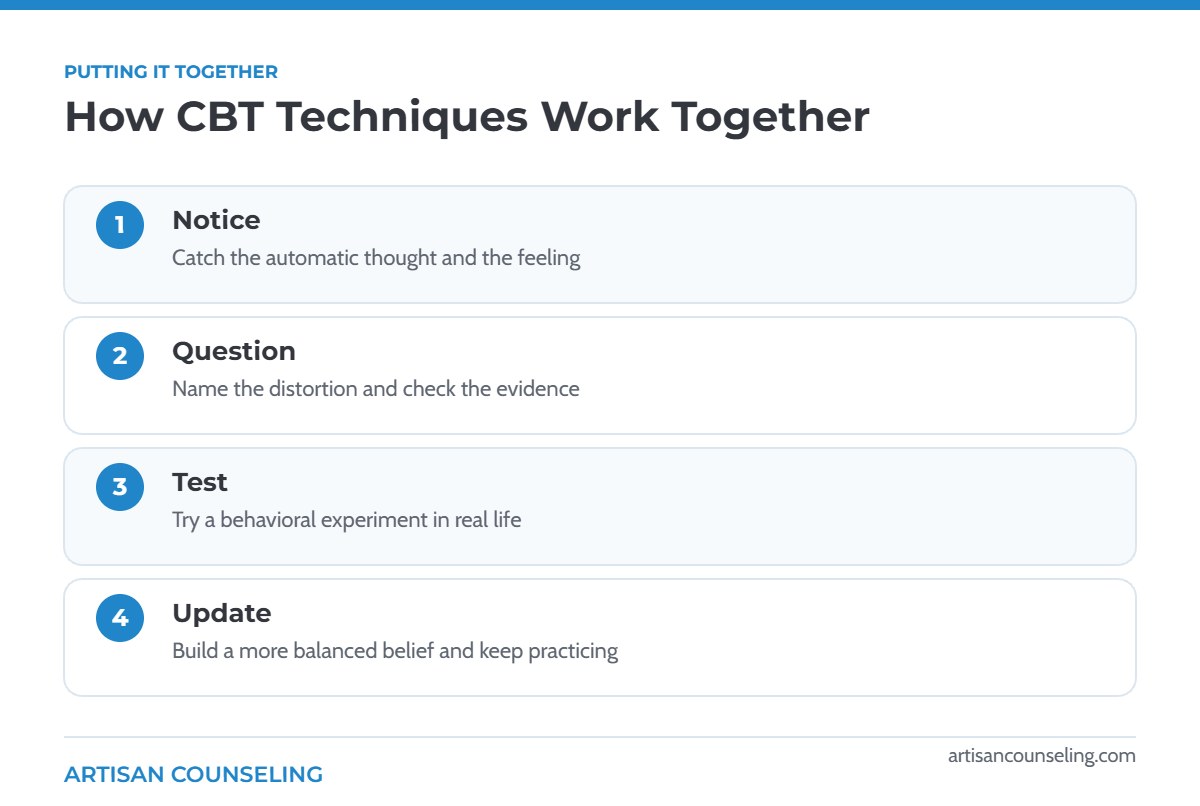
Practice between sessions is key. Like learning any skill, the more you use these tools, the more natural they become. Many people find they can eventually use them on their own, long after therapy ends.
Frequently Asked Questions
What is the most common CBT technique?
Thought records and identifying cognitive distortions are among the most widely used. They form the foundation for many other CBT skills.
Can I use CBT techniques on my own?
Some CBT techniques can be practiced on your own, and many people find workbooks helpful. Working with a counselor makes it easier to apply them to your specific situation and stay on track.
Is exposure therapy safe?
When guided by a trained professional, exposure is done gradually and at a pace you agree to. You are never forced into situations you are not ready for.
How quickly do CBT techniques start working?
Some people notice small changes within a few weeks, but it varies. Consistent practice usually leads to the most lasting results.
Learning CBT Skills at Artisan Counseling
If you want practical tools to manage anxiety, depression, or stress, our counselors can help. Explore our CBT therapy services or learn about individual counseling.
You can meet our counselors, visit our Newport News or Suffolk offices, or connect through telehealth across Virginia. Reach out to get started.