

Key Takeaways
- EMDR and traditional trauma counseling (such as CPT, Prolonged Exposure, and trauma-focused CBT) are both well-researched, effective approaches for PTSD.
- EMDR uses bilateral stimulation while you briefly hold a memory in mind and usually requires less detailed talking about what happened.
- Talk-based trauma therapies work through thoughts, beliefs, and avoidance directly, often with structured homework between sessions.
- The best fit depends on your history, goals, comfort with talking, and how stable you feel right now. Many counselors blend approaches.
If you have been researching trauma treatment, you have probably run into two broad options: EMDR, which pairs eye movements or tapping with a memory you hold in mind, and more traditional trauma counseling, which helps you process what happened through structured conversation.
Both approaches have strong research support, and both help people heal. They simply work in different ways and can suit different people at different points in recovery.
In this article, you will learn what each approach involves, how they compare side by side, who tends to do well with each, and how to choose a starting point with your counselor.
What Is EMDR Therapy?
EMDR stands for Eye Movement Desensitization and Reprocessing. It was developed by psychologist Francine Shapiro in the late 1980s and is now recommended for PTSD by organizations such as the American Psychological Association and the World Health Organization.
EMDR is based on the idea that some distressing memories are stored in a raw, unprocessed way. When something reminds you of the event, the original fear, body sensations, and negative beliefs (“I am not safe,” “It was my fault”) can show up as if it were happening now.
How a Typical EMDR Session Works
- You and your counselor identify a target memory, the image that represents it, and the belief attached to it.
- You notice the memory briefly while following side-to-side eye movements, hand taps, or alternating tones.
- After each short set, you share what you noticed, and the next set builds from there.
- Over time, the memory usually feels more distant and less charged, and a healthier belief feels truer.
You do not need to describe the event in detail out loud. For many people, that is one of EMDR’s biggest appeals. You can learn more in our guide to what to expect during an EMDR session.
What Does Traditional Trauma Counseling Include?
“Traditional” trauma counseling is not one single method. It usually refers to talk-based therapies designed specifically for trauma. The most researched ones include:
Cognitive Processing Therapy (CPT)
CPT focuses on “stuck points,” the beliefs that formed after the trauma about yourself, others, and the world. You learn to examine and gently challenge those beliefs, often through written worksheets between sessions.
Prolonged Exposure (PE)
PE helps you gradually approach memories and situations you have been avoiding. Repeated, safe exposure helps your brain learn that the memory is not the danger itself, which reduces fear over time.
Trauma-Focused CBT
Trauma-focused cognitive behavioral therapy combines coping skills, education about trauma responses, and gradual processing of the trauma story. It is widely used with children, teens, and families. Our CBT therapy page explains the broader approach.
Open-Ended, Relational Trauma Work
Some people benefit from less structured counseling that focuses on the therapeutic relationship, safety, and the long-term patterns trauma created. This is common for people with complex or childhood trauma.
EMDR vs. Traditional Trauma Counseling: Key Differences
Both approaches aim for the same outcome: memories that no longer control your daily life. The path is what differs.
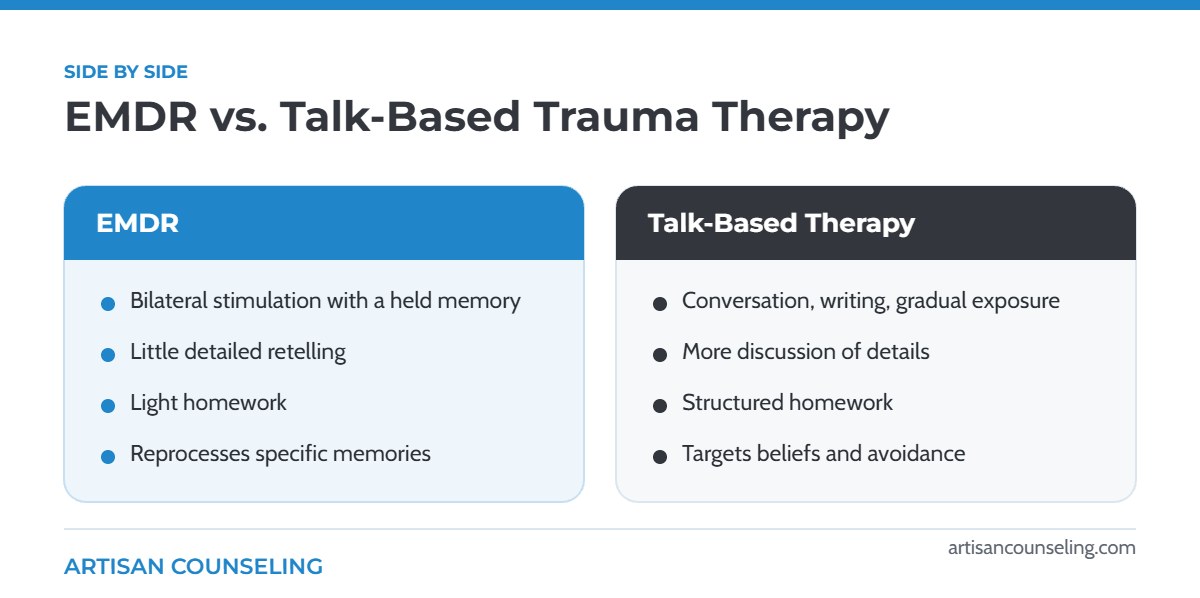
| Factor | EMDR | Talk-Based Trauma Therapy |
|---|---|---|
| How much you talk about details | Minimal; brief check-ins | Often more detailed discussion or writing |
| Main tool | Bilateral stimulation with a held memory | Conversation, worksheets, gradual exposure |
| Homework | Usually light (self-soothing practice) | Often structured assignments |
| Focus | Reprocessing specific memories | Beliefs, avoidance, and coping skills |
| Preparation | Built-in resourcing phase before processing | Skills and education early in treatment |
Who Tends to Do Well With EMDR?
EMDR often fits well when:
- Talking about the event in detail feels overwhelming or impossible.
- You have specific memories, such as an accident, assault, or medical event, that still feel vivid.
- You understand logically that it was not your fault, but your body does not believe it yet.
- You prefer a process that does not rely heavily on homework.
If you are curious whether the research holds up, read is EMDR effective for trauma.
Who Tends to Do Well With Traditional Approaches?
Talk-based trauma therapy can be a strong fit when:
- You want to understand your patterns and put words to your experience.
- Guilt, shame, or self-blame is a central part of your distress.
- You like structure, clear goals, and practice between sessions.
- You are dealing with ongoing stress where coping skills matter as much as memory processing.
Tip: Neither approach requires you to “relive” trauma without support. A good trauma counselor paces the work, teaches grounding skills first, and checks in with you constantly.
Why Many Counselors Combine Approaches
In practice, trauma treatment is rarely one method from start to finish. Many people start by building safety and coping skills, move into EMDR or another processing method, and then use talk therapy to integrate what changed into relationships, work, and identity.
Your counselor might also bring in body-based tools from somatic therapy or brainspotting if your trauma shows up strongly in physical sensations. The goal is a plan built around you, not a single technique.
How to Choose the Right Starting Point
Before your first appointment, it can help to think about these questions:
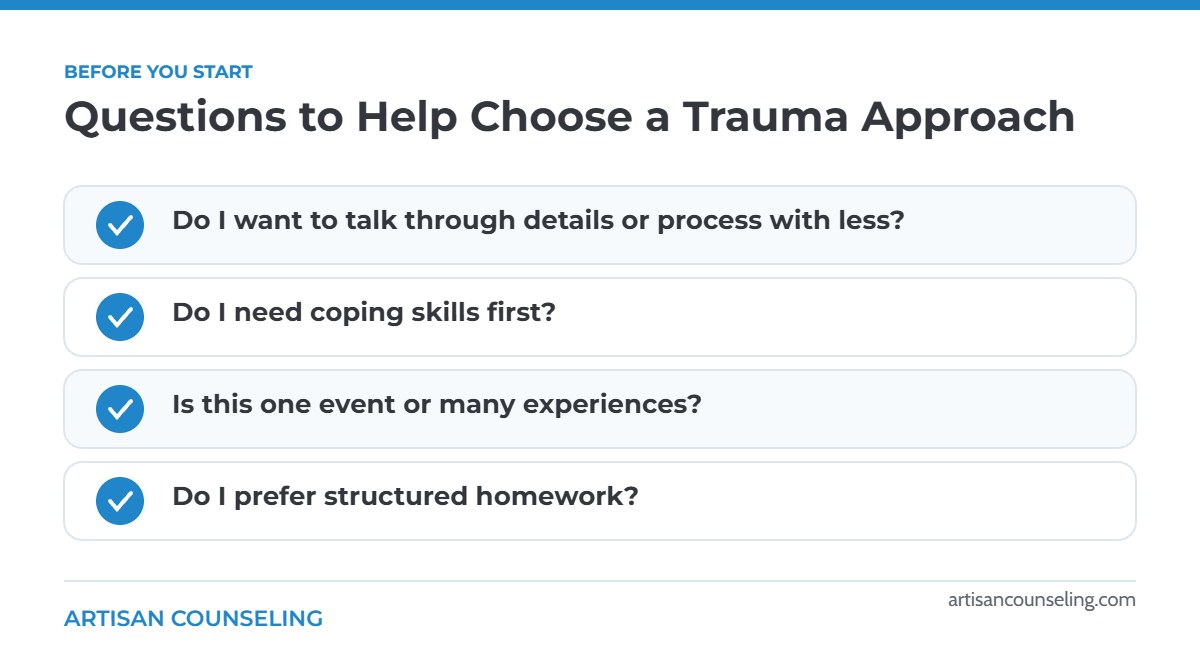
- Do I want to talk through what happened, or would I rather process it with less detail?
- How stable do I feel day to day? Do I need coping skills first?
- Is this one specific event, or many experiences over a long time?
- Do I prefer structured homework or more in-session work?
Bring your answers to an initial consultation. A trained counselor will assess your history and recommend a plan, and you can always adjust it as you go.
If you are in crisis: call or text 988 to reach the 988 Suicide & Crisis Lifeline, available 24/7, or call 911 in an emergency.
Frequently Asked Questions
Is EMDR better than talk therapy for trauma?
Not necessarily. Research supports both EMDR and trauma-focused talk therapies such as CPT and Prolonged Exposure as effective treatments for PTSD. The better choice depends on your history, preferences, and readiness.
Do I have to talk about my trauma in EMDR?
You will share enough for your counselor to understand the target memory, but EMDR does not require a detailed retelling. Much of the processing happens internally while you notice the memory during bilateral stimulation.
Can I switch from talk therapy to EMDR?
Yes. Many people begin with talk-based counseling and later add EMDR, or the reverse. If you are already in therapy, talk with your counselor about whether EMDR could support your goals.
How long does trauma therapy take?
It varies. Some people with a single-incident trauma notice meaningful change within a few months, while complex or long-term trauma usually takes longer. Your counselor will review progress with you regularly.
Find Trauma Counseling at Artisan Counseling
Artisan Counseling offers EMDR therapy alongside talk-based and body-based trauma approaches, so you do not have to choose a method on your own. You can browse our counselors to find someone with trauma training, then reach out to schedule at our Newport News office or by telehealth anywhere in Virginia.