
Key Takeaways
- DBT was first developed for people with chronic suicidal thoughts and borderline personality disorder (BPD), but it is not only for BPD.
- People who struggle with intense emotions, self-harm, eating concerns, substance use, or trauma-related distress may benefit.
- Its four skill areas, mindfulness, distress tolerance, emotion regulation, and interpersonal effectiveness, are useful for many people, with or without a diagnosis.
- DBT can be a full structured program or DBT-informed individual counseling. A counselor can help you decide which fits.
Dialectical behavior therapy, or DBT, is often mentioned alongside borderline personality disorder. Because of that, many people assume it is only for that diagnosis and not meant for them. In reality, it helps a much wider group of people, especially anyone whose emotions often feel overwhelming or hard to control.
If you are wondering whether DBT could help you or someone you love, it helps to understand who it was designed for, who else it serves well, and who might be better matched with a different approach.
In this article, you will learn what DBT is and what it teaches, whether it is only for BPD, the groups that tend to benefit most, situations where another approach may fit better, practical signs that DBT might be right for you, and what it looks like in practice.
What Is DBT?
DBT is a skills-based form of cognitive behavioral therapy developed by psychologist Marsha Linehan. The word “dialectical” refers to holding two ideas that seem opposite at the same time, most importantly: “I accept myself as I am, and I want to change.”
DBT teaches practical skills in four areas:
- Mindfulness: noticing the present moment, including your thoughts and feelings, without judging them.
- Distress tolerance: getting through a crisis without making it worse.
- Emotion regulation: understanding your feelings and reducing how vulnerable you are to emotional swings.
- Interpersonal effectiveness: asking for what you need, saying no, and setting boundaries while protecting your relationships and self-respect.
For a plain-language look at each skill area, see DBT skills explained.
Is DBT Only for Borderline Personality Disorder?
No. DBT was created in the late 1980s and early 1990s for people experiencing chronic suicidal thoughts and self-harming behaviors, many of whom met criteria for BPD. Linehan found that standard CBT did not fully meet their needs, so she blended CBT’s focus on change with acceptance-based ideas drawn from mindfulness practice.
The people DBT was first built for often felt emotions very intensely and had trouble returning to a calm baseline. That focus on intense, fast-moving emotions is exactly why DBT has since been adapted and studied for many other concerns. Today, counselors recommend DBT or DBT skills for people with a wide range of diagnoses, and for many people with no diagnosis at all.
Common Myths About DBT and BPD
- “Being referred to DBT means I have BPD.” A recommendation for DBT is about the skills you might benefit from, not a label. Only a licensed professional can assess whether any diagnosis applies.
- “DBT is only for people in crisis.” DBT was built to help people in serious distress, but its skills are just as useful for everyday stress, like handling a tense conversation or calming down after a hard day.
- “DBT means accepting everything as it is.” Acceptance in DBT does not mean giving up or approving of something painful. It means acknowledging reality so you can decide what to do next.
Who Else Can Benefit From DBT?
DBT and DBT-informed counseling are used with many groups today. Here are some of the most common.
People With Suicidal Thoughts or Self-Harm
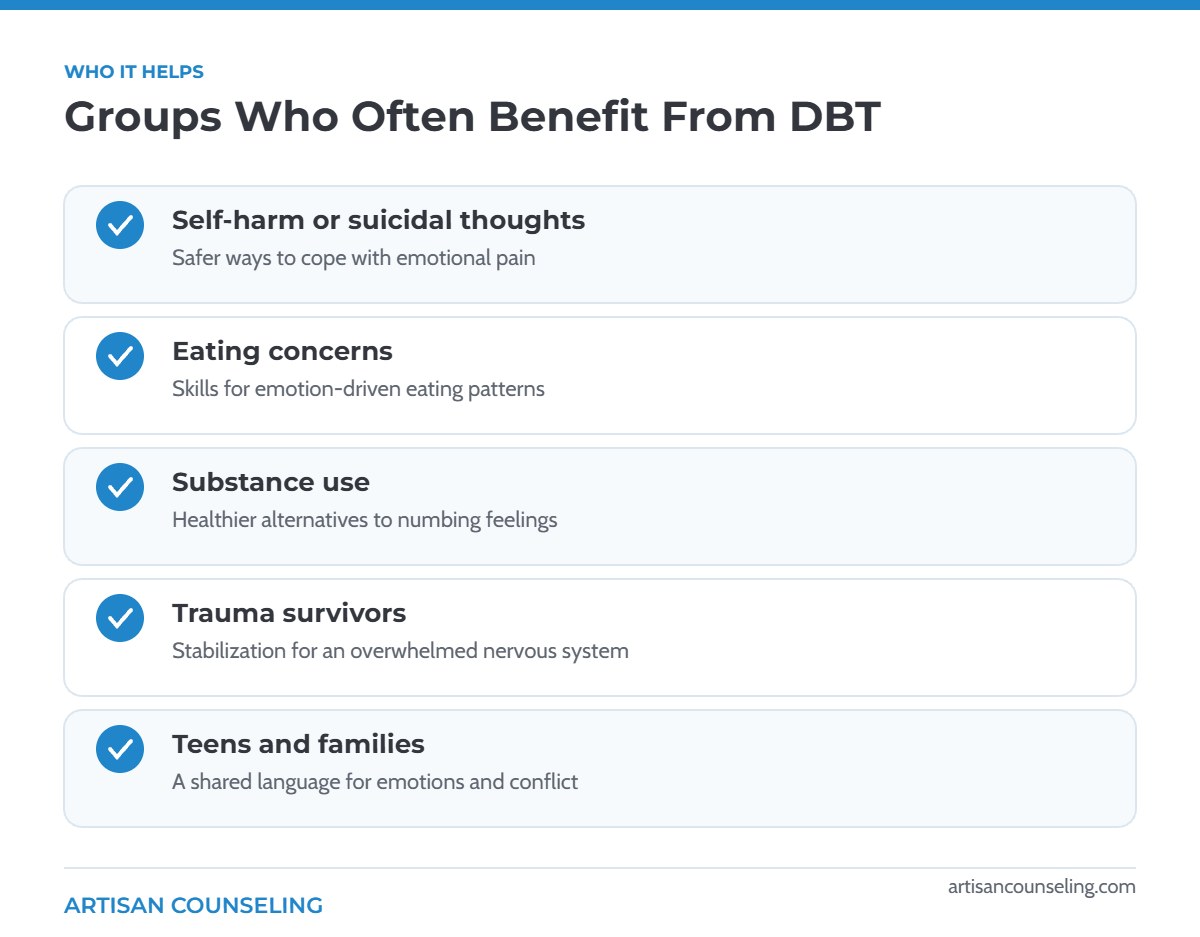
DBT remains one of the best-known approaches for people who struggle with recurring suicidal thoughts or self-harm, regardless of diagnosis. It focuses on building safer ways to cope with emotional pain.
If you are in crisis: call or text 988 to reach the 988 Suicide & Crisis Lifeline, available 24/7, or call 911 in an emergency.
People With Eating Concerns
Adapted forms of DBT are used for binge eating and bulimia, where eating behaviors are often tied to managing difficult emotions.
People Who Use Substances to Cope
When alcohol or drugs become a way to numb painful feelings, DBT skills can offer healthier alternatives and help reduce urges.
Trauma Survivors
Trauma can leave people with intense emotional reactions and a nervous system that is easily overwhelmed. DBT skills can help with stabilization, often alongside trauma-informed therapy or trauma-focused treatments such as EMDR.
Teens and Their Families
Adolescent DBT programs often include parents or caregivers so the whole family learns a shared language for handling emotions and conflict.
People With Depression, Anxiety, or Strong Reactions to Stress
You do not need a specific diagnosis to benefit. If your emotions feel overwhelming, or you tend to react quickly and intensely and regret it later, DBT skills can help. Our article on what emotional regulation really means explores this further.
Who May Not Be the Best Fit for DBT?
DBT is helpful for many people, but it is not the right first choice for everyone. Another approach might fit better if:
- You cannot commit to the structure right now. Comprehensive DBT often involves weekly individual therapy plus a skills group and between-session practice.
- Your main goal is exploring your history. If you want to focus primarily on understanding past experiences, other approaches may suit you better, though DBT skills can still help alongside them.
- You are not yet ready to change behaviors. DBT asks you to try new skills. If you are still deciding whether you want to change, a counselor can help you explore that first.
This does not mean DBT is closed to you. Many counselors use DBT skills flexibly within regular individual counseling.
How Do You Know if DBT Might Fit You?
Consider whether any of these feel familiar:
- Your emotions feel very intense or shift quickly
- You often act on emotions in ways you later regret
- Your relationships feel stormy or unstable
- You swing between holding everything in and boiling over
- You use behaviors like self-harm, bingeing, or substances to cope
- You want practical, concrete tools you can use right away
If several of these sound like you, DBT or DBT-informed counseling may be worth exploring. A licensed counselor can talk through your goals and help you decide on the best approach.
What Does DBT Look Like in Practice?
DBT can be delivered in two main ways, depending on your needs.
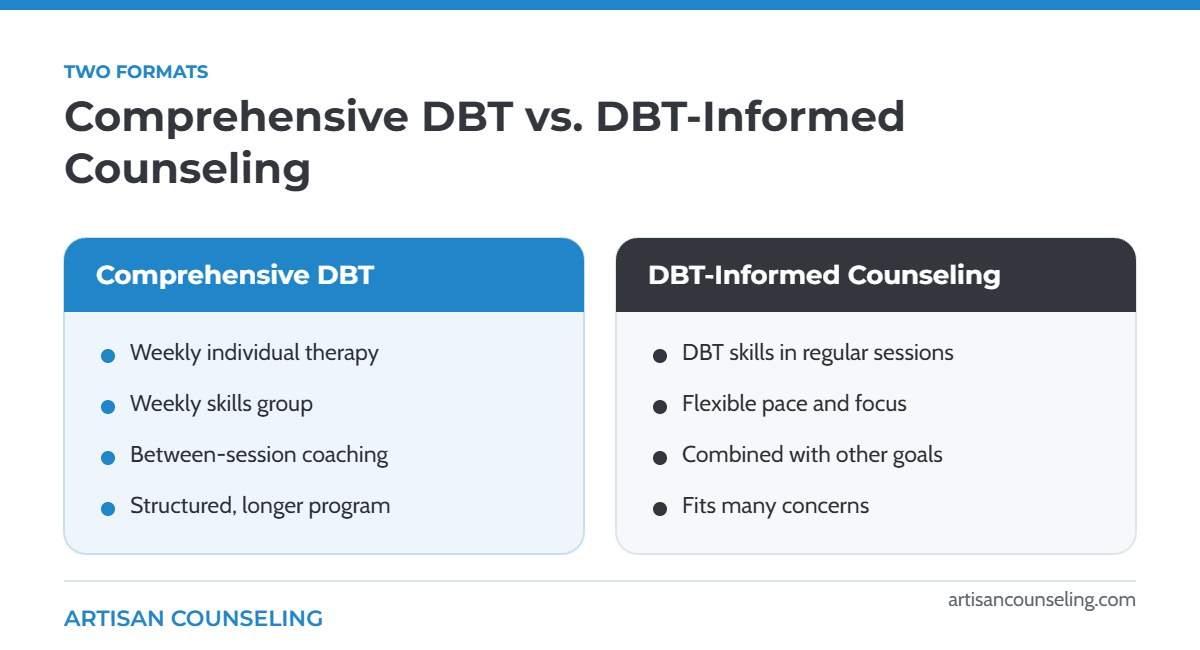
Comprehensive DBT is a structured program that typically includes weekly individual therapy, a weekly skills group, coaching between sessions to help you use skills in real moments, and a consultation team for the therapist. These programs often run for several months to a year.
DBT-informed counseling brings DBT skills into regular one-on-one sessions, often alongside other goals. You might practice a grounding skill before a difficult conversation, use a script to ask your partner or boss for something clearly and calmly, track emotions and urges over the week to spot patterns, or learn the “STOP” skill (Stop, Take a step back, Observe, Proceed mindfully) for moments when you feel a strong urge to react.
Tip: DBT works best when you practice between sessions. Start small: pick one skill, use it once a day for a week, and bring notes about what worked to your next appointment.
Frequently Asked Questions
Can you do DBT without a BPD diagnosis?
Yes. Many people who use DBT skills do not have BPD or any formal diagnosis. A counselor will focus on your goals and what is getting in the way.
What is the difference between DBT and CBT?
DBT grew out of CBT. Both focus on changing unhelpful patterns, but DBT adds a strong emphasis on acceptance, mindfulness, and skills for handling intense emotions and relationships.
Can DBT help with anxiety?
DBT skills like mindfulness and distress tolerance can help many people manage anxiety, especially when it comes with intense emotional reactions. CBT is also commonly used for anxiety, and some counselors combine both.
Is DBT good for teenagers?
Yes. Adapted DBT for adolescents is widely used and usually involves caregivers, helping families build skills together.
Exploring DBT at Artisan Counseling
If you think DBT skills could help you or your teen, we are here to talk it through. Learn more about our DBT therapy services, explore individual counseling that weaves in DBT skills, and meet our counselors.
We offer appointments at our Newport News office, our Suffolk counseling office, and by telehealth across Virginia. Contact us to schedule a first conversation.