Key Takeaways
- Self-awareness is the ability to notice your thoughts, feelings, and behaviors and understand how they affect you and others.
- It has two sides: how well you understand yourself (internal) and how well you understand how others experience you (external).
- Repeated patterns, surprise at feedback, and outsized reactions can signal that self-awareness has room to grow.
- Simple habits like pausing, journaling, and asking for feedback build self-awareness over time.
- Counseling offers a safe, structured space to see patterns that are hard to spot on your own.
Most people want to change something about their lives. Maybe you want calmer relationships, more confidence at work, or simply to stop ending up in the same frustrating situations. Yet change is hard when you cannot clearly see what is driving your choices in the first place.
That is where self-awareness comes in. It is not about overanalyzing every move or becoming self-critical. It is about seeing yourself honestly and with compassion so you can make choices that actually fit who you are.
In this article, you will learn what self-awareness really means, the two kinds of self-awareness, common signs that yours may be low, practical ways to build it, and when talking with a counselor can help.
What Is Self-Awareness?
Self-awareness is the ability to notice what is happening inside you, including your thoughts, emotions, physical sensations, and urges, and to understand how those experiences shape your behavior. It also includes recognizing how your actions land with the people around you.
Think of it as the difference between being swept along by a reaction and being able to say, “I am getting defensive right now, and I think it is because I feel criticized.” That small moment of recognition creates space to respond differently.
Self-awareness is a skill, not a fixed trait. Some people learned it early because their families talked openly about feelings. Others learned to tune their inner world out to cope. Either way, it can be developed at any age.
What Are the Two Types of Self-Awareness?
Psychologists often describe self-awareness as having two related but distinct sides. Strength in one does not guarantee strength in the other.
Internal Self-Awareness
Internal self-awareness is how clearly you understand your own values, needs, emotions, strengths, and triggers. People with strong internal awareness tend to know what matters to them and can usually explain why they feel the way they do.
External Self-Awareness
External self-awareness is how accurately you understand the way others see you. You might believe you come across as calm and direct, while coworkers experience you as abrupt. Closing that gap helps you communicate the way you intend and builds trust in relationships.
Self-awareness is not the same as self-criticism. The goal is to observe yourself the way a kind, honest friend would, noticing patterns without attacking yourself for having them.
Signs of Low Self-Awareness
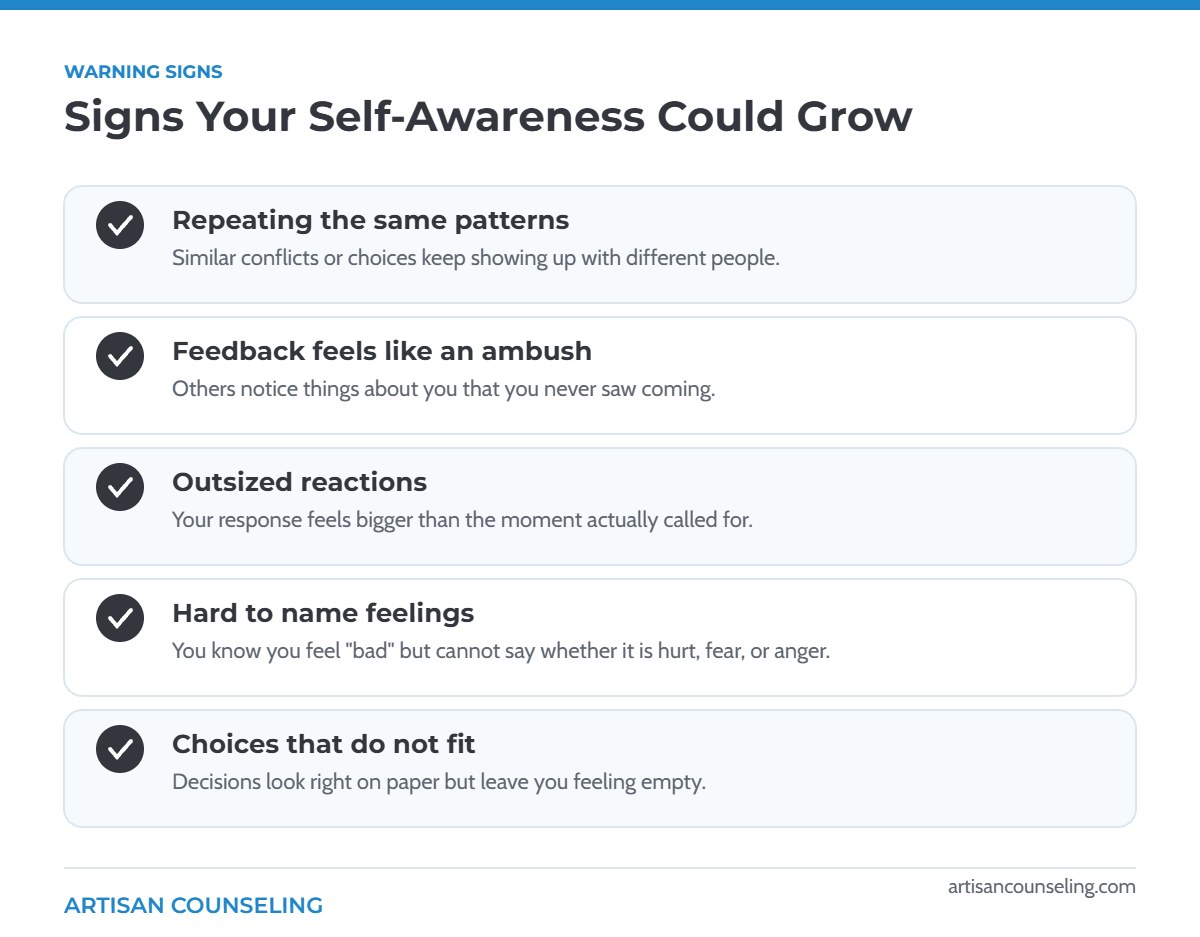
Low self-awareness is common and is not a character flaw. Often it simply means you have been busy surviving, caring for others, or moving too fast to look inward. These signs may sound familiar:
You Keep Repeating the Same Patterns
Different jobs, partners, or friendships seem to end with the same conflict. When a pattern follows you across situations, it often points to something within you worth exploring, such as a fear of conflict or a habit of overcommitting.
Feedback Catches You Off Guard
If comments from others regularly feel like they came out of nowhere, there may be a gap between how you see yourself and how you come across.
Your Reactions Feel Bigger Than the Situation
A minor comment leaves you furious or crushed for days. Intense reactions often connect to older experiences or unmet needs that have not been named yet.
You Struggle to Name Your Feelings
You might know you feel “off” or “stressed” without being able to tell whether it is disappointment, loneliness, fear, or resentment. Naming emotions more precisely is one of the most useful parts of self-awareness.
Your Decisions Do Not Feel Like Yours
You follow the path that looks right or that others expect, then feel restless or empty. This can happen when you have lost touch with your own values.
Why Self-Awareness Matters for Personal Growth
You cannot change what you cannot see. Self-awareness is the foundation for nearly every other kind of growth, including:
- Healthier relationships: Understanding your needs and triggers makes it easier to communicate clearly and repair after conflict.
- Better emotional regulation: Noticing a feeling early gives you more options for handling it. Learn more in our guide to what emotional regulation really means.
- Clearer decisions: When you know your values, choices about work, relationships, and time become easier.
- Stronger boundaries: You have to notice discomfort before you can protect yourself from what causes it. Our article on why healthy relationships need healthy boundaries explores this further.
How to Build Self-Awareness: Practical Habits
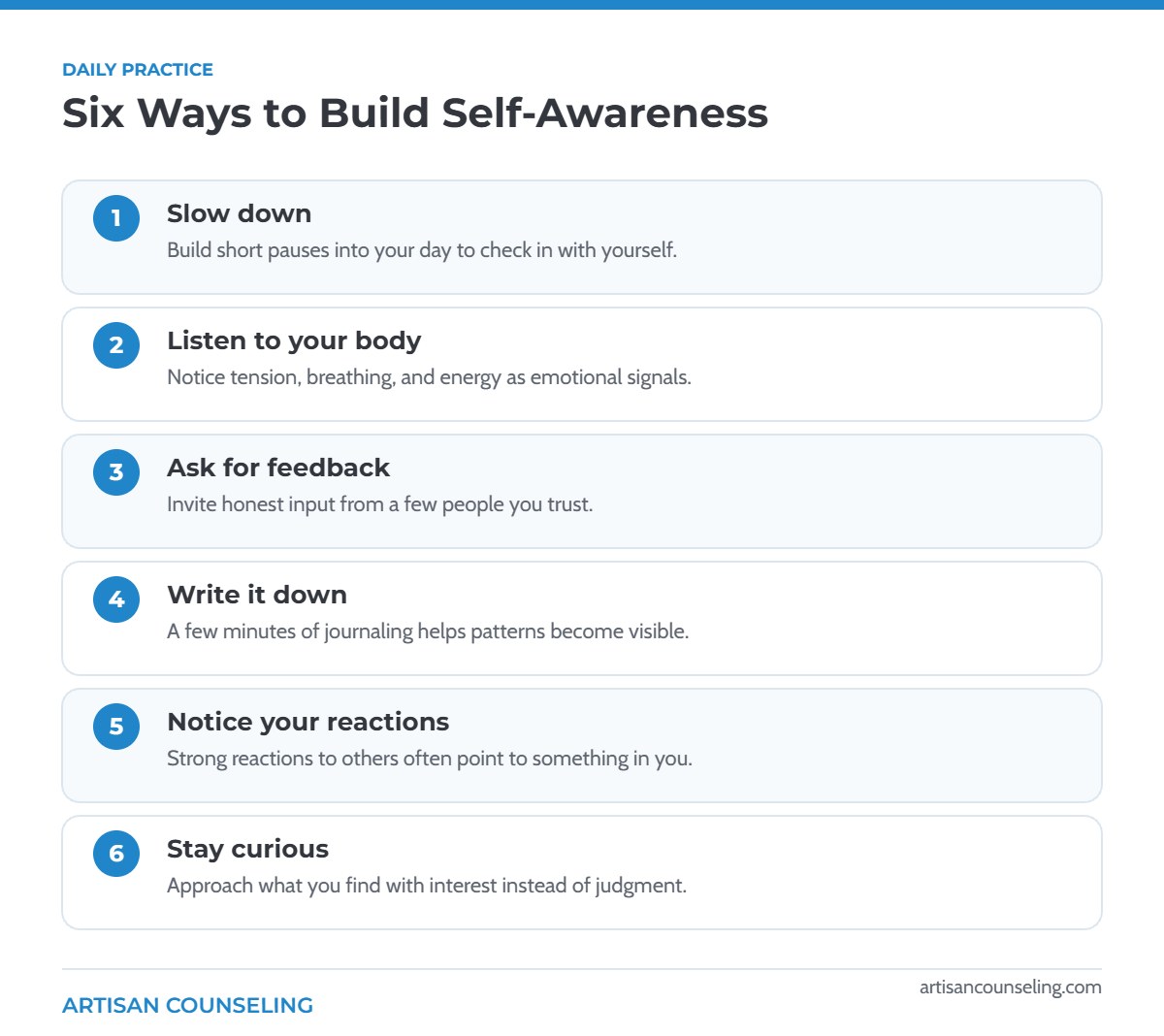
Self-awareness grows through small, consistent practices rather than one big breakthrough. Try a few of these and notice which fit your life.
Slow Down
It is hard to notice anything while rushing. Try a brief check-in a few times a day: What am I feeling? What do I need right now? Even 30 seconds counts.
Pay Attention to Your Body
Emotions often show up physically before you can name them. A tight jaw, shallow breathing, or a heavy chest can be early signals of stress, anger, or sadness.
Ask for Honest Feedback
Choose two or three people who care about you and ask a specific question, such as “What do I do when I am stressed?” Listen without defending yourself, then reflect on what you heard.
Write It Down
Journaling helps thoughts move from a blur into something you can examine. Simple prompts work well: What bothered me today? What did I want in that moment? What would I do differently?
Notice Your Reactions to Other People
When someone irritates or impresses you strongly, ask what that reaction says about your own values, fears, or wishes.
Get Curious, Not Judgmental
When you discover something uncomfortable about yourself, treat it as information rather than proof that something is wrong with you. Curiosity keeps you learning; shame tends to shut learning down.
When Counseling Can Help You Grow
Some patterns are very hard to see from the inside, especially those shaped by childhood experiences, trauma, or long-standing beliefs about yourself. A counselor can reflect patterns back to you, help you put words to feelings, and offer a safe place to try new ways of responding.
Counseling may be especially helpful if you feel stuck in repeating relationship patterns, struggle with low self-esteem, or notice that your emotions often feel overwhelming. Approaches such as cognitive behavioral therapy (CBT) help you notice how thoughts, feelings, and actions connect.
Frequently Asked Questions
Can self-awareness be learned?
Yes. Self-awareness is a skill that improves with practice. Habits such as journaling, mindful check-ins, and asking for feedback strengthen it over time, and counseling can speed the process by helping you notice patterns you might miss alone.
What is the difference between self-awareness and overthinking?
Self-awareness is curious and leads to clearer choices. Overthinking tends to loop, focuses on worst-case scenarios, and leaves you feeling more anxious rather than more informed. If reflection consistently makes you feel worse, it may have turned into rumination.
How long does it take to become more self-aware?
Many people notice small shifts within a few weeks of consistent practice, such as catching a reaction a moment sooner. Deeper changes in long-standing patterns usually take longer and often benefit from support.
Is self-awareness the same as emotional intelligence?
Self-awareness is one core part of emotional intelligence. Emotional intelligence also includes managing your emotions, understanding other people, and handling relationships well.
Getting Support at Artisan Counseling
If you want to understand yourself more deeply and make changes that last, you do not have to do it alone. Our licensed counselors offer individual counseling in person in Newport News and Suffolk, and through telehealth across Virginia. You can meet our counselors or reach out to schedule a first appointment.