
Key Takeaways
- Healthy boundaries define what you are comfortable with and help both partners feel respected and safe.
- Boundaries protect closeness by preventing resentment, burnout, and confusion.
- Common types include emotional, physical, time, digital, and financial boundaries.
- Setting a boundary works best when it is clear, kind, specific, and followed by consistent action.
Many people worry that boundaries will push their partner away. In reality, the opposite is usually true. Clear boundaries help both partners understand each other, reduce resentment, and make it safe to be close.
If this is affecting your relationship, couples counseling at our Newport News and Suffolk offices can help you and your partner work through it together.
In this article, you will learn what healthy boundaries really are, why the old idea that “being close means having no limits” falls apart, the types of boundaries most relationships need, and practical scripts for setting them.
What Are Healthy Boundaries in a Relationship?
A boundary is a limit or guideline that describes what you are comfortable with and how you will take care of yourself. Boundaries are about your own choices, not about controlling your partner.
For example, “You can’t go out with friends” is an attempt to control. “I need us to have one evening a week that’s just ours” is a boundary that expresses a need.
Boundaries vs. Rules
Rules tell someone else what to do. Boundaries tell others what you will do. “If the conversation turns to yelling, I’ll take a break and come back when we’re calmer” is a boundary you can follow through on yourself.
What Healthy Boundaries Look Like Day to Day
Boundaries are often small and ordinary. They show up in moments like these:
- Telling your partner you need to sleep by 10:30 on work nights, even if they stay up later.
- Saying, “I don’t want to talk about my weight. Please don’t comment on what I eat.”
- Keeping a standing coffee date with a friend, even when your partner would rather you stay home.
- Letting your partner know you will answer texts after work, not during meetings.
None of these push a partner away. They simply make it clearer how to love you well.
Why Do Healthy Relationships Need Boundaries?
Some people believe that truly close couples share everything and never say no. That idea tends to create problems over time.
- Boundaries prevent resentment. Saying yes when you mean no builds frustration that eventually comes out.
- They protect your identity. Each partner keeps friendships, interests, and values of their own.
- They build trust. When you know your partner will be honest about their limits, you can trust their yes.
- They reduce conflict. Clear expectations mean fewer misunderstandings.
- They prevent burnout. No one can meet every need of another person.
If you often feel responsible for your partner’s feelings, you may relate to the signs of codependency. You can also check yourself against these 15 signs of unhealthy boundaries.
What Types of Boundaries Do Couples Need?
Boundaries cover many areas of a relationship. These are the most common.
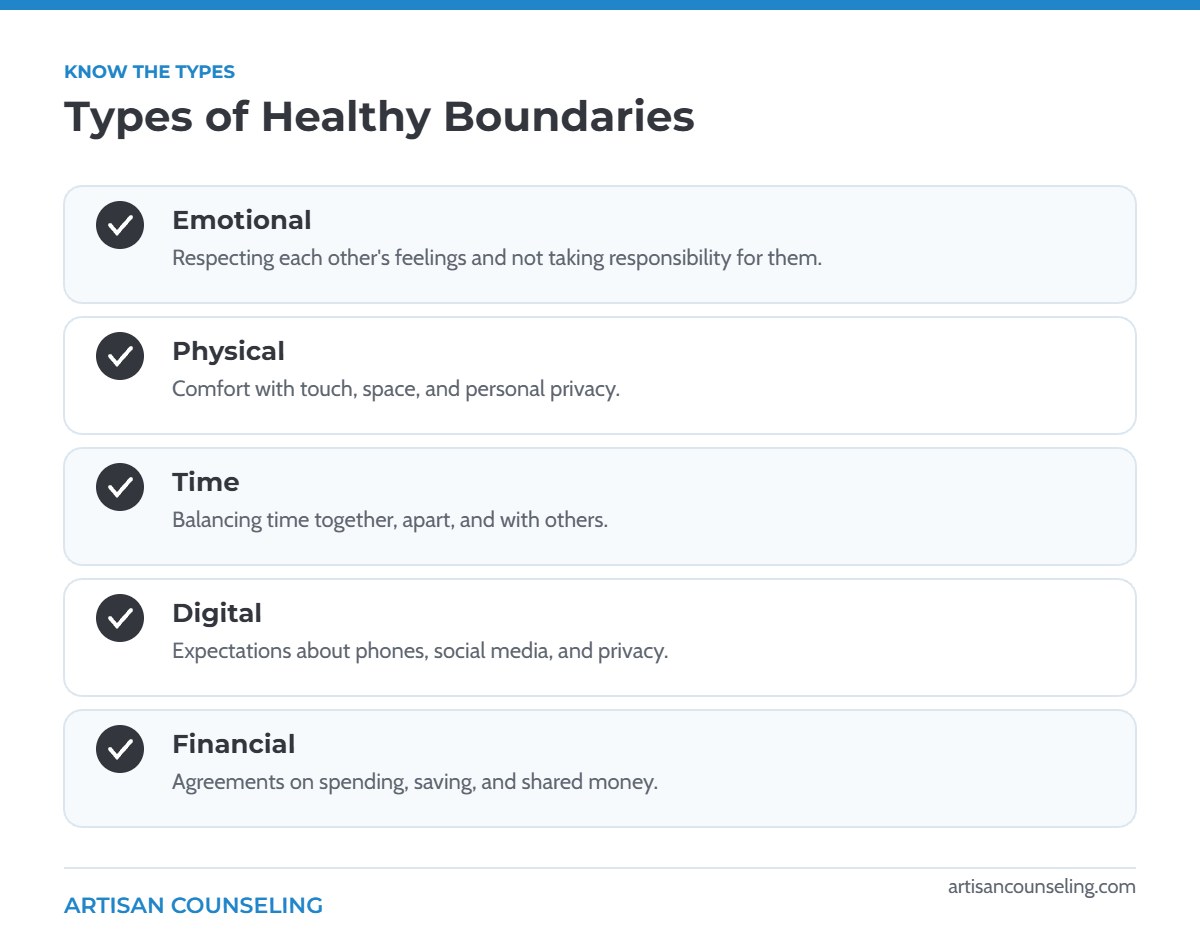
Emotional Boundaries
You care about your partner’s feelings without taking responsibility for fixing all of them. You can share feelings without being judged or dismissed.
Physical Boundaries
These cover touch, personal space, privacy, and intimacy. Consent and comfort apply in every relationship, including long-term ones.
Time Boundaries
Healthy couples balance time together, time apart, and time with friends and family.
Digital Boundaries
Expectations around phones at dinner, sharing passwords, posting about each other, and texting during work.
Financial Boundaries
Agreements about spending limits, savings goals, and how shared money is handled.
How Do You Know a Boundary Is Needed?
Many people do not realize they need a boundary until they feel worn down. Your emotions and body often notice first. Ask yourself:
- Do I feel a sense of dread before certain conversations or plans?
- Am I saying yes and then feeling irritated or resentful afterward?
- Do I hide parts of my life to avoid a reaction?
- Do I feel like I have lost touch with my friends, hobbies, or goals?
- Do I feel tense, tired, or tight in my chest around a particular topic?
For example, if you notice that you feel a knot in your stomach every Sunday because your partner expects a full day with their family, that feeling is useful information. It does not mean your partner is doing something wrong. It means there is a conversation worth having about what works for both of you.
How Do You Set a Healthy Boundary?
Setting boundaries is a skill. These steps make it easier.
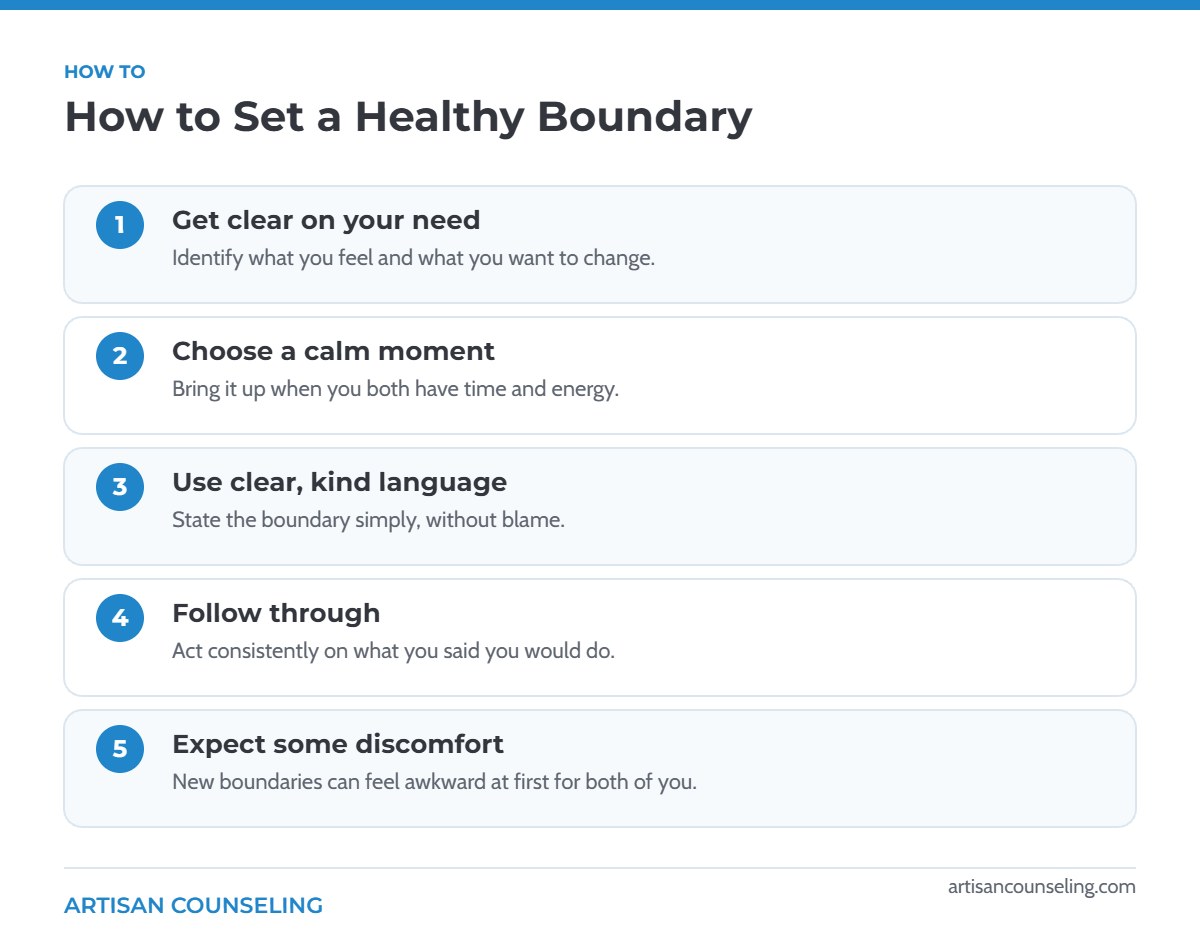
Get Clear on What You Need
Notice when you feel resentful, drained, or uncomfortable. Those feelings often point to a boundary that needs attention.
Pick the Right Moment
Bring it up when you are both calm, not in the middle of an argument.
Say It Clearly and Kindly
Try simple scripts like these:
- “I need 30 minutes to decompress after work before we talk about plans.”
- “I’m not comfortable with sharing our arguments with your family. Can we keep those between us?”
- “I’d like us to check with each other before purchases over $200.”
- “When voices get raised, I’m going to take a break and come back in 20 minutes.”
Follow Through Consistently
A boundary is only as strong as your follow-through. Calmly act on what you said, every time.
A Sample Boundary Conversation
Here is how a boundary conversation might sound from start to finish:
- Name the situation: “I’ve noticed we’ve been scrolling our phones through most of dinner lately.”
- Share the feeling: “I miss talking with you, and I end up feeling a little lonely.”
- Make the request: “Could we leave our phones in the other room while we eat?”
- Invite their view: “What would make that work for you?”
If your partner forgets, a gentle reminder works better than a lecture: “Phones away?” Over time, small follow-through like this builds trust that you mean what you say.
Respecting Your Partner’s Boundaries Too
Boundaries go both ways. When your partner sets a limit, try to listen with curiosity instead of taking it as rejection. You might ask, “Can you tell me more about what you need?” It is okay to feel disappointed. It is not okay to pressure, guilt, or punish your partner for having a limit.
Expect some pushback: When you start setting boundaries, a partner may feel surprised or uncomfortable. That does not mean the boundary is wrong. Give it time and keep communicating with kindness.
What If Your Partner Doesn’t Respect Your Boundaries?
Occasional slip-ups happen as couples adjust. Repeatedly ignoring, mocking, or punishing your boundaries is a more serious sign. It can point to control or manipulation. Learn more in how to recognize emotional manipulation. If you ever feel unsafe, prioritize your safety and reach out for help.
Warning signs that go beyond normal adjustment include:
- Your partner checks your phone, tracks your location, or controls money after you have asked them not to.
- Saying no leads to the silent treatment, threats, or guilt trips that last for days.
- You are told your needs are “crazy” or “too much” whenever you raise them.
- You feel afraid of how your partner will react.
If you are in crisis: If you feel unsafe or are in immediate danger, call 911. If you are struggling emotionally or having thoughts of harming yourself, call or text 988 to reach the 988 Suicide & Crisis Lifeline.
How Can Counseling Help With Boundaries?
Many people struggle with boundaries because they grew up in families where limits were not respected. A counselor can help you understand those roots, practice assertive communication, and handle guilt. Individual counseling supports personal growth, while couples counseling helps partners create shared agreements that work for both.
In session, a counselor might help you notice the moments when you abandon your own needs, practice saying a boundary out loud before you say it at home, and work through the guilt or fear that comes up afterward. In couples sessions, partners often work on creating agreements around time, money, family, and technology, then check in on how those agreements are going. Sessions are available in person and through telehealth across Virginia, which many busy couples find easier to schedule.
Frequently Asked Questions
Are boundaries selfish?
No. Healthy boundaries help you show up more honestly and sustainably in a relationship. They protect both partners from resentment and burnout.
What is an example of a healthy boundary in a relationship?
An example is, “I need some quiet time after work before we talk about the day.” It expresses a personal need clearly without blaming or controlling your partner.
How do I set boundaries without feeling guilty?
Guilt is common, especially if you are used to putting others first. Remind yourself that boundaries support the relationship, start with small ones, and notice that the relationship can handle them.
What should I do if my partner keeps crossing my boundaries?
Restate the boundary clearly and follow through on the consequence you described. If the pattern continues, consider counseling, and seek support right away if you feel unsafe.
Can boundaries change over time?
Yes. Your needs may shift with a new job, a baby, a move, or a health change. It is healthy to revisit boundaries as life changes and to check in with your partner about whether current agreements still work for both of you.
Strengthening Your Relationship With Artisan Counseling
Learning to set healthy boundaries can transform how you connect. Our team of counselors offers support in Newport News, Suffolk, and online through telehealth. Contact us to get started.