

Key Takeaways
- Cognitive behavioral therapy (CBT) is a structured, goal-focused therapy built on the link between thoughts, feelings, and behaviors.
- CBT helps you notice unhelpful thinking patterns, test them against evidence, and practice new behaviors in daily life.
- It is one of the most widely researched therapies for anxiety, depression, and many other concerns.
- Sessions are collaborative and often include practice between sessions, so you build skills you can keep using.
Maybe you have heard a friend mention CBT, or a doctor suggested it, and you are not sure what it actually involves. The name sounds clinical, but the idea behind it is practical: the way you interpret a situation shapes how you feel and what you do next.
Cognitive behavioral therapy gives you tools to catch those interpretations, question them, and respond differently. It is active, skills-based, and usually focused on the problems affecting your life right now.
In this article, you will learn the core idea behind CBT, what a typical session looks like, the thinking patterns it targets, the behavioral techniques counselors use, what CBT can help with, and how to tell whether it is a good fit for you.
What Is Cognitive Behavioral Therapy?
CBT is a form of talk therapy that focuses on how thoughts, emotions, physical sensations, and behaviors influence one another. It was developed in the 1960s and 1970s, drawing on the work of Aaron Beck and Albert Ellis, and has since become one of the most studied approaches in mental health care.
Unlike therapies that spend most of their time exploring the past, CBT tends to concentrate on present-day patterns that keep you stuck. Your history still matters, but the main question is: what is keeping this problem going today, and what can you do differently?
The Thought-Feeling-Behavior Cycle
Imagine a coworker walks past without saying hello. One person thinks, “They must be upset with me,” feels anxious, and avoids them all afternoon. Another thinks, “They look busy,” feels neutral, and moves on. Same event, different interpretation, very different outcome.
Physical sensations are part of the cycle, too. The anxious coworker might notice a tight chest and a knot in the stomach, which can feel like proof that something is wrong. CBT helps you see how body sensations, thoughts, and actions feed each other, so you can step in at any point in the loop.
CBT helps you slow that cycle down so you can see each piece. Once you can spot the thought, you can check whether it is accurate and choose a more helpful response.
What Happens in a CBT Session?
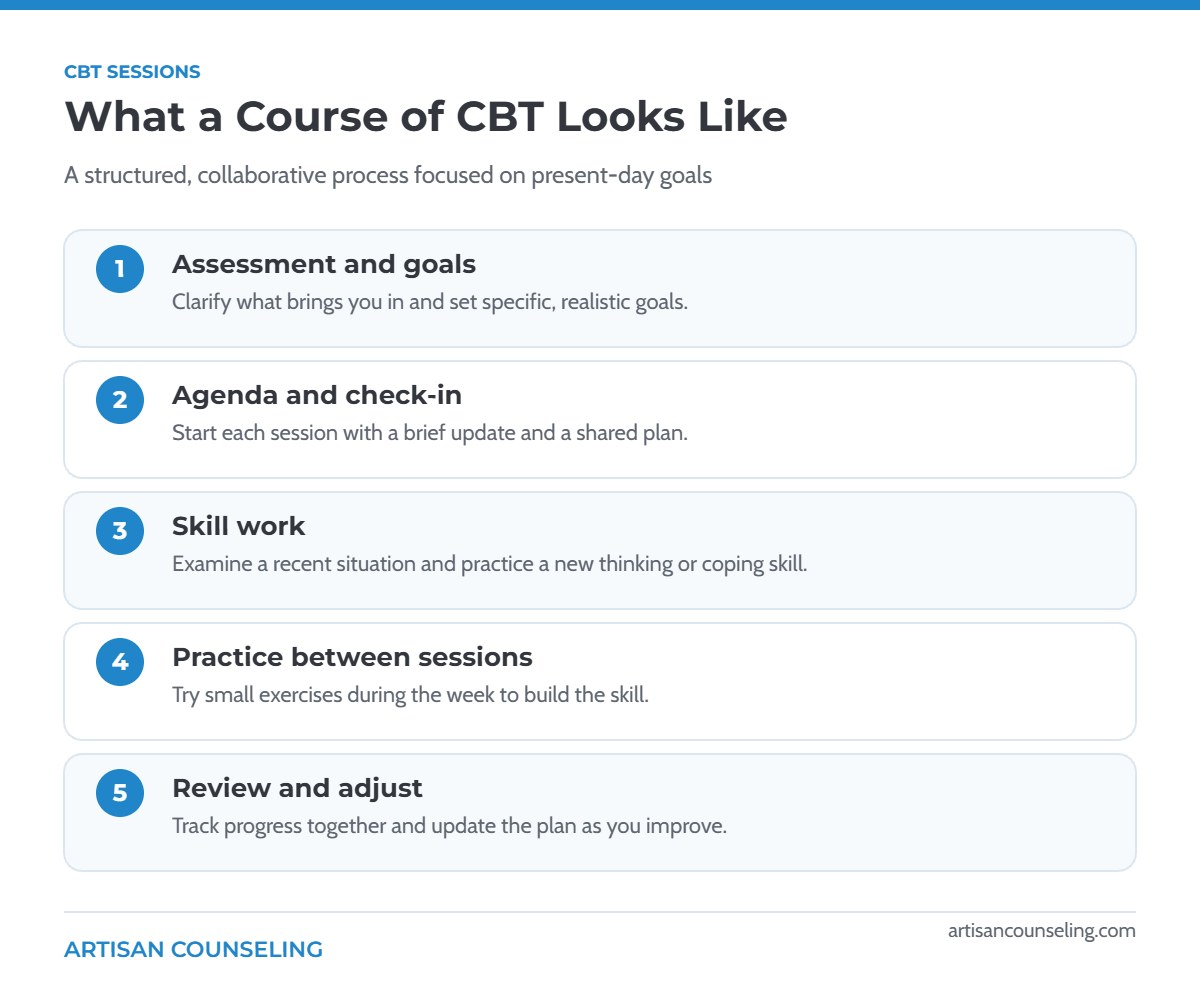
CBT sessions are structured but still personal. Your counselor works with you as a partner, and you are encouraged to speak up about what is and is not helping. A typical course of CBT follows a recognizable rhythm:
- Assessment and goals. Early sessions focus on understanding what brings you in and defining clear, specific goals.
- Check-in and agenda. Each session usually starts with a brief update and a shared plan for the time together.
- Skill work. You and your counselor explore a recent situation, identify the thoughts involved, and practice a new skill.
- Practice between sessions. You may try a thought record, a small experiment, or a coping skill during the week.
- Review and adjust. Progress is reviewed regularly so the plan can change as you improve.
If you are nervous about getting started, ask your counselor to walk you through what the first few sessions will involve. Knowing the plan can ease a lot of uncertainty.
Which Thinking Patterns Does CBT Target?
CBT pays close attention to cognitive distortions: automatic, often exaggerated ways of thinking that feel true in the moment. Everyone has them. They become a problem when they are frequent and drive painful emotions or avoidance. Common examples include:
- Catastrophizing: assuming the worst possible outcome, such as “If I make a mistake, I will get fired.”
- All-or-nothing thinking: seeing things in extremes, like “If it is not perfect, it is a failure.”
- Mind reading: believing you know what others think, usually something negative about you.
- Overgeneralization: treating one event as a never-ending pattern, such as “This always happens to me.”
- Should statements: rigid rules for yourself or others that lead to guilt or frustration.
- Discounting the positive: dismissing good feedback or successes as luck or exceptions.
The goal is not to force positive thinking. It is to find balanced, realistic thoughts that fit the evidence. If you notice the same worries looping, you may also find why negative thoughts keep repeating helpful.
An Example Thought Record
A thought record is one of the most common CBT tools. Here is what a completed one might look like:
- Situation: My friend did not reply to my text for a whole day.
- Automatic thought: “She is annoyed with me. I must have said something wrong.”
- Feeling: Anxious (7 out of 10), sad (5 out of 10).
- Evidence for: She usually replies quickly.
- Evidence against: She mentioned a busy week at work. We had a good time last weekend. She has been slow to reply before and was fine.
- Balanced thought: “She is probably busy. If something is wrong, I can ask her.”
- Feeling after: Anxious (3 out of 10).
The situation did not change, but the emotional intensity did. With practice, many people find they can run through this process in their head within a few moments.
What Behavioral Techniques Are Used in CBT?
The “behavioral” half of CBT is just as important as the thinking work. Changing what you do often changes how you feel, sometimes faster than changing thoughts alone.
Behavioral Activation
Often used for depression, behavioral activation involves gradually scheduling meaningful or enjoyable activities, even when motivation is low. Action can come before motivation, not only after it.
Exposure
For anxiety, phobias, and OCD, exposure means facing feared situations in small, planned steps. Over time, your brain learns that the situation is more manageable than it predicted.
Behavioral Experiments
A behavioral experiment tests a belief in real life. If you believe “People will think I am boring if I speak up in meetings,” you might share one idea and observe what actually happens.
Problem-Solving and Coping Skills
CBT also teaches structured problem-solving, relaxation strategies, and planning skills that make everyday stress easier to handle. For a closer look, see common CBT techniques counselors use.
Try this: The next time you feel a sudden shift in mood, ask yourself, “What was just going through my mind?” Write the thought down. That simple habit is the starting point for most CBT work.
What Can CBT Help With?
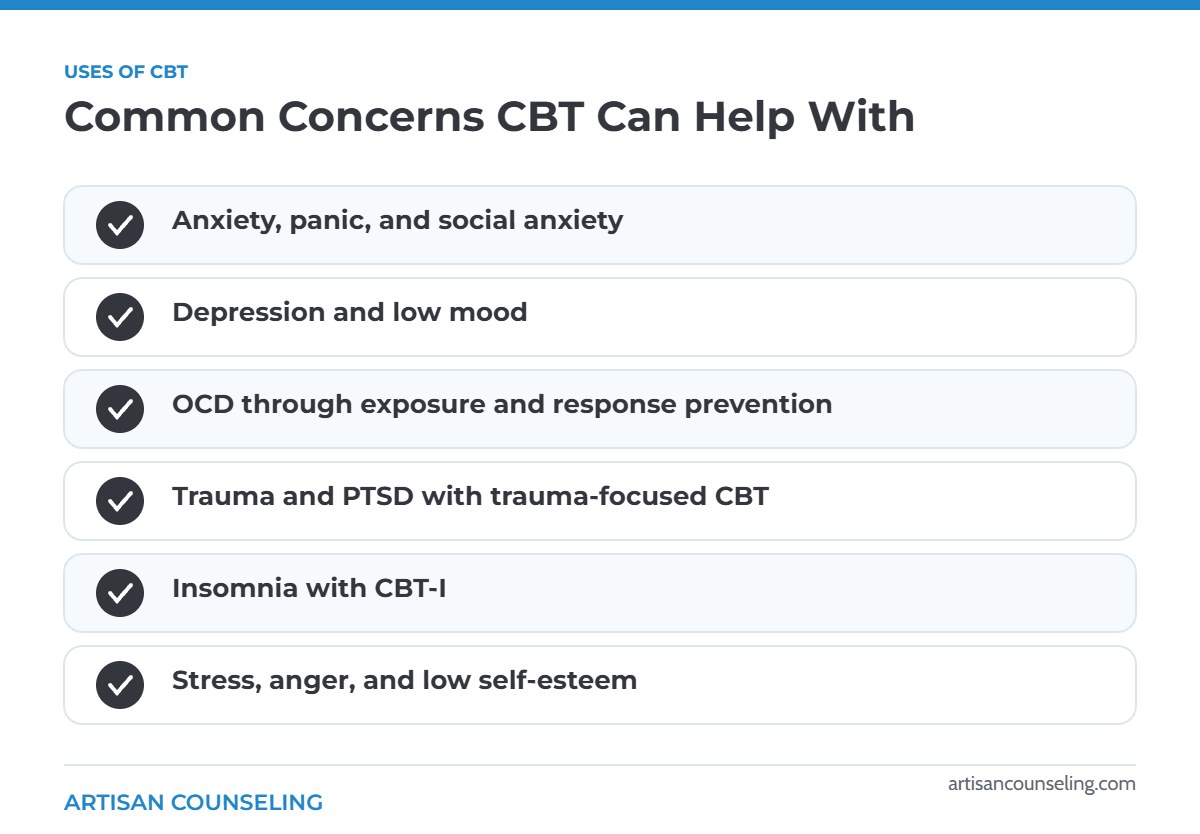
CBT has a strong research base and is recommended in many clinical guidelines. It is commonly used for:
- Anxiety disorders, including generalized anxiety, panic, and social anxiety
- Depression and persistent low mood
- Obsessive-compulsive disorder (often through exposure and response prevention)
- Trauma and PTSD (through trauma-focused forms of CBT)
- Insomnia (CBT-I is a specialized version)
- Stress, anger, low self-esteem, and relationship patterns
If depression is your main concern, our article on whether CBT can help with depression goes deeper.
Is CBT Right for You?
CBT tends to be a good fit if you want practical tools, like structure, and are willing to practice skills between sessions. It is often time-limited, and many people notice changes within a few months, though the pace depends on your goals and circumstances.
Questions to Ask Yourself
- Do I want concrete strategies I can use right away?
- Am I willing to try exercises or small experiments between sessions?
- Is there a specific problem, such as worry, panic, or low mood, that I want to target?
- Do I like having clear goals and tracking my progress?
If you answered yes to most of these, CBT may be a strong starting point.
CBT may be less ideal on its own if you primarily want open-ended space to explore your history, or if intense emotions make structured exercises hard to use at first. In those cases, a counselor may blend CBT with other approaches. You can compare options in CBT vs. talk therapy.
What CBT Looks Like at Artisan Counseling
When you start CBT with one of our counselors, the first sessions focus on getting to know you, understanding what brings you in, and setting goals that matter to you. From there, your counselor will introduce skills one at a time and help you practice them with real situations from your week. If other concerns come up, such as trauma or relationship stress, your counselor may blend CBT with other approaches so your care fits the whole picture, not just one symptom.
Frequently Asked Questions
How long does CBT usually take?
Many courses of CBT last somewhere between a few months and several months of weekly sessions, but there is no fixed timeline. Your counselor will review progress with you regularly and adjust the plan based on your goals.
Is CBT just positive thinking?
No. CBT is about accurate, balanced thinking rather than forced positivity. You learn to weigh evidence for and against a thought and arrive at a more realistic view.
Do I have to do homework in CBT?
Practice between sessions is a core part of CBT because skills grow with repetition. Assignments are planned together and should feel manageable, not like schoolwork.
Will I keep using CBT skills after therapy ends?
That is one of the main goals. CBT is designed to teach skills you can continue using on your own, so you become better able to manage future challenges. Many people find it helpful to review their notes or worksheets when stress returns.
Can CBT be done through telehealth?
Yes. CBT adapts well to secure video sessions, and many people find it just as convenient and effective as meeting in person.
Starting CBT at Artisan Counseling
If you are ready to learn practical skills for anxiety, low mood, or stress, our counselors offer cognitive behavioral therapy tailored to your goals. You can meet our counselors to find someone who feels like a good fit.
We see clients in person at our Newport News office and our Suffolk office, and through telehealth across Virginia. When you are ready, reach out to schedule a first appointment.