

Key Takeaways
- Start by naming what you want help with, since that points you toward the right specialty and approach.
- Check that the counselor is licensed in your state, such as an LPC, LCSW, LMFT, or psychologist.
- Logistics matter: location, telehealth, schedule, insurance, and cost all affect whether you can stay consistent.
- The relationship with your therapist is one of the strongest predictors of a good outcome, so fit matters.
- It is normal and okay to switch therapists if the fit is not right after a few sessions.
Deciding to start counseling is a big step. Then comes the next question: who should you actually see? With so many license types, specialties, and therapy styles, the search can feel overwhelming before you even book a first session.
The good news is that you do not need to find a perfect match on the first try. In this guide, you will learn how to clarify what you want from counseling, how to read credentials and specialties, which practical details to check, what to notice in the first session, and when it makes sense to switch.
What Do You Want From Counseling?
Before you look at profiles, take a few minutes to think about why you want support right now. Your answer helps narrow the field quickly.
Questions to Ask Yourself
- What is the main concern: anxiety, depression, trauma, grief, relationships, parenting, or a life transition?
- Do you want to work on this alone, with a partner, or with your family?
- Do you prefer practical, skills-based tools, or more space to talk and explore?
- Are there identity factors, such as culture, faith, gender, or sexuality, that you want your therapist to understand well?
If you are not sure counseling is right for you yet, our article on how to know if you need individual counseling can help.
How Do You Check a Therapist’s Credentials and Specialties?
A licensed professional has completed graduate training, supervised clinical hours, and a state licensing exam. In Virginia, licenses are issued and verified through the state’s health professions licensing boards, so you can confirm that a license is active.
Common License Types
- LPC (Licensed Professional Counselor): master’s-level counselor trained to diagnose and treat mental health concerns.
- LCSW (Licensed Clinical Social Worker): master’s-level clinician with training in therapy and in the social factors that affect wellbeing.
- LMFT (Licensed Marriage and Family Therapist): clinician focused on couples and family relationships.
- Psychologist (PhD or PsyD): doctoral-level clinician who provides therapy and psychological testing.
- Residents: counselors who have finished their degree and are working toward full licensure under the supervision of a licensed clinician.
Psychiatrists and psychiatric nurse practitioners can prescribe medication. Most counseling practices focus on therapy and can coordinate with a prescriber if medication is part of your care.
Areas of Focus and Therapy Approaches
Look for experience with your specific concern. Then look at the methods the therapist uses. For example, cognitive behavioral therapy (CBT) is structured and skills-based, while EMDR therapy is designed for processing traumatic memories. Other approaches include DBT, IFS, art therapy, and the Gottman Method for couples.
Not sure which approach fits? Our comparison of DBT vs. CBT is a helpful place to start.
What Practical Details Should You Consider?
Even a great therapist will not help much if you cannot get to sessions consistently. Before you book, check these practical factors.
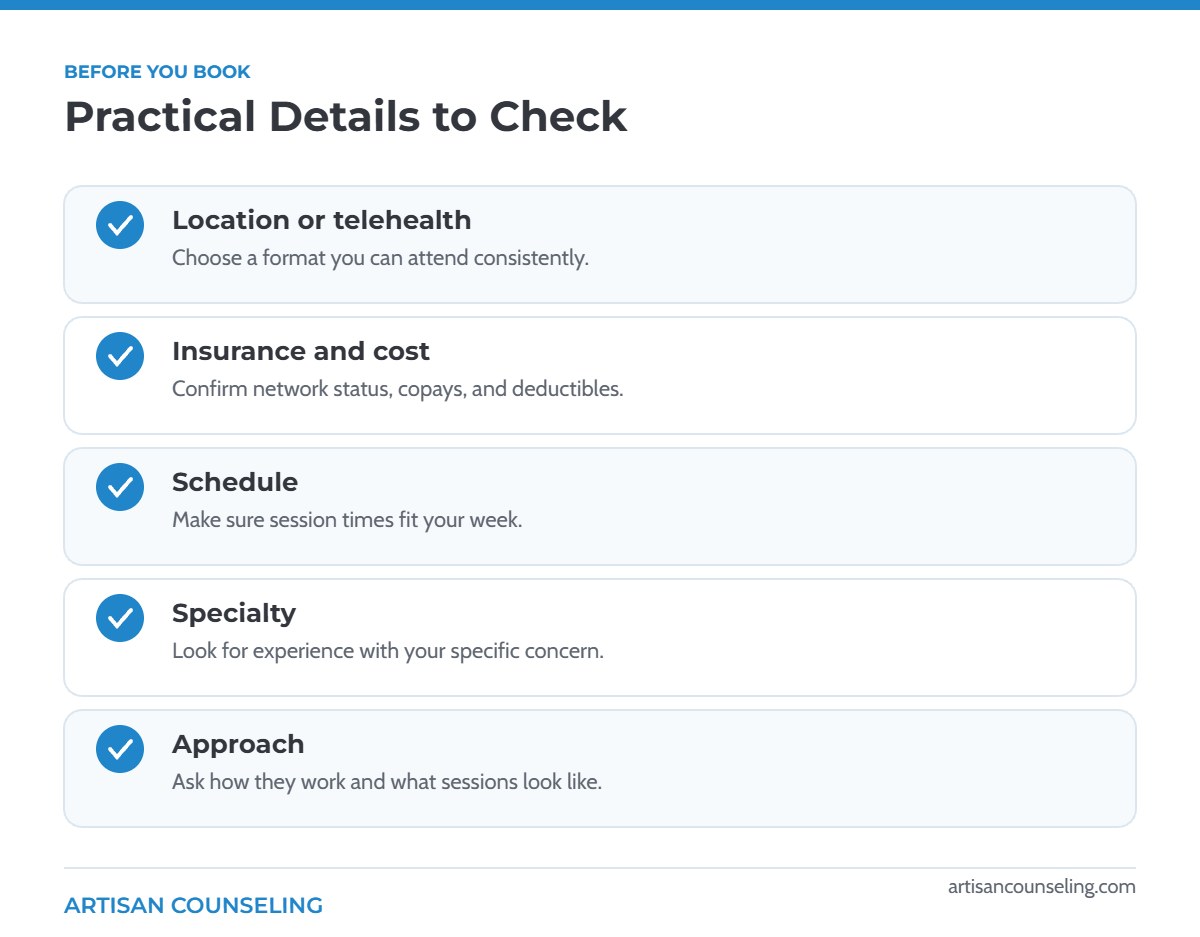
Location and Telehealth
Some people like the structure of an in-person office. Others prefer the convenience of video sessions from home. Many practices offer both. If you are weighing options, read our guide to in-person vs. telehealth counseling.
Insurance and Cost
Ask whether the therapist is in network with your plan, what your copay or deductible looks like, and whether they offer superbills for out-of-network reimbursement. Knowing costs up front prevents surprises later.
Scheduling and Availability
Ask about session times, how often you would meet, and how far out appointments are booked. Weekly sessions are common at first, so make sure the schedule is realistic for you.
Questions to Ask a Potential Therapist
Many therapists offer a brief phone consultation. Use it to ask a few direct questions:
- Have you worked with people dealing with concerns like mine?
- What approach do you usually use, and what does a typical session look like?
- How will we set goals and measure progress?
- What is your cancellation policy, and how do you handle contact between sessions?
Tip: Pay attention to how the therapist answers, not just what they say. Do they listen, explain clearly, and welcome your questions? That is a preview of what working together will feel like.
Why Does the First Session Matter?
The first session is partly for the therapist to understand you and partly for you to get a sense of them. Research on psychotherapy consistently shows that the therapeutic relationship, often called the therapeutic alliance, is one of the strongest predictors of how well therapy works.
Notice whether you feel respected, whether the therapist seems curious about your experience, and whether you leave with at least a small sense of hope or direction. You can learn more in our article on what happens in your first counseling session.
How Do You Know the Fit Is Right?
It is normal to feel a bit awkward at first. Trust tends to build over a few sessions. After three or four meetings, check in with yourself.
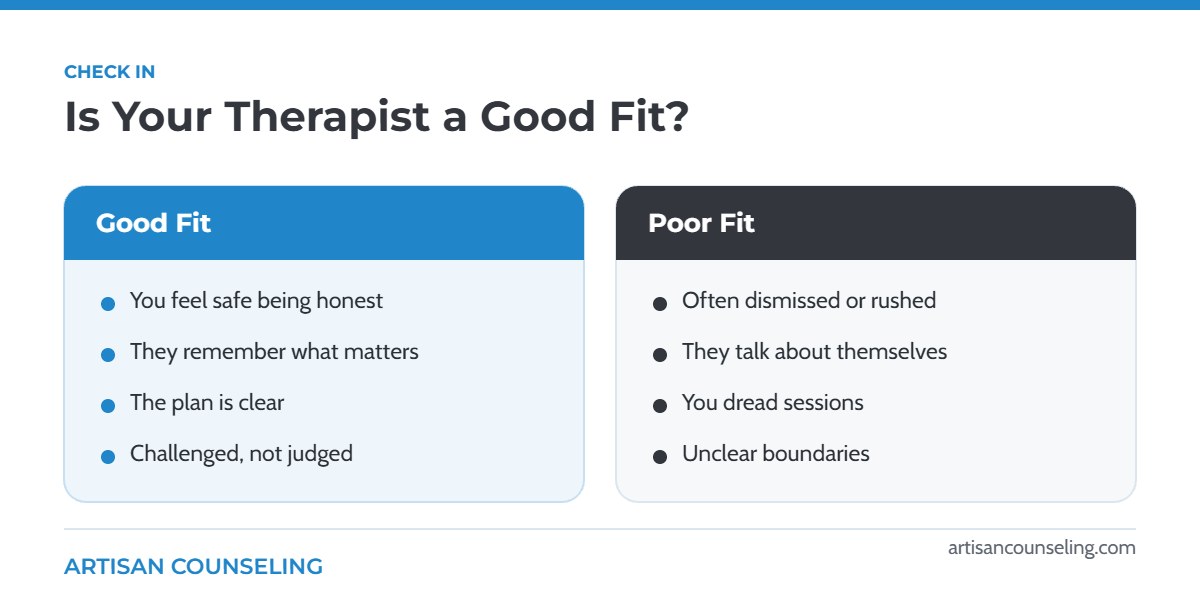
Signs of a Good Fit
- You feel safe being honest, even about hard things.
- Your therapist remembers important details and connects them.
- You understand the plan and how it relates to your goals.
- You feel challenged at times, but not judged.
Signs It May Not Be the Right Match
- You often feel dismissed, rushed, or misunderstood.
- The therapist talks about themselves more than about you.
- You dread sessions for reasons unrelated to the difficult topics themselves.
- Boundaries feel unclear or unprofessional.
When Is It Okay to Switch Therapists?
Any time. Switching does not mean you failed or that therapy will not work for you. Good therapists want you to get the right care and will not take it personally.
If you feel comfortable, mention your concerns in session first. Sometimes an honest conversation improves the fit. If it does not, ask for a referral, or reach out to another counselor in the same practice so your records can transfer more easily.
Frequently Asked Questions
How many sessions should I give a new therapist?
Many people give it three or four sessions before deciding. That is usually enough time to get past first-session nerves and see whether you feel understood and are making some progress.
Does it matter whether my therapist is an LPC or an LCSW?
Both are licensed to provide counseling, and both can be excellent. Experience with your concern, the approach they use, and how comfortable you feel usually matter more than the specific license.
Can I request a therapist with a specific background?
Yes. It is reasonable to ask for a therapist who shares or understands parts of your identity, or who has a certain specialty. A practice intake team can help match you.
Is online therapy as effective as in-person therapy?
For many common concerns, research suggests video counseling can be similarly effective to in-person sessions. The best format is the one you can attend consistently and feel comfortable in.
Finding Your Counselor at Artisan Counseling
Our team includes licensed counselors and supervised residents with a wide range of specialties. You can browse our counselor profiles to learn about each person’s focus and style, or let our intake team help match you.
We offer individual counseling and more in Newport News and Suffolk and by telehealth across Virginia. Contact us with any questions about fit, insurance, or availability.