

Key Takeaways
- Cognitive behavioral therapy (CBT) is one of the most widely studied and recommended talk therapies for depression.
- CBT helps you notice and change unhelpful thought patterns and re-engage with activities that support your mood.
- Sessions are structured and collaborative, and they often include practice between sessions.
- CBT is not the only option. Some people do best when it is combined with other therapies or medication managed by a medical provider.
Depression can make everything feel heavier. Getting out of bed takes effort, things you used to enjoy feel flat, and your mind may keep repeating harsh messages about yourself and your future.
If you are looking for help, you have probably come across cognitive behavioral therapy, or CBT. It is one of the most commonly recommended approaches for depression, and for good reason. It is practical, focused, and backed by a large body of research.
In this article, you will learn what CBT actually involves, why it can help with depression, the main techniques counselors use, what sessions feel like, how long it usually takes, and when you might need more than CBT alone.
What Is Cognitive Behavioral Therapy?
CBT is a form of talk therapy built on a simple idea: our thoughts, feelings, and behaviors are connected. When one changes, the others tend to shift too.
With depression, this connection often becomes a downward cycle. You feel low, so you think “nothing will help,” so you withdraw, which makes you feel even lower. CBT helps you find places to interrupt that cycle.
Unlike some therapies that focus mostly on the past, CBT is mainly present-focused and goal-oriented. Your counselor works with you as a team to identify specific problems and practical ways to address them.
Why Does CBT Work for Depression?
CBT targets two of the main forces that keep depression going: negative thinking patterns and withdrawal from life. By working on both, it helps reverse the cycle.
Catching Unhelpful Thought Patterns
Depression tends to filter how you see things. Common patterns include:
- All-or-nothing thinking: “If it is not perfect, I failed.”
- Overgeneralizing: “This always happens to me.”
- Discounting the positive: “That compliment does not count.”
- Mind reading: “They think I am a burden.”
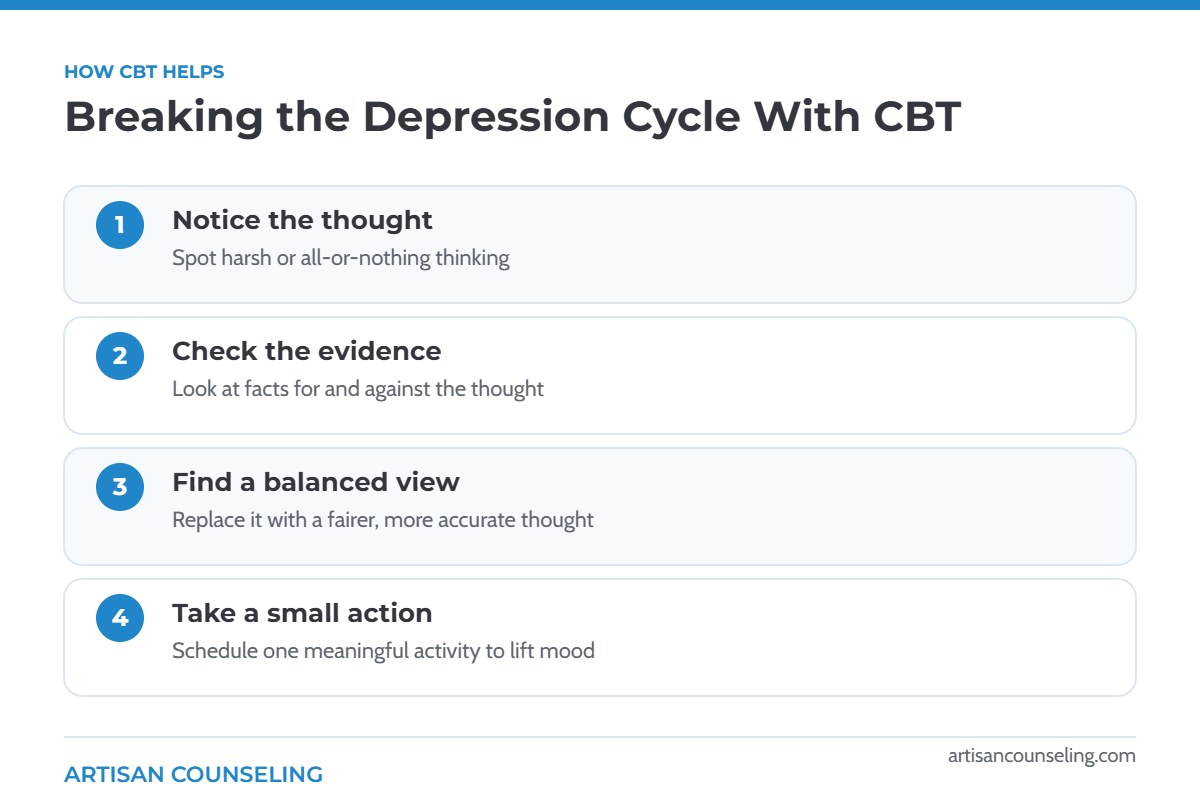
In CBT, you learn to notice these thoughts, look at the evidence for and against them, and develop more balanced alternatives. This is not about forced positivity. It is about seeing your situation more accurately. Our article on why negative thoughts keep repeating explains why these loops are so sticky.
Behavioral Activation
When you are depressed, you naturally do less. Unfortunately, doing less often means fewer chances to feel pleasure or accomplishment, which deepens low mood.
Behavioral activation means gradually scheduling small, meaningful activities, even when you do not feel like it. A short walk, a call with a friend, or finishing one small task can begin to lift mood over time. In CBT, action often comes before motivation, not the other way around.
What Does a CBT Session Feel Like?
CBT sessions are usually structured but still warm and personal. A typical session might include:
- Checking in on your mood and the past week
- Setting a focus or agenda for the session together
- Reviewing any practice you tried since last time
- Learning or practicing a skill, such as a thought record
- Planning a small, realistic step to try before your next session
Between-session practice is a key part of CBT. It helps skills carry over into daily life. Your counselor will tailor it to your energy level, because depression can make even small tasks feel hard. To see more of these tools, read about CBT techniques counselors commonly use.
Try this: Next time you notice a harsh thought, write it down and ask, “What would I say to a friend who thought this?” Then write that kinder, more balanced response next to it.
How Long Does CBT for Depression Take?
CBT is often considered a shorter-term therapy. Many people attend weekly sessions for roughly 12 to 20 weeks, though this varies widely. Some notice changes within the first several weeks, while others need more time, especially if depression has been present for a long while or other concerns are involved.
Progress is rarely a straight line. You might have good weeks and harder weeks. What matters is the overall direction and the skills you build along the way, which many people continue to use long after therapy ends.
When Might CBT Not Be Enough on Its Own?
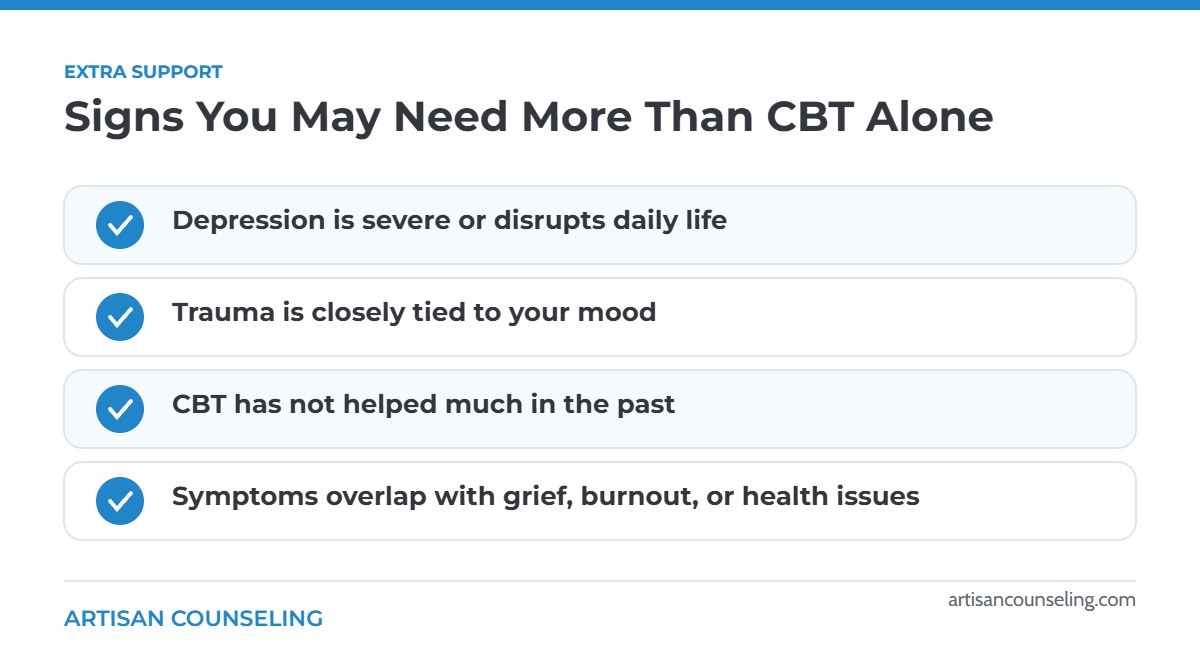
CBT helps many people, but it is not the right fit for everyone or every situation. You may benefit from additional or different support if:
- Your depression is severe or makes daily functioning very difficult
- Trauma is closely tied to how you feel
- You have tried CBT before without much change
- Symptoms overlap with something else, such as burnout, grief, or a medical condition
In these cases, a counselor might combine CBT with other approaches or suggest talking with a doctor or psychiatric provider about medication. Depression and exhaustion can also look alike, so you may find our article on burnout vs. depression helpful.
If you are in crisis: if you are having thoughts of suicide or self-harm, call or text 988 to reach the 988 Suicide & Crisis Lifeline, available 24/7, or call 911 in an emergency.
Frequently Asked Questions
Is CBT effective for depression?
CBT is one of the most researched therapies for depression and is widely recommended by professional organizations. Results vary by person, so it helps to work with a counselor to adjust the approach to your needs.
Can CBT be used together with antidepressants?
Yes. Many people use CBT along with medication prescribed by a medical provider. Your counselor and prescriber can coordinate care if you choose.
Can I do CBT for depression online?
Yes. CBT adapts well to telehealth because it focuses on conversation, skills, and practice that can be done anywhere.
What if I do not have the energy for homework?
That is very common with depression. A good CBT counselor starts with very small steps and adjusts assignments to what feels possible for you right now.
Getting Help for Depression at Artisan Counseling
If depression is weighing on you, you do not have to work through it alone. Our counselors offer cognitive behavioral therapy as part of individual counseling tailored to your goals.
You can meet our counselors, visit our Newport News office or our Suffolk location, or meet by telehealth. Contact us to schedule a first appointment.