Key Takeaways
- In everyday use, “marriage counseling” and “couples therapy” mean nearly the same thing, and many counselors use the terms interchangeably.
- Marriage counseling often refers to shorter-term, goal-focused work on current problems in a marriage.
- Couples therapy is a broader term that includes dating, engaged, and unmarried partners and may explore deeper patterns.
- The counselor’s training, approach, and fit with both partners matter more than the label.
If you are looking for help with your relationship, you have probably seen both terms: marriage counseling and couples therapy. It is natural to wonder whether they are different services, and which one you need.
If this is affecting your relationship, couples counseling at our Newport News and Suffolk offices can help you and your partner work through it together.
The short answer is that the overlap is large. In this article, you will learn where the two terms come from, the subtle differences people usually mean, what both have in common, when individual counseling fits alongside couples work, and how to choose the right support for your relationship.
Is There a Difference Between Marriage Counseling and Couples Therapy?
In practice, most licensed counselors use the terms interchangeably. There is no separate license for “marriage counseling” versus “couples therapy,” and the same professional may offer both under either name.
When people do draw a distinction, it usually comes down to who the service is for and how deep the work goes.
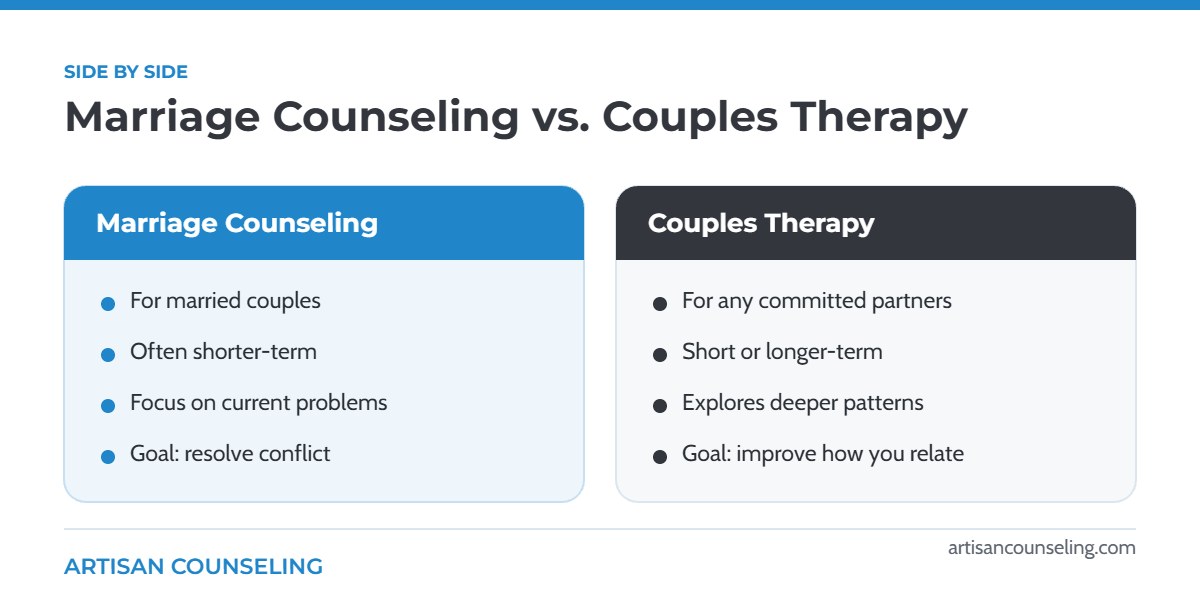
| Marriage Counseling | Couples Therapy | |
|---|---|---|
| Who it serves | Married couples | Any committed partners, married or not |
| Typical focus | Specific current problems | Current problems plus underlying patterns |
| Typical length | Often shorter-term | Short or longer-term |
| Goal | Resolve conflict and strengthen the marriage | Understand and improve how partners relate |
Where the Terms Come From
“Marriage counseling” is the older, more familiar phrase. It grew out of a time when most committed relationships that sought help were marriages, and the professional field is still often called marriage and family therapy.
“Couples therapy” became more common as more people sought help while dating, living together, engaged, or in long-term partnerships without marriage. It is a more inclusive term that applies to all couples, including LGBTQ+ partners.
You may also see related terms like “relationship counseling” or “premarital counseling.” Premarital counseling is a specific, usually short-term form of couples work for partners preparing to marry. It often covers expectations about money, family, children, roles, and how you handle conflict, so you can talk through differences before they become recurring problems.
Some counselors still prefer one label over the other for their own reasons, and some practices use both on their websites so people can find them. Either way, the label tells you very little about how sessions will actually go.
When Marriage Counseling Makes Sense
The term marriage counseling often fits when you want focused, practical help with a specific issue in your marriage, such as:
- Frequent arguments about money, chores, or parenting.
- Adjusting to a new baby, a move, retirement, or a blended family.
- Making a major decision together.
- Recovering closeness after a stressful season.
Sessions tend to center on communication skills, problem-solving, and agreeing on next steps. Read how counseling improves communication for examples of the skills you might learn.
When Couples Therapy Makes More Sense
Couples therapy may be a better description when you are not married, or when the issues feel deeper or longer-standing, such as:
- The same conflict cycle repeating for years.
- Trust broken by infidelity or secrecy.
- One or both partners carrying trauma that affects closeness. Our article on how childhood trauma affects adult relationships explains this connection.
- Emotional distance, low intimacy, or feeling like roommates.
- Deciding whether to commit further, such as moving in together or getting married.
What Happens in a Typical Couples Session?
Knowing what to expect can make the first appointment feel less intimidating. While every counselor works a little differently, many follow a similar arc.
The First Few Sessions
Early sessions usually focus on getting to know both of you and your story as a couple. Your counselor may ask how you met, what has been going well, what brought you in now, and what each of you hopes will change. Some counselors also meet with each partner individually once to hear each perspective.
The Middle Phase
Once goals are clear, sessions shift to practice. For example, a couple who keeps fighting about money might discuss a recent argument while the counselor slows it down, helps each partner name what they felt, and coaches them to respond in a new way. You may leave with something to try at home, such as a weekly check-in or a new way to start hard conversations.
Wrapping Up
As things improve, sessions may become less frequent. The goal is for you to use your new skills without the counselor in the room. Some couples return for a few “tune-up” sessions during stressful seasons.
To learn more about how long this usually takes, see how long counseling takes.
What Both Approaches Have in Common
Whatever it is called, good relationship counseling shares the same core elements:
- A neutral counselor who supports the relationship rather than taking sides.
- Evidence-informed methods, such as the Gottman Method or Emotionally Focused Therapy.
- Focus on patterns, not on deciding who is right.
- Practical skills for communication, conflict, and repair.
- Attention to connection, including friendship, appreciation, and intimacy.
Tip: When you contact a practice, ask what approach the counselor uses with couples and how they handle situations where partners want different things. Their answer will tell you more than the service name.
What If Only One Partner Wants to Go?
It is common for one partner to be more eager than the other. The hesitant partner may worry about being blamed, feel embarrassed, or think the problems are not serious enough. A few approaches can help:
- Share what you hope for, not what is wrong with them: “I want us to feel closer, and I think help could make that easier.”
- Suggest trying a set number of sessions, such as three, before deciding.
- Invite your partner to help choose the counselor.
- Ask whether telehealth would feel more comfortable than an office.
If your partner still says no, you can begin on your own. Changes in how one person responds often shift the whole pattern.
Individual Counseling Alongside Couples Work
Sometimes one or both partners benefit from individual sessions in addition to couples work. This can help when someone is dealing with anxiety, depression, grief, or past trauma that spills into the relationship.
Individual counseling can also be the right starting point if your partner is not ready to attend. Many counselors recommend that the same therapist not provide both individual and couples therapy to the same person, to keep things balanced, so you may see different counselors for each. Learn more about individual counseling.
How to Choose the Right Support
Instead of worrying about the label, focus on these questions:
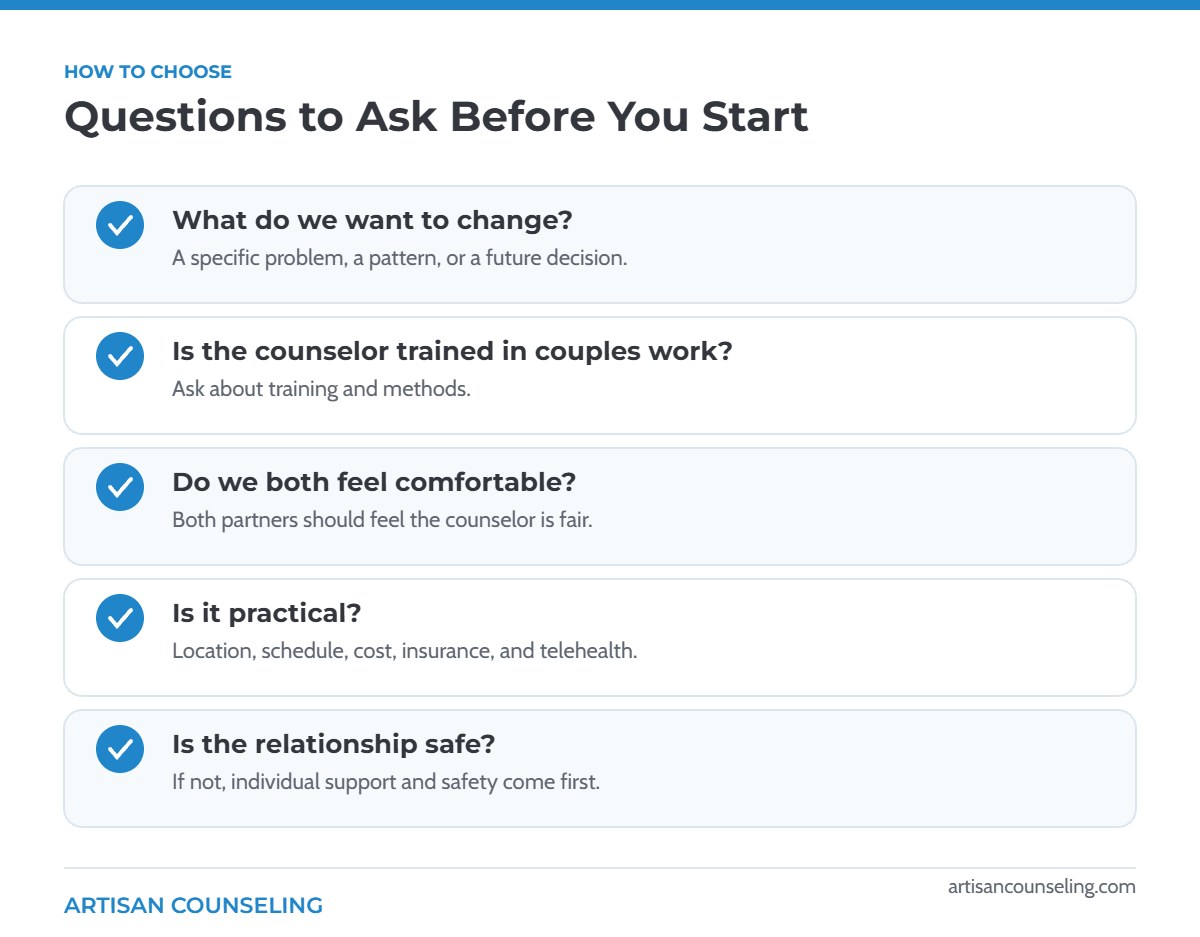
- What do we want to change? A specific problem, a long-standing pattern, or a decision about the future?
- Is the counselor trained in couples work? Ask about their training and methods.
- Do both of us feel comfortable? Both partners should feel the counselor is fair.
- Is it practical? Consider location, scheduling, cost, insurance, and whether telehealth works for you.
- Is the relationship safe? If there is violence or coercive control, individual support and safety planning come first.
Questions to Ask Before Your First Session
A short phone call can answer a lot. You might ask:
- “How much of your practice is couples work?”
- “What approach do you use, and what does a typical session look like?”
- “How do you stay balanced if we see things very differently?”
- “Do you offer telehealth for couples?”
- “Is couples counseling covered by our insurance, or what are the self-pay options?”
Notice how you both feel after the call. A good fit usually feels respectful, clear, and hopeful, even if the topics ahead are hard.
If you are still deciding whether it is time to seek help at all, see when couples should seek counseling.
Frequently Asked Questions
Do you have to be married to go to marriage counseling?
No. Most counselors welcome any committed couple, whether married, engaged, dating, or living together. Many practices simply call this service couples counseling.
Does insurance cover marriage or couples counseling?
Coverage varies by plan. Some insurance plans do not cover couples counseling unless it is connected to a diagnosed condition. Check with your insurer and the practice before your first session.
Can marriage counseling be done online?
Yes. Many couples attend sessions by telehealth, which can make scheduling easier. You can join from the same room or, in some cases, from separate locations.
How do we know if couples counseling is working?
Signs of progress include arguments that cool down faster, more repair after conflict, and feeling more understood. Change is rarely a straight line, so talk with your counselor if you feel stuck. They can adjust the focus or approach.
Relationship Counseling at Artisan Counseling
Whether you call it marriage counseling or couples therapy, our counselors can help you understand each other and build a stronger connection. Explore our couples counseling services, meet our counselors, or review insurance and payment information before you reach out.