

Key Takeaways
- Dialectical behavior therapy (DBT) is a skills-based therapy that balances acceptance with change.
- DBT teaches four skill areas: mindfulness, distress tolerance, emotion regulation, and interpersonal effectiveness.
- It was developed by psychologist Marsha Linehan, originally for chronic suicidal behavior and borderline personality disorder, and is now used much more widely.
- Comprehensive DBT combines individual therapy, skills training, between-session coaching, and a consultation team; many counselors also offer DBT-informed care.
Some emotions do not just show up. They flood in, take over, and leave you acting in ways you later regret. If you often feel that your feelings are bigger than your ability to manage them, you are not alone, and you are not broken.
Dialectical behavior therapy was designed for exactly this experience. It combines practical skills for handling intense emotions with a deep respect for where you are right now.
In this article, you will learn what “dialectical” means, where DBT came from, the four core skill areas, how DBT is structured, who it helps, and how it compares with CBT.
What Does “Dialectical” Mean in DBT?
A dialectic is the idea that two things that seem opposite can both be true. In DBT, the central dialectic is acceptance and change: you are doing the best you can, and you can also learn to do things differently.
This balance matters. Many people with intense emotions have felt judged or pushed to “just calm down.” DBT validates your experience while still helping you build new skills. You also learn to move away from all-or-nothing thinking toward a more flexible “both/and” view.
Where Did DBT Come From?
DBT was developed by psychologist Marsha Linehan in the late 1980s and early 1990s. She found that standard cognitive behavioral therapy, with its strong focus on change, could feel invalidating to people in intense emotional pain. Adding acceptance strategies, many drawn from mindfulness practice, made treatment more effective and easier to stay in.
DBT was first studied with people experiencing chronic suicidal behavior and borderline personality disorder. Since then, it has been adapted for many other concerns. You can read more in is DBT only for borderline personality disorder?.
What Are the Four Core DBT Skills?
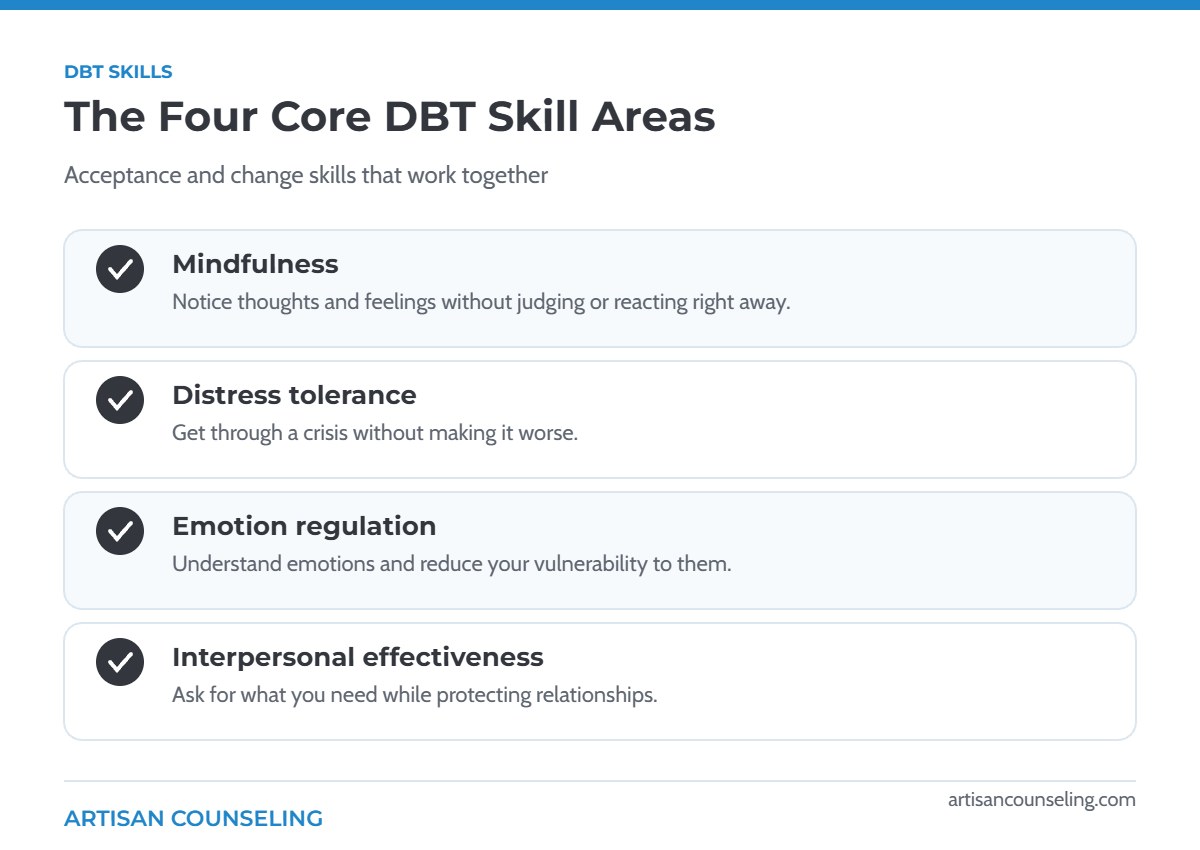
DBT skills are grouped into four modules. Together, they help you stay present, survive hard moments, understand your emotions, and protect your relationships.
1. Mindfulness
Mindfulness is the foundation of DBT. You learn to notice thoughts, feelings, and sensations without judging them or acting on them right away. DBT describes “wise mind,” the balance between emotional mind and reasonable mind.
2. Distress Tolerance
These skills help you get through a crisis without making it worse. Examples include TIPP skills (such as cold water or intense exercise to quickly lower arousal), distraction strategies, self-soothing, and radical acceptance of situations you cannot change right now.
3. Emotion Regulation
Emotion regulation skills help you name emotions, understand what triggers them, reduce vulnerability (through sleep, eating, and exercise habits), and use “opposite action” when an urge does not fit the facts.
4. Interpersonal Effectiveness
These skills help you ask for what you need, say no, and handle conflict while keeping relationships and self-respect intact. DBT uses memorable acronyms such as DEAR MAN, GIVE, and FAST.
For practical examples of each, see DBT skills explained.
Try this: When you notice a strong urge, pause and name it: “I am feeling angry, and I have the urge to send that text.” Naming the emotion and the urge creates a small gap where you can choose your next step.
How Is DBT Structured?
Comprehensive DBT, the version studied most in research, typically includes four parts:
- Individual therapy to work on personal goals and apply skills to your life.
- Skills training, often in a group, to learn and practice the four modules.
- Between-session coaching to help you use skills in real moments.
- A consultation team that supports therapists in delivering DBT effectively.
Many counselors also offer DBT-informed therapy, which uses DBT skills and principles within individual sessions without every component of the full program. Ask any counselor which format they provide so you know what to expect.
Who Can Benefit From DBT?
DBT can be helpful if you:
- Experience intense emotions that feel hard to control
- Act impulsively when upset and regret it later
- Struggle with self-harm urges or chronic thoughts of suicide
- Have stormy or unstable relationships
- Cope through substance use, bingeing, or other harmful behaviors
- Feel empty, numb, or unsure of who you are
It has been adapted for teens, eating disorders, substance use, and trauma-related difficulties. Our article on who benefits from DBT explores this further. If emotions feel overwhelming in general, what emotional regulation really means is a helpful companion read.
If you are in crisis: call or text 988 to reach the 988 Suicide & Crisis Lifeline, available 24/7, or call 911 in an emergency.
How Is DBT Different From CBT?
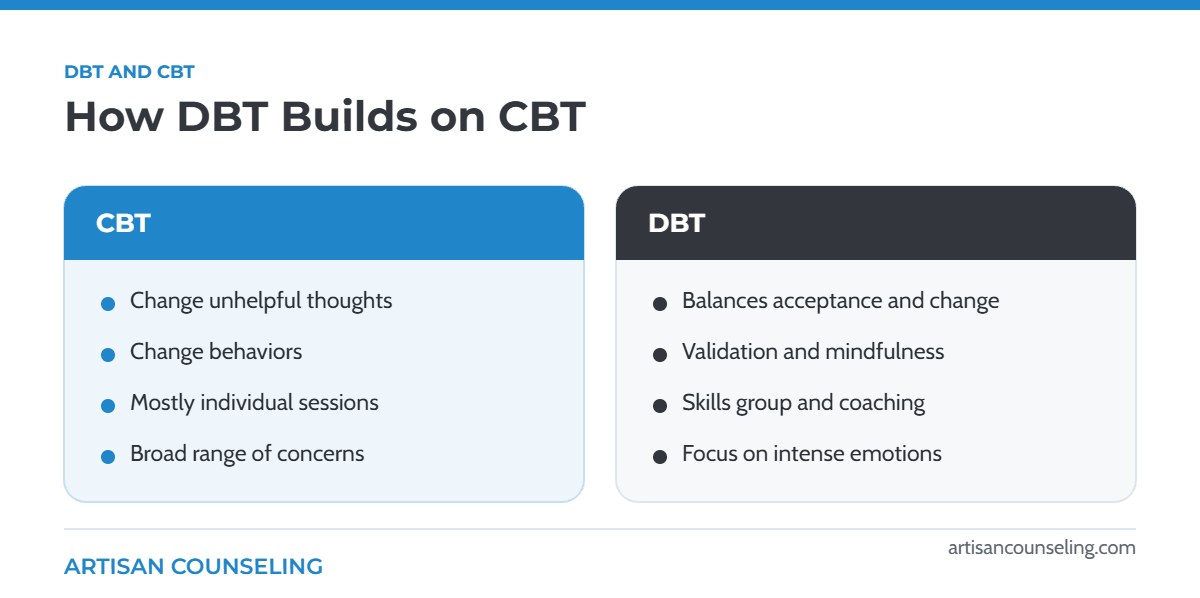
DBT grew out of CBT, so they share a focus on practical skills and changing behavior. The main differences are emphasis:
- CBT focuses mainly on identifying and changing unhelpful thoughts and behaviors.
- DBT adds acceptance, validation, and mindfulness alongside change.
- DBT places more emphasis on managing intense emotions and crises.
- Comprehensive DBT often includes group skills training and coaching.
For a deeper comparison, read DBT vs. CBT: key differences.
Frequently Asked Questions
How long does DBT take?
Comprehensive DBT programs often run for about six months to a year, since each skills module takes time to learn and practice. DBT-informed individual therapy can be shorter or longer depending on your goals.
Is DBT only for borderline personality disorder?
No. DBT was first developed for borderline personality disorder and chronic suicidality, but it is now used for many concerns involving intense emotions, impulsive behavior, and relationship difficulties.
Can I learn DBT skills on my own?
Workbooks can introduce the skills, but most people find it much easier to learn and apply them with guidance from a trained counselor, especially during hard moments.
Is DBT available through telehealth?
Yes. DBT skills and individual DBT-informed therapy can be delivered effectively over secure video.
Exploring DBT at Artisan Counseling
If intense emotions are affecting your relationships, work, or sense of self, our counselors offer dialectical behavior therapy skills and support. Meet our counselors to find someone with DBT experience.
We see clients in Newport News and Suffolk, and through telehealth across Virginia. Reach out to our team with any questions about getting started.