
Key Takeaways
- CBT is a type of talk therapy, but it is more structured, skills-based, and focused on present-day patterns than many other approaches.
- Broader talk therapy, such as person-centered or psychodynamic work, offers more open-ended space to explore feelings, history, and meaning.
- Both approaches rely on a strong relationship with your counselor, which is one of the best predictors of progress.
- Many counselors blend methods, and you can shift approaches as your needs change.
When you start looking for a counselor, you will quickly run into terms like CBT, talk therapy, and integrative therapy. It can be hard to tell what is different, and whether the difference matters for you.
The short answer is that CBT is one kind of talk therapy, with a particular structure and set of tools. Other forms of talk therapy work differently and can be a better match for certain goals.
In this article, you will learn what “talk therapy” really means, what makes CBT distinct, how the two feel different in session, when each tends to fit best, and how to decide where to start.
What Does “Talk Therapy” Actually Mean?
Talk therapy, also called psychotherapy, is an umbrella term for treatment where you and a trained counselor talk through what you are experiencing. It includes many approaches, such as:
- Person-centered therapy, which emphasizes empathy, acceptance, and following your lead
- Psychodynamic therapy, which explores how past experiences and unconscious patterns shape the present
- Narrative, solution-focused, and other approaches with their own emphasis
- Cognitive behavioral therapy and related methods such as DBT and ACT
When people contrast “CBT vs. talk therapy,” they usually mean CBT versus more open-ended, exploratory forms of counseling. That is the comparison this article uses.
What Makes CBT Different?
CBT is built on the idea that thoughts, feelings, and behaviors affect one another, and that changing unhelpful thoughts and actions can change how you feel. Several features set it apart:
- Structure: sessions often follow an agenda and work toward defined goals.
- Present focus: the emphasis is on what keeps a problem going now.
- Skills: you learn specific techniques, such as thought records or exposure.
- Practice: exercises between sessions are a normal part of the work.
- Measurement: progress is often tracked so the plan can be adjusted.
For a full overview, read what CBT therapy is and how it works.
How Do CBT and Talk Therapy Feel Different in Session?
The biggest difference is often the feel of the hour. In CBT, you might spend part of a session breaking down a stressful moment, identifying the thought behind it, and practicing a new response. You will likely leave with something to try during the week.
In broader talk therapy, a session may follow whatever feels most important that day. You might explore a memory, a relationship, or a feeling that keeps coming up, with your counselor helping you make sense of it rather than assigning a specific skill.
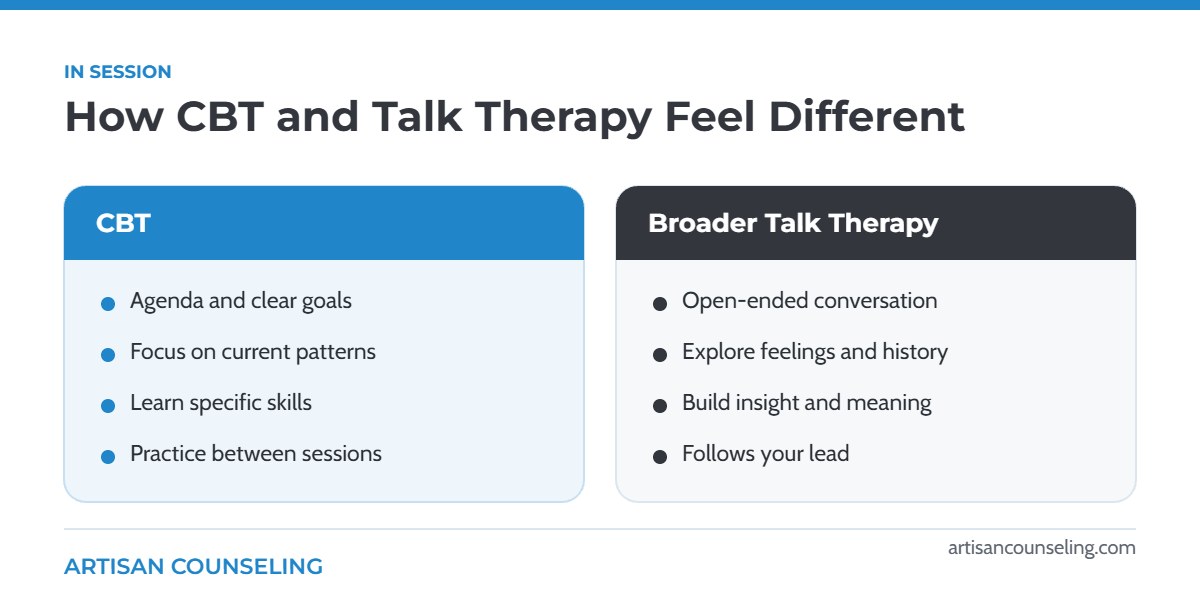
Neither style is better in general. They are different tools that suit different needs, and both depend on trust and collaboration with your counselor.
When Does CBT Tend to Be the Better Fit?
CBT is often a strong choice when:
- You want practical tools you can use right away.
- Your concern is specific, such as panic attacks, a phobia, insomnia, or persistent worry.
- You like structure and measurable goals.
- You are open to practicing skills between sessions.
- You prefer a time-limited approach.
CBT is widely recommended for anxiety and depression. You can see how it is applied in CBT for anxiety.
When Does Broader Talk Therapy Fit Better?
A more exploratory approach can be a better starting point when:
- You want to understand where long-standing patterns come from.
- You are working through grief, identity questions, or a major life transition.
- You need space to process feelings before learning skills.
- Your concerns are complex and involve relationships, history, and meaning.
- Structured exercises feel overwhelming right now.
If you are carrying the effects of early experiences, you may also find how childhood trauma can affect you decades later useful as you think about your options.
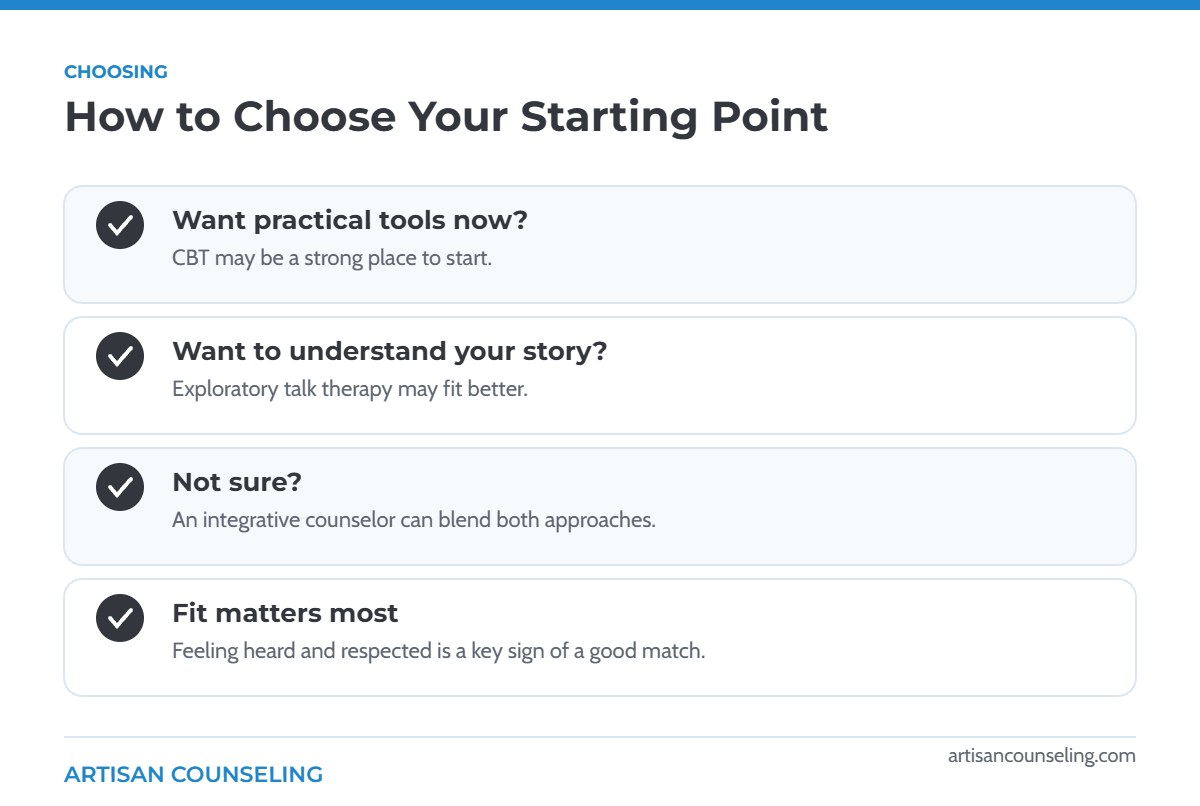
Good to know: Research consistently shows that the relationship between you and your counselor, often called the therapeutic alliance, matters a great deal across all approaches. Feeling heard and respected is a good sign you are in the right place.
Can You Combine CBT With Other Approaches?
Yes, and many counselors do. An integrative approach might use open-ended conversation to understand your story, then bring in CBT tools when you are ready to change specific patterns. Your plan can also shift over time.
The comparison below summarizes the main differences.
| Feature | CBT | Broader Talk Therapy |
|---|---|---|
| Session style | Structured, agenda-based | Open-ended, client-led |
| Main focus | Current thoughts and behaviors | Feelings, history, and meaning |
| Between sessions | Practice exercises are common | Reflection, usually less formal |
| Length | Often time-limited | Can be shorter or longer term |
| Often used for | Anxiety, depression, OCD, insomnia | Grief, life transitions, relationships, self-understanding |
Frequently Asked Questions
Is CBT considered talk therapy?
Yes. CBT is a form of talk therapy, but it is more structured and skills-focused than many other approaches. When people compare the two, they usually mean CBT versus open-ended counseling.
Which is more effective, CBT or talk therapy?
CBT has an especially large research base for anxiety and depression, but other forms of talk therapy are also effective for many concerns. The best choice depends on your goals, preferences, and the fit with your counselor.
Can I switch from CBT to another approach?
Yes. You can tell your counselor at any time if an approach is not working for you. Adjusting the plan is a normal part of counseling.
How do I know which approach my counselor uses?
Ask. Counselors are happy to explain how they work, what a typical session looks like, and why they recommend a particular approach for you.
Finding the Right Approach at Artisan Counseling
You do not need to know which method you want before reaching out. Our counselors offer CBT along with many other approaches, and we will help you find a fit during your first sessions.
Learn more about individual counseling, get to know our counselors, or contact us to get started. We offer sessions in Newport News, Suffolk, and through telehealth across Virginia.