Key Takeaways
- Early relationships shape the expectations, fears, and coping habits you bring into adult relationships.
- Common patterns include fear of abandonment, difficulty trusting, people-pleasing, and mistaking intensity for love.
- These patterns are learned survival strategies, not character flaws, and they can change.
- Self-awareness, nervous system regulation, and trauma-informed counseling all support healing.
The relationships you had as a child set up a template for the relationships you have as an adult. If your early caregivers were safe and consistent, closeness tends to feel workable. If home was chaotic, frightening, neglectful, or unpredictable, love can feel confusing or even dangerous, long after you have grown up and moved out.
Many adults do not connect their current relationship struggles with what happened when they were young. They only know they keep ending up in the same kind of conflict, shutting down when someone gets close, or feeling anxious whenever a partner seems distant.
In this article, you will learn what childhood trauma actually includes, the most common ways it shows up in adult relationships, why these patterns develop, and practical steps you can take to build healthier connections, with or without a counselor.
What Counts as Childhood Trauma?
Childhood trauma is not limited to dramatic, one-time events. It includes any experience that overwhelmed a child’s ability to cope and left them feeling unsafe, unseen, or alone. Some trauma involves something harmful that happened. Some involves something important that did not happen.
- Abuse: physical, emotional, or sexual abuse.
- Neglect: unmet physical needs or chronic emotional neglect, where feelings were ignored or dismissed.
- Household instability: a parent’s substance use, untreated mental illness, domestic violence, or incarceration.
- Loss and disruption: the death of a caregiver, a difficult divorce, frequent moves, or foster care.
- Chronic criticism or unpredictability: never knowing which version of a parent would show up.
Two siblings can grow up in the same home and be affected differently. What matters most is how the experience landed for you and whether you had a safe adult to help you make sense of it. If you want a deeper look at long-term effects, read our article on how childhood trauma can affect you decades later.
How Childhood Trauma Shows Up in Adult Relationships
Trauma rarely announces itself. It usually shows up as patterns that feel automatic. You may recognize yourself in several of these.
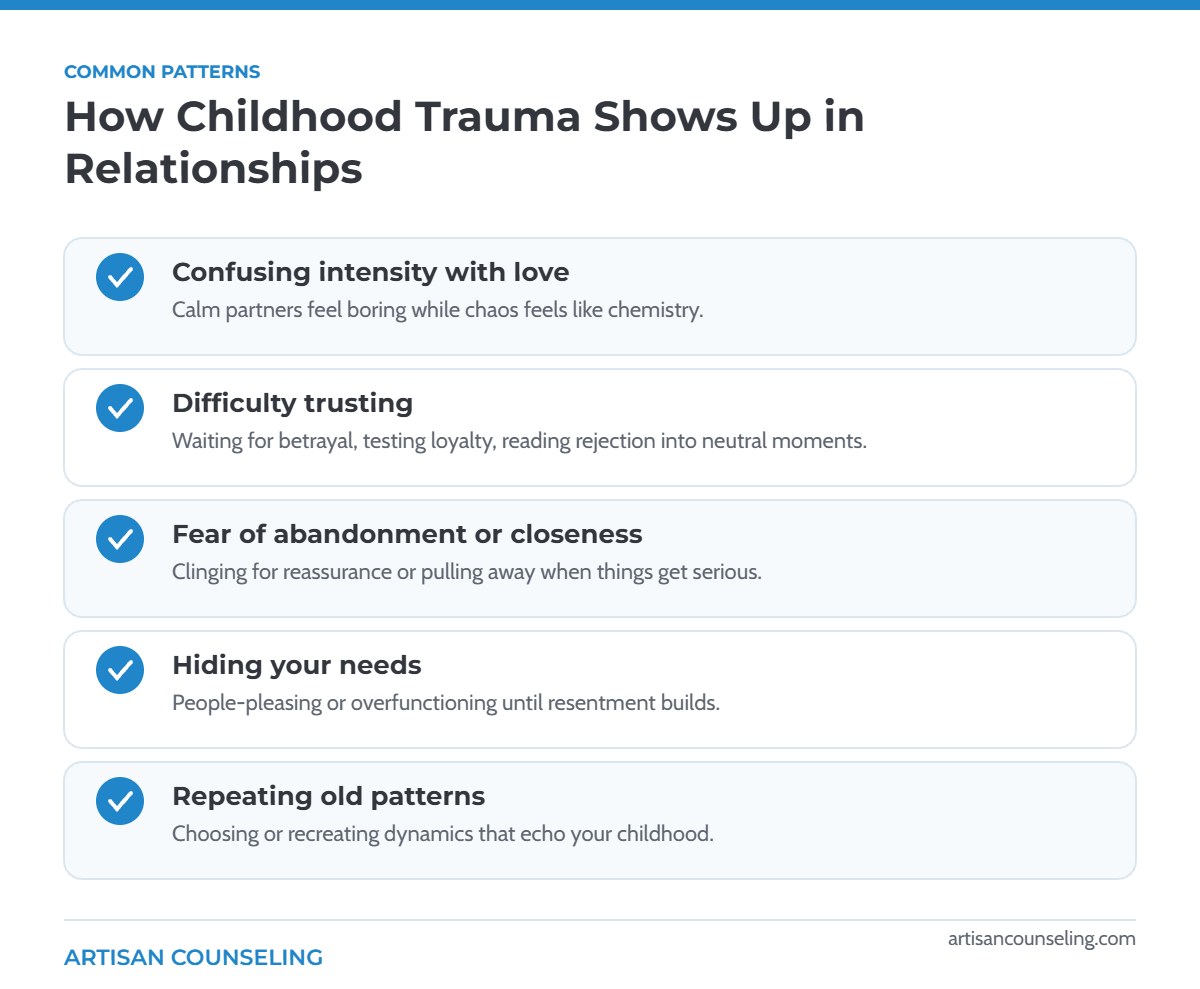
You Confuse Intensity With Love
If affection in childhood came with chaos, a calm and steady partner may feel boring, while a hot-and-cold relationship feels like chemistry. The nervous system is drawn to what is familiar, even when familiar means painful.
You Have Trouble Trusting Even Good People
You may wait for the other shoe to drop, test your partner’s loyalty, or read neutral behavior as rejection. A late text can feel like proof that you are about to be left.
You Fear Abandonment or Feel Smothered by Closeness
Some people cling, seek constant reassurance, and panic at distance. Others pull away when things get serious because closeness feels like losing themselves. Many people swing between both, which can be confusing for them and their partners.
You Struggle to Ask for What You Need
If your needs were ignored or punished, you may have learned to have no needs at all. You might people-please, overfunction by taking care of everything, or stay quiet until resentment builds and spills over.
You Repeat Familiar Patterns
You may find yourself in relationships that echo your childhood, such as choosing partners who are critical or emotionally unavailable, or reacting the way a parent once did. This is not a choice to suffer. It is the mind trying to master an old situation by recreating it. Our article on why people stay in unhealthy relationships explores this further.
Why These Patterns Develop
As a child, you could not leave, fight back, or change your caregivers. So you adapted. You learned to stay small, stay alert, stay helpful, or stay detached, whatever kept you as safe and connected as possible.
These adaptations were smart at the time. The problem is that the nervous system keeps running them in adulthood, even when the danger is gone. When a partner raises their voice or goes quiet, your body may react as if you are still that child. This is why you can understand logically that your partner is safe and still feel alarmed. For more on this, see signs your nervous system is stuck in survival mode.
Attachment research describes how early caregiving shapes whether adults feel secure, anxious, or avoidant in close relationships. Attachment styles are not fixed labels. Many people move toward greater security through healthy relationships and therapy, sometimes called earned security.
What Healing Looks Like
Healing does not mean erasing your past or never feeling triggered again. It means your reactions become less intense, you recover faster, and you have more choice about how you respond.
- You notice a pattern while it is happening instead of only afterward.
- You can say “I’m feeling scared right now” instead of attacking or withdrawing.
- A steady, kind partner starts to feel safe rather than dull.
- You can set a boundary without guilt taking over for days.
- Conflict feels like a problem to solve together, not a threat to survive.
Progress is rarely a straight line. Setbacks are part of the process, as we explain in healing isn’t linear.
Practical Steps You Can Start Today
These steps will not replace professional support, but they can help you begin changing old patterns.
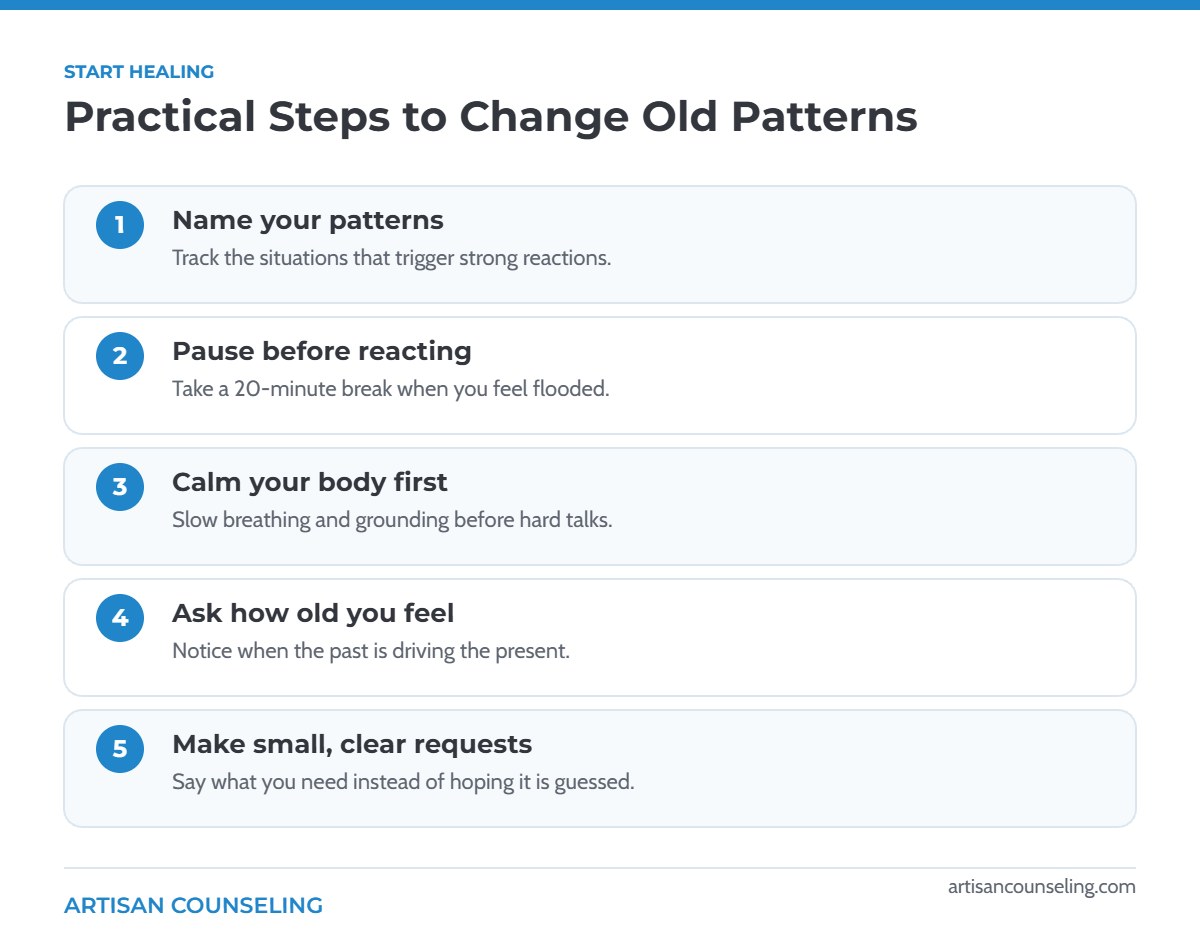
- Name your patterns. Write down the situations that trigger strong reactions in your relationships. Look for themes, such as distance, criticism, or conflict.
- Pause before reacting. When you feel flooded, take a break of at least 20 minutes and tell your partner you will come back to the conversation.
- Calm your body first. Slow breathing with a longer exhale, feeling your feet on the floor, or a short walk can help your nervous system settle before you talk.
- Ask “How old do I feel right now?” If the answer is “about eight,” you are likely reacting to the past as much as the present.
- Practice small, clear requests. Try “Could you text me if you’re running late?” instead of hoping your partner will guess.
- Choose safe people. Notice who is consistent, respectful, and kind, and spend more time with them.
Tip: Share what you are learning with your partner during a calm moment, not in the middle of an argument. Saying “When you go quiet, I tend to panic, and I’m working on that” builds understanding instead of blame.
When to Consider Counseling
It may be time to reach out to a counselor if relationship patterns keep repeating despite your efforts, if you feel anxious, numb, or hopeless much of the time, or if past experiences still intrude through nightmares, flashbacks, or intense reactions.
Trauma-informed therapists use approaches such as EMDR therapy, Internal Family Systems (IFS), and somatic work to help process painful memories and build new ways of relating. Couples counseling can also help partners understand each other’s histories and respond with more compassion.
If you are in crisis: call or text 988 to reach the 988 Suicide & Crisis Lifeline, available 24/7, or call 911 in an emergency. If you are in an unsafe relationship, contact local emergency services or a domestic violence hotline.
Frequently Asked Questions
Can childhood trauma cause relationship problems even if I don’t remember much?
Yes. Many people have limited memories of early childhood, yet their bodies and relationship patterns still reflect what happened. A counselor can help you work with present patterns without needing a complete memory of the past.
Is it possible to have a healthy relationship after childhood trauma?
Absolutely. Many trauma survivors build secure, loving relationships. It often involves learning to recognize triggers, communicating needs clearly, and choosing partners who are consistent and respectful.
Should my partner come to therapy with me?
It depends on your goals. Individual therapy is often a good place to work through your own history, while couples counseling helps you both change the patterns between you. Some people benefit from both.
What type of therapy is best for childhood trauma?
There is no single best approach. Evidence-supported options include EMDR, trauma-focused cognitive behavioral therapy, and other trauma-informed methods. A good fit with your therapist matters as much as the specific technique.
Getting Support at Artisan Counseling
You do not have to untangle these patterns alone. Our licensed counselors offer trauma-informed therapy for individuals and couples in Newport News and Suffolk, as well as telehealth across Virginia. Take a look at our counselors to find someone who feels like a good fit, or reach out to schedule a consultation.