Key Takeaways
- Emotional safety means you can share your thoughts, feelings, and needs without fear of being ridiculed, punished, or shut out.
- It shows up in everyday moments: how partners handle conflict, respond to vulnerability, and repair after hurt.
- Criticism, contempt, stonewalling, and unpredictability are some of the most common things that erode it.
- Emotional safety can be rebuilt with consistent small actions, and couples counseling can help when you feel stuck.
Most people know what it feels like to be with someone who makes them feel calm and accepted. They also know the opposite: bracing for a reaction, choosing words carefully, or keeping important feelings to themselves because sharing them never seems to go well.
If this is affecting your relationship, couples counseling at our Newport News and Suffolk offices can help you and your partner work through it together.
That difference comes down to emotional safety. It is one of the foundations of a healthy relationship, whether you are dating, married, or rebuilding after a hard season.
In this article, you will learn what emotional safety actually means, the signs that it is present (or missing), what tends to wear it down, and specific steps you and your partner can take to build more of it.
What Does Emotional Safety in a Relationship Mean?
Emotional safety is the sense that you can be yourself with your partner. You can disagree, admit a mistake, ask for something, or show a softer side without worrying that it will be used against you.
It does not mean a relationship without conflict or discomfort. Every couple argues and hurts each other sometimes. What matters is that both people can bring up hard things, feel heard, and trust that the relationship can handle honesty.
Emotional Safety vs. Physical Safety
Physical safety means being free from harm, threats, or intimidation. It is the most basic requirement of any relationship. Emotional safety builds on top of it. A relationship can be physically safe but still feel emotionally unsafe if one person is regularly dismissed, belittled, or shut out.
What Are the Signs of an Emotionally Safe Relationship?
Emotional safety is easier to recognize in everyday behavior than in big gestures. Here are some of the clearest signs it is present.
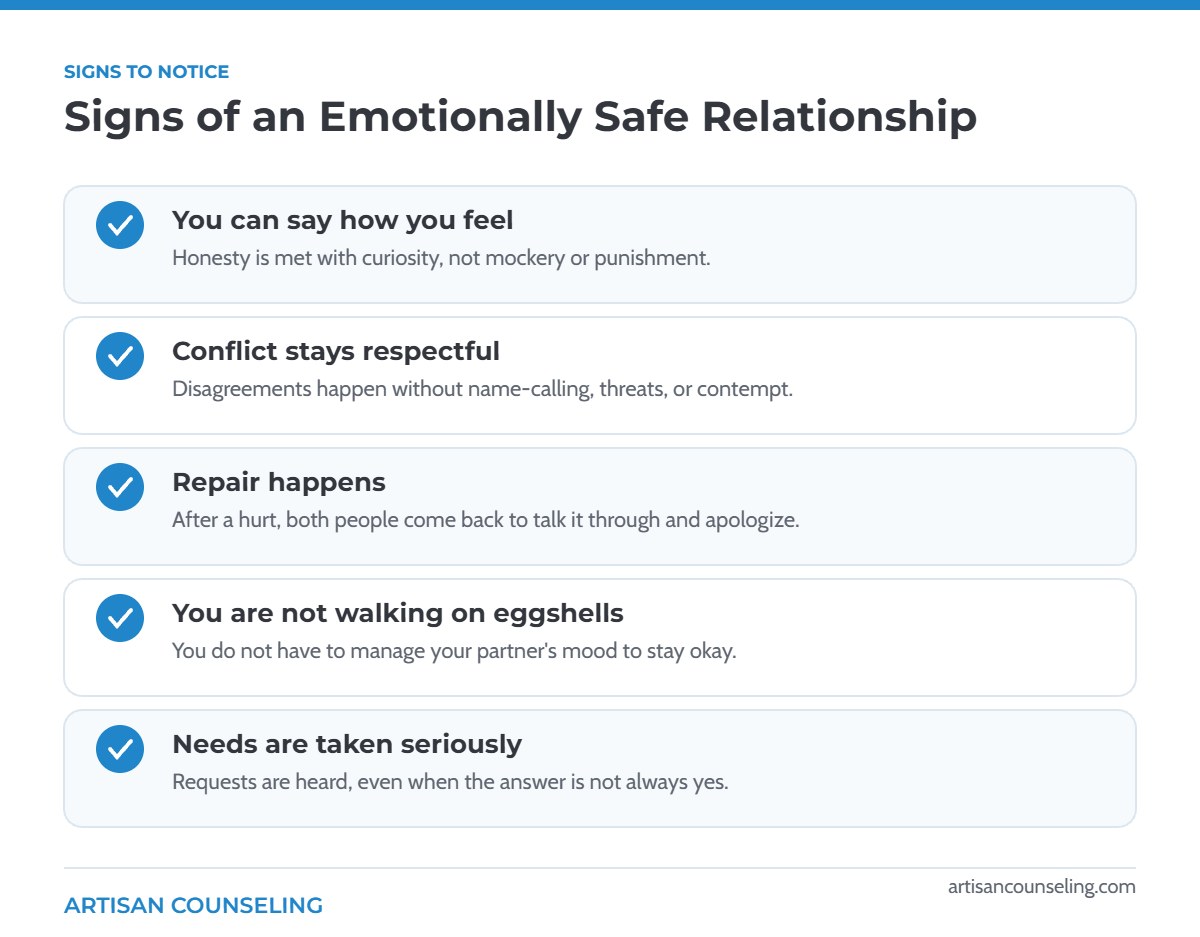
You Can Be Honest Without Fear
You can say “that hurt me” or “I disagree” and expect a conversation, not an attack. Your partner may not like what you say, but they stay engaged.
Conflict Stays Respectful
Arguments may get heated, but they do not involve name-calling, threats, mocking, or bringing up every past mistake. Both people stay focused on the issue rather than on winning.
You Repair After Hurt
No couple avoids every hurt. In emotionally safe relationships, partners come back after a rupture, take responsibility for their part, and reconnect.
You Are Not Walking on Eggshells
You do not spend your energy managing your partner’s moods or predicting what will set them off. You feel relaxed enough to be yourself most of the time.
What It Looks Like in Everyday Moments
For example, imagine telling your partner you felt embarrassed by a joke they made at a party. In an emotionally safe relationship, they might say, “I didn’t realize that landed badly. I’m sorry. I’ll be more careful.” In a less safe one, the response might be, “You’re too sensitive,” followed by an evening of tension. The first response makes it easier to speak up next time. The second teaches you to keep quiet. Over months and years, these small exchanges shape how open each partner feels they can be.
A Quick Self-Check
- Do I feel comfortable bringing up a concern with my partner?
- When I share something vulnerable, do I usually feel closer afterward or more exposed?
- After a fight, do we find our way back to each other?
- Do I hold back parts of myself to avoid a reaction?
What Erodes Emotional Safety?
Emotional safety rarely disappears in one moment. It usually wears down through repeated patterns. Relationship researchers John and Julie Gottman describe four especially damaging ones: criticism, contempt, defensiveness, and stonewalling.
- Criticism: attacking your partner’s character (“you always” or “you never”) instead of describing a specific behavior.
- Contempt: eye-rolling, sarcasm, mockery, or treating your partner as beneath you.
- Defensiveness: responding to every concern with excuses or counterattacks.
- Stonewalling: shutting down, going silent, or leaving the conversation without saying when you will return.
- Unpredictability: warmth one day and coldness or anger the next, with no clear reason.
- Breaking confidences: sharing something private or using a vulnerable moment against your partner later.
If these patterns feel familiar, it does not mean your relationship is doomed. It means there are specific habits to work on. Our article on why communication breaks down in relationships explores how these cycles take hold.
Important: If you feel afraid of your partner, are being threatened, controlled, or harmed, that is a safety issue, not a communication problem. Reach out to a trusted professional or a domestic violence hotline for guidance.
How Can You Build More Emotional Safety Together?
The good news is that emotional safety is built through small, repeated actions. You do not need a perfect relationship to start. These steps help both partners feel more secure.
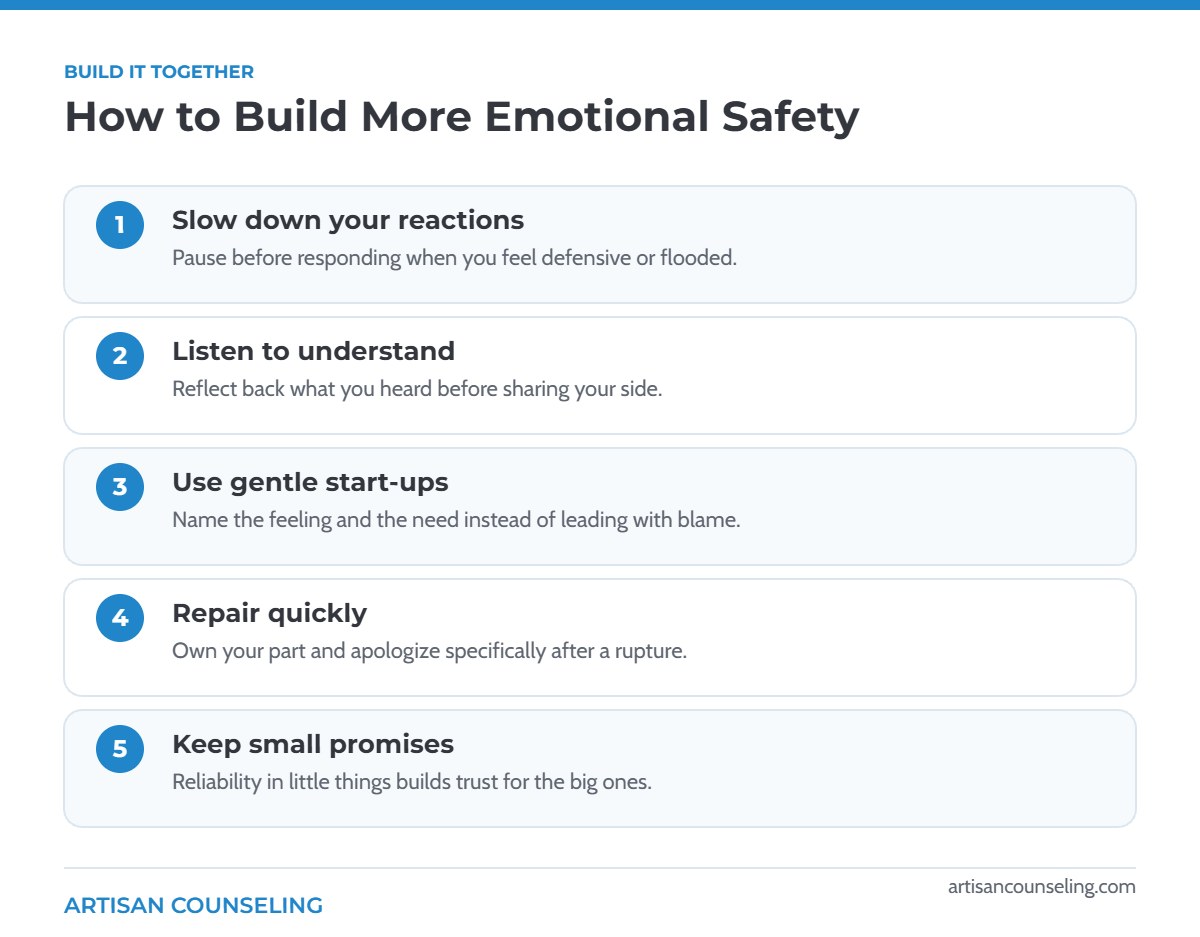
Slow Down When You Feel Defensive
When your heart is racing or you feel the urge to snap back, take a short break. Tell your partner you need 20 minutes and that you will come back to the conversation. Then follow through.
Listen to Understand, Not to Respond
Before sharing your side, reflect back what you heard: “It sounds like you felt ignored when I was on my phone at dinner.” This simple step lowers defensiveness on both sides.
Start Hard Conversations Gently
Instead of “you never help,” try “I’m feeling overwhelmed with the house this week. Could you take care of dinner on Tuesday?” Naming a feeling and a specific need invites cooperation.
Repair Quickly and Specifically
A good repair names what happened and owns your part: “I raised my voice and dismissed what you said. I’m sorry. I want to hear you.” Specific apologies rebuild trust faster than general ones.
Be Reliable in Small Things
Following through on small promises, like calling when you said you would, shows your partner they can count on you. Trust grows from consistency.
Make Bids for Connection, and Respond to Them
Small moments of reaching out, like sharing a funny story, asking about your partner’s day, or touching their shoulder as you pass, are often called bids for connection. Turning toward these bids, even briefly, tells your partner they matter. Try putting your phone down when your partner starts talking, or saying, “Tell me more,” instead of half-listening.
Try a Weekly Check-In
Set aside 20 to 30 minutes each week to talk about the relationship when you are both calm. You might use three simple prompts: “What felt good between us this week?” “Was there a moment you felt hurt or disconnected?” “What is one thing I can do this week to help you feel supported?” Keep the tone curious, not critical, and end with something you appreciate about each other.
Healthy limits also matter. Learn more in our guide on why healthy relationships need healthy boundaries.
When Should You Consider Couples Counseling?
Sometimes couples know what they want to change but cannot break the cycle on their own. Counseling can help if:
- The same arguments repeat without resolution.
- One or both of you feel shut out, criticized, or alone in the relationship.
- Trust has been damaged by an affair, secrecy, or repeated broken promises.
- You avoid important topics because talking only makes things worse.
In couples counseling at Artisan Counseling, early sessions often focus on understanding each partner’s perspective and the cycle you get caught in. From there, your counselor can help you practice safer ways to raise concerns and respond to each other, right in the session, so the skills feel more natural at home.
A counselor can help you slow conversations down, understand the needs underneath each reaction, and practice new ways of responding. Approaches like the Gottman Method and Emotionally Focused Therapy focus directly on building safety and connection. If you are wondering whether it is time, read when couples should seek counseling.
Frequently Asked Questions
Can a relationship be emotionally unsafe without being abusive?
Yes. A relationship can lack emotional safety because of habits like criticism, defensiveness, or withdrawal, without involving abuse. These patterns are often changeable when both partners are willing to work on them. Abuse, which involves control, intimidation, or harm, is different and requires a safety-focused response.
How long does it take to rebuild emotional safety?
It varies with the depth of hurt and how consistently both partners practice new habits. Many couples notice small shifts within weeks of changing how they handle conflict, while rebuilding trust after a major breach usually takes longer.
What if only one partner wants to work on it?
You can still change your part of the pattern, such as how you start conversations or respond to conflict, and that often shifts the dynamic. Individual counseling can help you clarify what you need and how to communicate it.
Is feeling nervous before hard conversations a sign the relationship is unsafe?
Not necessarily. Most people feel some nervousness before vulnerable conversations. It becomes a concern when you consistently fear ridicule, punishment, or explosive reactions.
Building a Safer Relationship with Artisan Counseling
Emotional safety is something couples can learn and strengthen together. Our licensed counselors offer couples counseling to help partners communicate more openly and reconnect. You can meet our counselors, visit us in Newport News or Suffolk, or contact us to schedule a first session.