Key Takeaways
- Communication breakdowns usually come from repeated patterns, not from a lack of love or effort.
- Common cycles include pursue-withdraw, criticism-defensiveness, mind reading, and avoiding hard topics.
- Stress, past hurts, and different communication styles make these cycles stick.
- Gentle start-ups, reflective listening, real breaks, and regular check-ins can help couples reconnect.
Many couples say the same thing: “We just can’t talk anymore.” Small disagreements turn into big fights, or important topics get avoided altogether. Both partners may feel misunderstood, even though both care deeply.
If this is affecting your relationship, couples counseling at our Newport News and Suffolk offices can help you and your partner work through it together.
The problem is rarely that two people have nothing to say. More often, they are stuck in a pattern that makes it hard for either of them to be heard. In this article, you will learn what communication breakdown looks like, the most common patterns behind it, why those patterns take hold, and specific tools that help couples talk more effectively.
What Does Communication Breakdown Look Like?
Communication breakdown is not just arguing. Healthy couples argue too. Breakdown is when conversations repeatedly leave you more disconnected than before. Signs include:
- Conversations escalate quickly or end with someone walking away.
- You avoid certain topics because they always go badly.
- You feel like you are talking to a wall, or that you are always the one bringing things up.
- You replay arguments later, thinking of what you wish you had said.
- Small comments get interpreted as criticism.
For example, one partner says, “You forgot to call the plumber again.” The other hears, “You are unreliable,” and fires back about something the first partner forgot last month. Within minutes, the conversation is no longer about the plumber at all. Both people feel attacked, and neither feels heard.
What Patterns Cause Communication to Break Down?
Most couples fall into a few predictable cycles. Recognizing your pattern is often the first step to changing it.
The Pursue-Withdraw Cycle
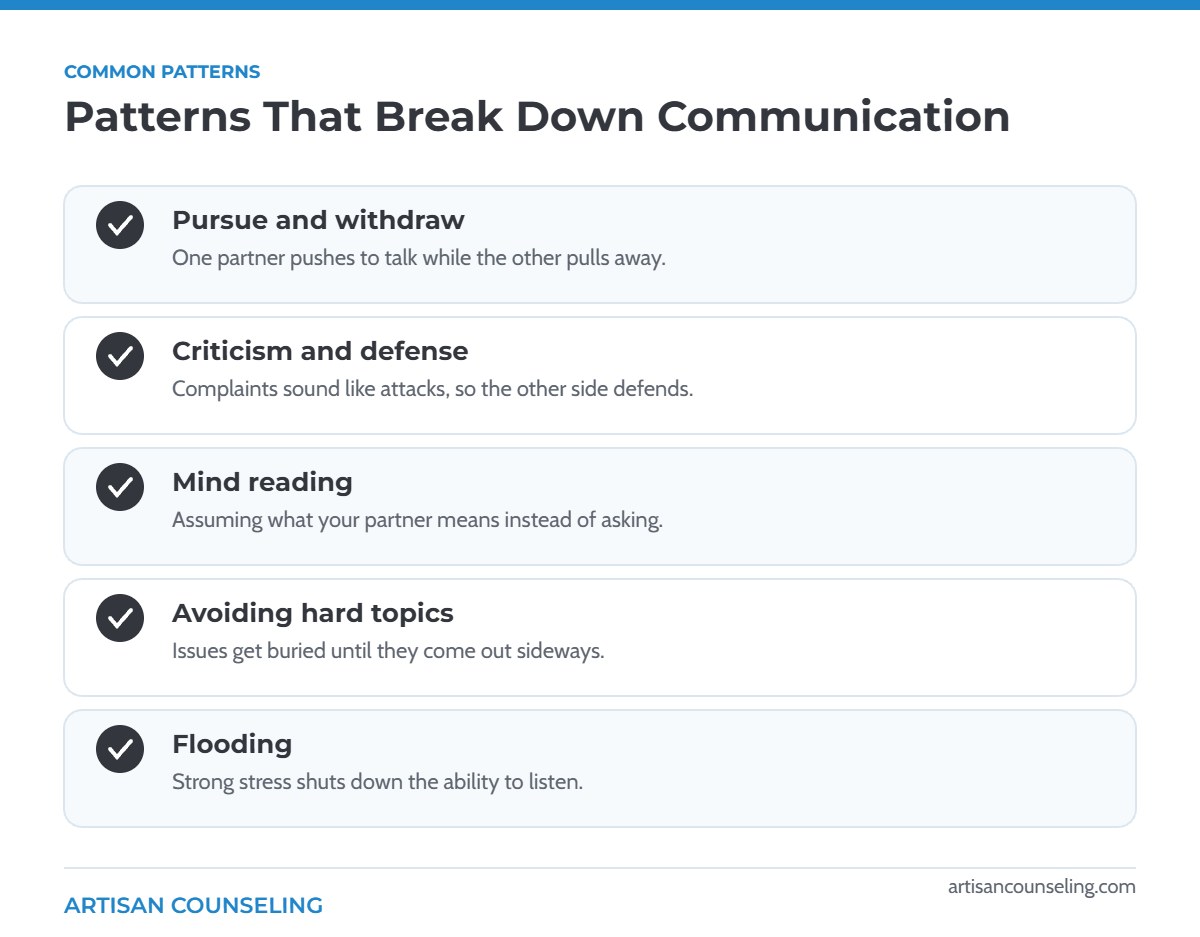
One partner seeks connection by raising concerns or pushing to talk. The other feels overwhelmed and pulls back. The more one pursues, the more the other withdraws, and both feel alone.
In daily life, this might look like one partner texting several times about an unresolved issue while the other goes quiet for hours. The pursuer feels abandoned, and the withdrawer feels overwhelmed. Each person’s reaction makes sense on its own, but together they keep the loop going.
Criticism and Defensiveness
When a complaint sounds like an attack on someone’s character, the natural response is to defend. Then the original concern never gets addressed.
Mind Reading and Assumptions
After years together, it is easy to assume you know what your partner means. Acting on assumptions instead of asking creates misunderstandings that are hard to undo.
Avoidance
Avoiding conflict can feel peaceful in the short term. Over time, unspoken resentments build and tend to come out in sarcasm, distance, or sudden blowups.
Emotional Flooding
When stress spikes, your body shifts into fight-or-flight. Your heart races and it becomes hard to think clearly or listen. Conversations held in this state rarely go well.
Signs You Are Flooded
Flooding often shows up in your body first. You might notice a racing heart, a hot face, clenched jaw, or a sudden urge to leave the room or raise your voice. When this happens, it is very hard to listen or problem-solve. Recognizing these cues early is one of the most useful skills a couple can build.
Why Do These Patterns Take Hold?
Communication patterns are not random. They usually make sense once you understand what is driving them.
Stress and Exhaustion
Work, parenting, money, and health concerns leave less patience for careful conversations. Couples often communicate worst when they need each other most.
Past Experiences
How your family handled conflict shapes how you handle it now. If disagreements once meant yelling or silence, those reactions can feel automatic. Learn more in how childhood experiences affect adult relationships.
Unresolved Hurts
When past injuries were never repaired, new conversations get filtered through old pain. A small comment can trigger a much bigger reaction.
Different Communication Styles
Some people process out loud; others need time alone first. Neither is wrong, but without understanding each other, these differences can feel like rejection.
How Can Couples Improve Communication?
Changing a communication pattern takes practice, but small shifts can make a real difference.
Use a Gentle Start-Up
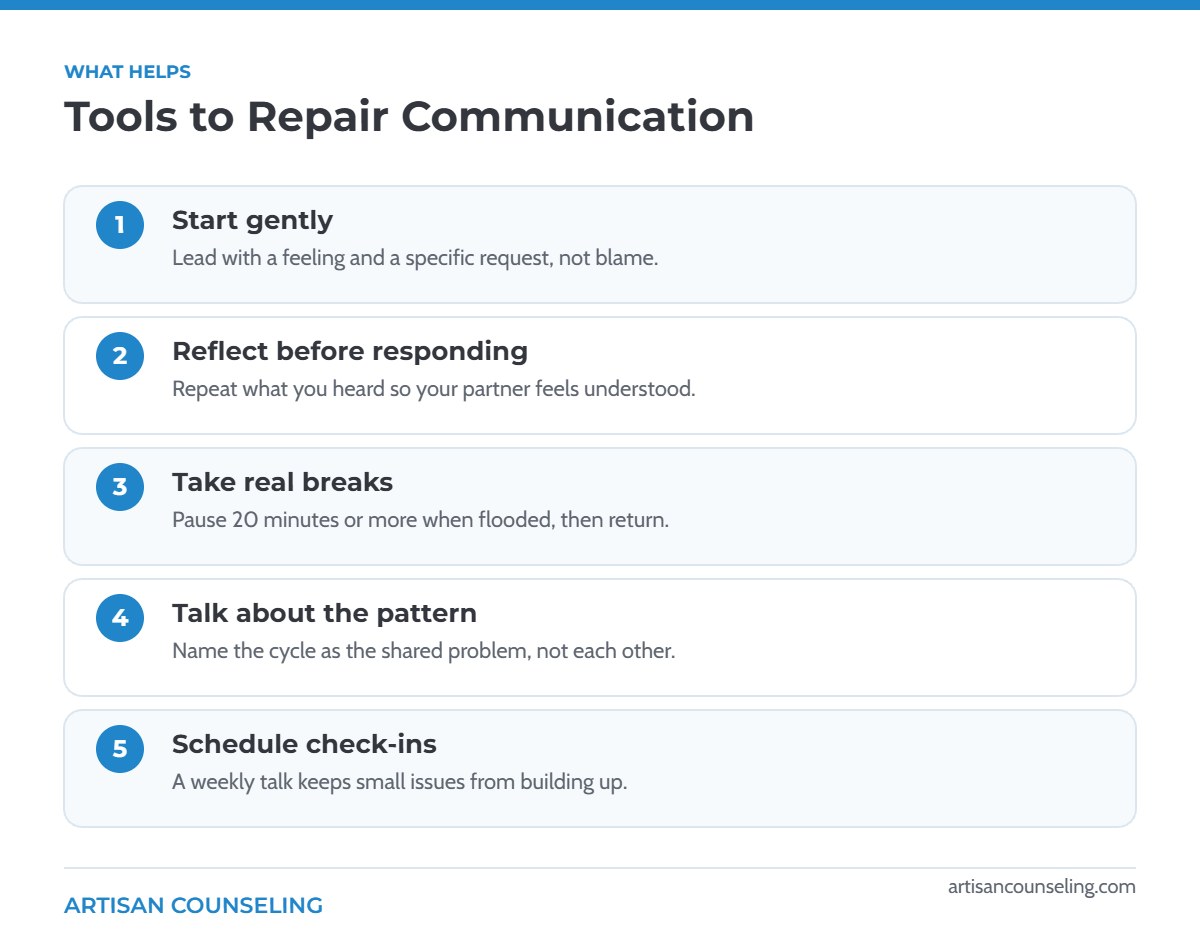
Begin with how you feel and what you need. Instead of “you never listen,” try “I felt hurt when my news got brushed off. I’d love for you to ask me about it.”
Compare “You never help with the kids” to “I am feeling stretched thin tonight. Could you handle bath time so I can have a few minutes to reset?” The second version names a feeling and a specific request, which makes it much easier for your partner to say yes.
Reflect Before You Respond
Summarize what your partner said and check if you got it right. Feeling understood lowers defensiveness more than almost anything else.
Take Breaks That Actually Help
If either of you feels flooded, agree to pause for at least 20 minutes. Do something calming rather than rehearsing your argument, then return to the conversation as promised.
A break works best when you agree on it ahead of time. You might say, “I am getting overwhelmed. I want to finish this conversation, and I need twenty minutes first.” Use that time to calm your body, such as taking a walk or breathing slowly, rather than rehearsing your argument. Then come back as promised.
Make the Pattern the Problem
Try saying, “We’re in our cycle again, where I push and you pull away.” Naming the pattern helps you face it as a team.
Schedule Regular Check-Ins
A weekly 20-minute talk about what is going well and what needs attention keeps small issues from piling up.
Tip: Choose your timing. Hard conversations go better when you are both fed, rested, and not rushing. Asking “Is now a good time to talk about something important?” sets a cooperative tone.
If the same issue keeps coming back, our article on how to stop arguing about the same things offers more strategies.
Phrases to Try When Conversations Get Stuck
Having a few go-to phrases can help you interrupt the cycle in the moment. Try these:
- “Can we start over? I do not like how that came out.”
- “I want to understand. Can you tell me more about what you meant?”
- “I think we are both getting defensive. Can we slow down?”
- “What I am really worried about is…”
- “You have a point about that part.”
These small repair attempts may feel awkward at first. Over time, they signal to your partner that you are on the same team, even in the middle of a disagreement.
When Should You Seek Couples Counseling?
Counseling can help when your own efforts are not breaking the cycle, when conversations regularly turn hurtful, or when one or both of you feel hopeless about being understood. A counselor can slow conversations down, help each partner express the needs underneath their reactions, and coach new skills in real time. Learn more about how counseling improves communication.
At Artisan Counseling, couples work often starts with understanding how your conversations typically unfold, what each partner feels in those moments, and what you both want instead. From there, your counselor helps you practice new ways of talking in session, so the skills become easier to use at home. Some couples find the structure of the Gottman Method helpful for this kind of work.
Frequently Asked Questions
Can a relationship survive poor communication?
Yes, many couples improve communication significantly with effort and support. Communication is a skill, and both partners can learn new habits. The key is a shared willingness to work on it.
What is the most common communication problem in relationships?
Many couples struggle with a pursue-withdraw cycle, where one partner pushes to talk and the other pulls away. Criticism followed by defensiveness is also very common.
How do you communicate with a partner who shuts down?
Try lowering the intensity: start gently, keep the topic specific, and offer breaks. Ask what helps them feel able to talk, and agree on a time to return to the conversation.
Is it normal to argue in a healthy relationship?
Yes. Disagreement is a normal part of any close relationship. What matters is how you argue, whether you stay respectful, and whether you repair afterward.
Can we work on communication through telehealth?
Yes. Many couples find online sessions convenient, especially with busy schedules or children at home. Your counselor can still guide conversations, help you notice patterns, and practice skills with you over video.
How long does it take to improve communication as a couple?
It varies. Some couples notice fewer blowups within a few weeks of practicing new skills, while deeper patterns take longer. Consistent practice, patience, and a willingness to repair after mistakes matter more than speed.
Reconnecting With Help From Artisan Counseling
If you and your partner want to feel heard again, our couples counseling services can help you understand your patterns and practice new ways of talking. Meet our counselors, visit our Newport News office, or contact us to get started.