Key Takeaways
- Ongoing conflict between parents, not the separation itself, is one of the most harmful things for children.
- Keeping kids out of adult issues, staying consistent, and letting them love both parents protects their well-being.
- Treating co-parenting like a respectful business partnership can lower tension when emotions are still raw.
- Counseling, co-parenting classes, or mediation can help when conflict keeps escalating.
Separation or divorce ends a romantic relationship, but when you share children, it does not end your relationship as parents. You still have to make decisions, share schedules, and show up for the same kids, often while you are grieving, angry, or exhausted.
There is no perfect way to co-parent. But some approaches reliably make life easier for children, and some reliably make it harder. In this article, you will learn what co-parenting really asks of you, what hurts kids the most, practical strategies that help, common traps to avoid, and when to get outside support.
What Co-Parenting Actually Asks of You
Co-parenting means both parents stay involved in raising their children after separation and work together, at least enough, to meet the kids’ needs. You do not have to be friends. You do not have to agree on everything. You do have to keep the focus on your children rather than on the conflict between you.
That can be very hard when the relationship ended painfully. It often means separating your feelings about your ex as a partner from your view of them as a parent. Getting individual support for your own grief and anger can make that separation easier.
What Your Children Need to Hear
When you first tell children about the separation, aim to do it together if you can do so calmly. Keep the message simple and age-appropriate. Children usually need to hear a few core things, more than once:
- “This is a grown-up decision, and it is not your fault.”
- “We both love you, and that will not change.”
- “Here is what will stay the same, and here is what will be different.”
- “You can ask us questions anytime, and you can have any feelings about this.”
Avoid sharing details about why the relationship ended. Kids need reassurance and predictability, not adult explanations.
What Hurts Children the Most After Separation
Children can adjust well after their parents separate. What tends to cause lasting harm is ongoing exposure to conflict and being caught in the middle.
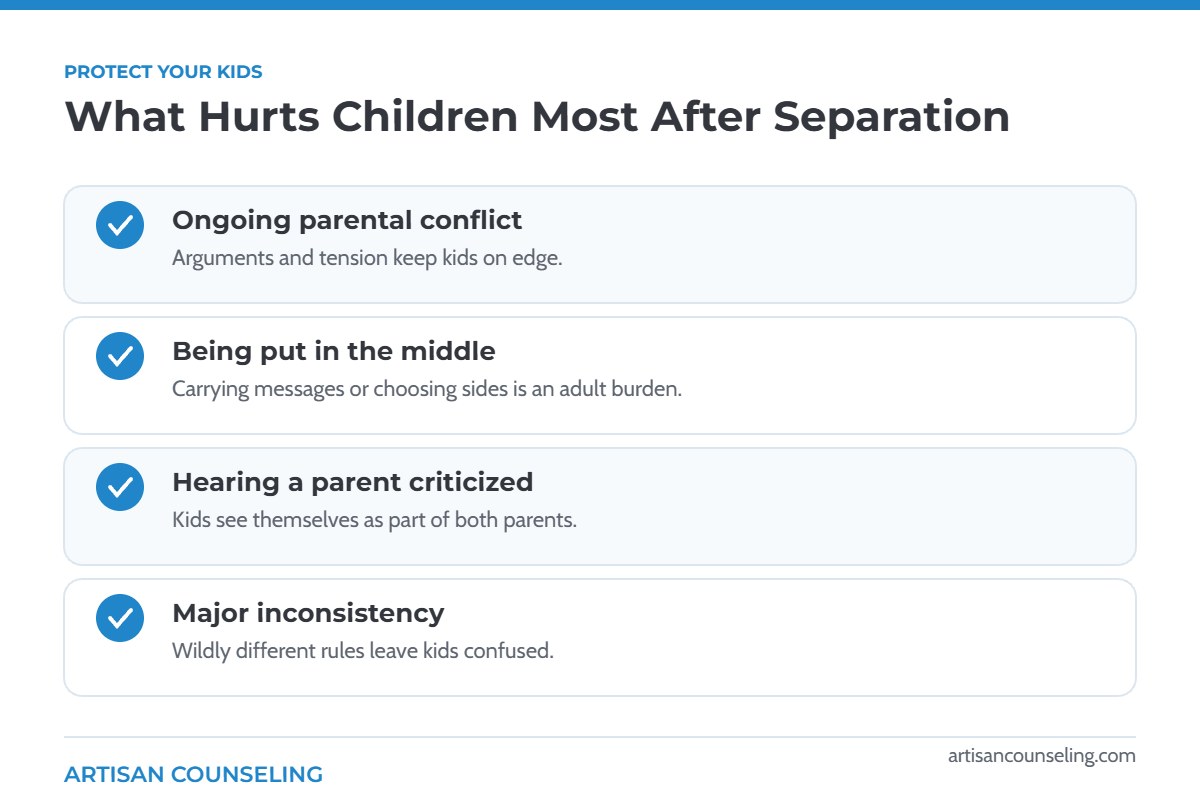
Ongoing Conflict Between Parents
Arguing at handoffs, tense phone calls within earshot, and constant disputes keep kids on edge. Even when they are not the topic, children absorb the stress.
Being Put in the Middle
Asking kids to carry messages, keep secrets, report on the other household, or choose sides puts an adult burden on a child. It forces them into a loyalty conflict they cannot win.
Hearing One Parent Criticize the Other
Children often see themselves as part of both parents. When they hear one parent criticized, they may feel that part of them is bad, too.
Major Inconsistency Between Homes
Different houses will have different styles, and that is fine. But wildly different rules on sleep, school, screens, or discipline can leave kids confused and testing limits.
Co-Parenting Tips That Actually Help
These strategies reduce conflict and give children more stability, even when the relationship between parents is strained.
Treat It Like a Business Relationship
If emotions run high, keep communication polite, brief, and focused on the kids. Think of your co-parent as a colleague on an important project. You do not have to like them to work with them respectfully.
Use One Main Communication Channel
Choose a single method, such as email, a shared calendar, or a co-parenting app, so information does not get lost and messages stay in writing. Keep messages factual. Read them once more before sending to remove sarcasm or blame.
Keep Handoffs Short and Neutral
Exchanges are not the time to negotiate schedules or bring up problems. A friendly hello and a quick goodbye help kids transition calmly. Some families use school or a neutral location for exchanges.
Agree on the Basics
Aim for rough consistency on bedtimes, homework, screen limits, and major consequences. You do not need identical households, just a shared foundation.
Let Kids Love Both Parents
Tell your children it is okay to enjoy time with their other parent and to miss them. Help them make cards or call the other parent on special occasions when appropriate.
Keep Adult Problems With Adults
Talk about finances, legal issues, and your feelings about the breakup with friends, family, or a counselor, not with your children.
Follow Through and Adjust as Kids Grow
Show up on time and keep your commitments. A schedule that works for a toddler may not work for a teenager with sports and a job, so revisit plans as your children’s needs change.
A Before-and-After Message Example
Small wording changes can lower tension a lot. For example, compare these two texts about a schedule change:
- Reactive: “Typical. You always change plans last minute and expect me to fix it.”
- Business-like: “I got your note about Friday. I can pick up at 6 instead of 5. Does that work?”
The second message solves the problem and leaves less room for an argument. If you feel a strong reaction to a message, it is okay to wait an hour before you respond, unless it is truly urgent.
Tip: Before sending a message to your co-parent, ask yourself, “Would I be comfortable if a judge or my child read this someday?” If not, rewrite it.
Common Co-Parenting Traps to Avoid
Even well-meaning parents fall into these patterns, especially when emotions are raw:
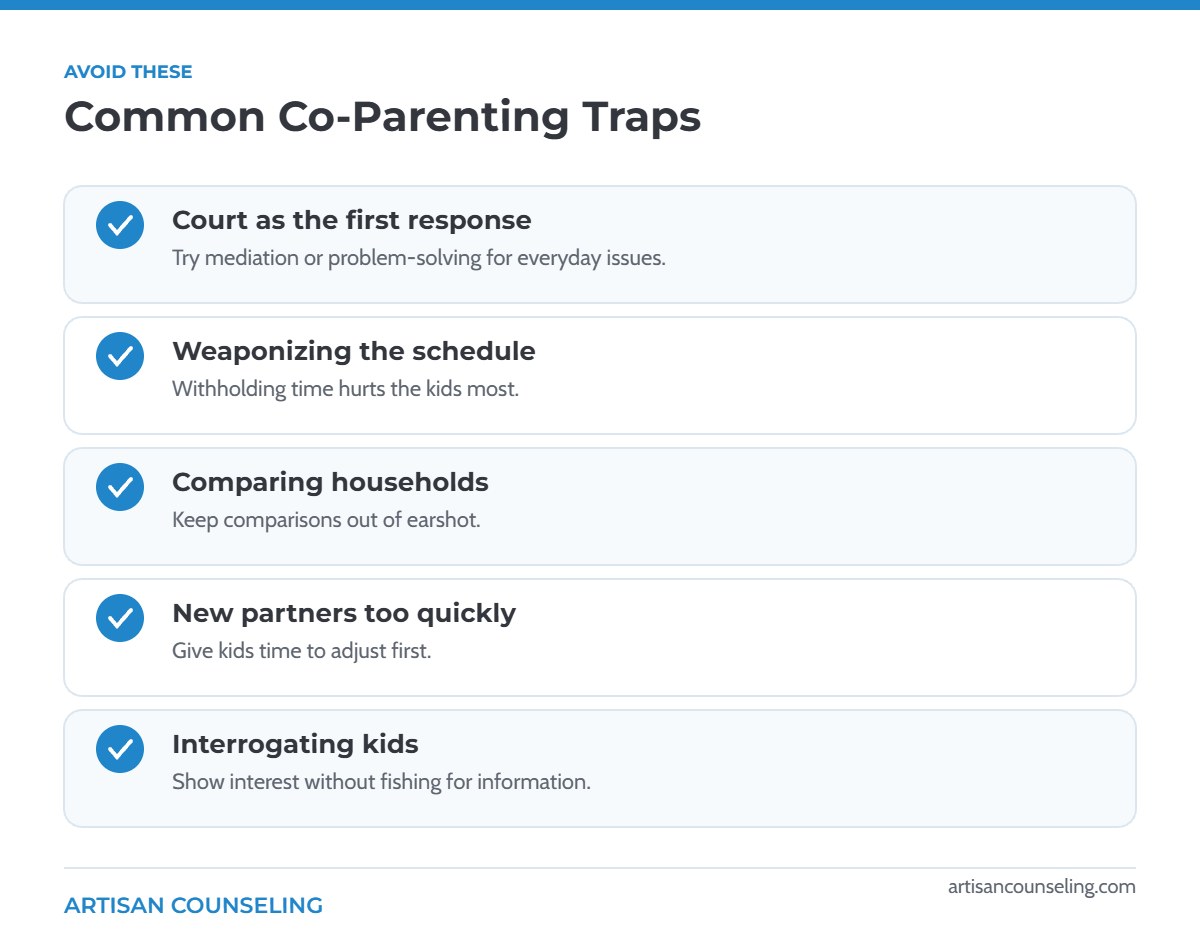
- Using court as the first response. Legal action is sometimes necessary, but for everyday disagreements, mediation or direct problem-solving is usually faster and less damaging.
- Weaponizing the schedule. Withholding time or refusing reasonable swaps to punish the other parent hurts the kids most.
- Comparing households out loud. Comments like “At my house, we don’t do that” put kids in an awkward position.
- Introducing new partners too quickly. Give children time to adjust to the separation before bringing a new partner into their lives.
- Interrogating kids after visits. Show interest in their time, but avoid fishing for information about the other home.
Helping Your Children Cope With Big Feelings
Children may react to separation with sadness, anger, clinginess, school problems, or regression to younger behaviors. Younger kids sometimes believe they caused the divorce, so it helps to say clearly that it is not their fault.
Name feelings, stay calm when emotions run high, and keep routines as steady as possible. Our article on parenting through big emotions without yelling offers practical tools for these moments.
Signs Your Child Is Adjusting
It can be reassuring to know what healthy adjustment looks like. Over time, many children start to settle into the new routine, talk more openly about both homes, return to their usual activities and friendships, and move between households with less distress. Bumps around holidays, birthdays, and transitions are normal. What matters most is the overall direction over months, not any single hard week.
Taking Care of Yourself
Co-parenting well is much harder when you are running on empty. Protect basic routines like sleep, meals, and movement. Lean on friends who let you vent without inflaming the conflict. Notice if anger at your ex is showing up in how you talk to or about your children, and treat that as a cue to get extra support rather than a reason for shame.
When to Get Help
Consider reaching out for professional support if:
- Conflict with your co-parent keeps escalating or most conversations end in arguments.
- Your child shows ongoing changes in mood, sleep, behavior, or school performance.
- You are struggling with grief, anger, anxiety, or depression after the separation.
- You are adjusting to a blended family or a new partner.
Family counseling can help children and parents adjust together, and individual counseling gives you space to process the end of your relationship. Our article on family counseling during life transitions explains how this support works.
If you are in crisis: call or text 988 to reach the 988 Suicide & Crisis Lifeline, available 24/7, or call 911 in an emergency. If you are in an unsafe relationship, contact local emergency services or a domestic violence hotline.
Frequently Asked Questions
What is the difference between co-parenting and parallel parenting?
Co-parenting involves regular cooperation and communication. Parallel parenting is used when conflict is high: each parent handles their own household with minimal direct contact, often communicating only in writing about essential matters.
How do I co-parent with someone who won’t cooperate?
Focus on what you can control. Keep communication brief and in writing, follow the parenting plan, and avoid reacting to provocation. Mediation or legal guidance may be needed for serious ongoing problems.
How long does it take kids to adjust to divorce?
Every child is different, and adjustment often takes months rather than weeks. Age, temperament, and especially the level of ongoing conflict between parents all play a role. Steady routines, reassurance, and keeping kids out of adult disputes tend to help them settle.
Should my child see a counselor after our divorce?
Not every child needs counseling, but it can help if your child seems stuck in sadness, anger, or anxiety, or if their behavior or schoolwork changes significantly. A counselor gives kids a neutral space to talk.
Co-Parenting Support at Artisan Counseling
You do not have to figure this out alone. Counseling for co-parenting might include sessions for you on your own, sessions with your children, or work on communication and routines, depending on what your family needs. Our counselors work with parents and children in Newport News and Suffolk and through telehealth across Virginia. Contact us to find the right support for your family.