Key Takeaways
- In Virginia, passing the National Clinical Mental Health Counseling Examination (NCMHCE) is one of the requirements for LPC licensure.
- The NCMHCE is a clinical, case-based exam, so success depends on applying counseling judgment, not just memorizing facts.
- Strong preparation means knowing the format, studying the core content areas, practicing with case studies, and having a consistent test-taking strategy.
- Artisan Counseling trainers Ben Newman, LPC, CSAC, CSOTP, and Tierra Ruffin developed a training to help residents in counseling and master’s students prepare.
Let’s be honest: no one wants to take the NCMHCE more than once. For residents in counseling and master’s students in Virginia, this exam is a major step on the road to becoming a Licensed Professional Counselor, and it can feel high-stakes.
The good news is that the NCMHCE rewards preparation and strategy. Because it tests how you think through real clinical situations, the right approach to studying can make a meaningful difference.
In this article, you will learn why the NCMHCE matters for Virginia licensure, what makes the exam unique, how and what to study, common pitfalls that lead to underperforming, and the strategies covered in Artisan Counseling’s NCMHCE training.
Why Does the NCMHCE Matter for LPC Licensure in Virginia?
In Virginia, the NCMHCE is used as one of the prerequisites for licensure as a Licensed Professional Counselor (LPC). The exam is designed to assess the clinical skills needed to practice safely and effectively as a licensed mental health professional.
Because requirements and exam details can change, always confirm current information with the Virginia Board of Counseling and the National Board for Certified Counselors (NBCC), which administers the exam.
What Makes the NCMHCE Different From Other Exams?
Many counseling students are used to multiple-choice tests that check recall. The NCMHCE is different. It is built around clinical case studies, and it asks you to make decisions the way you would with a real client.
- It is case-based: you read client scenarios and answer questions about assessment, diagnosis, and treatment.
- It tests clinical judgment: the best answer is often the most appropriate next step, not simply a true statement.
- It covers the full counseling process: from intake and assessment through treatment planning and counseling skills.
- It rewards a consistent strategy: working through each case the same way helps you stay focused and avoid traps.
For example, a case might describe a client with low mood, poor sleep, and recent job loss. A recall-based mindset jumps straight to a diagnosis. A clinical mindset asks first: Is there any safety concern? What else do I need to assess? How long have symptoms lasted? The exam tends to reward that second way of thinking.
How and What Should You Study for the NCMHCE?
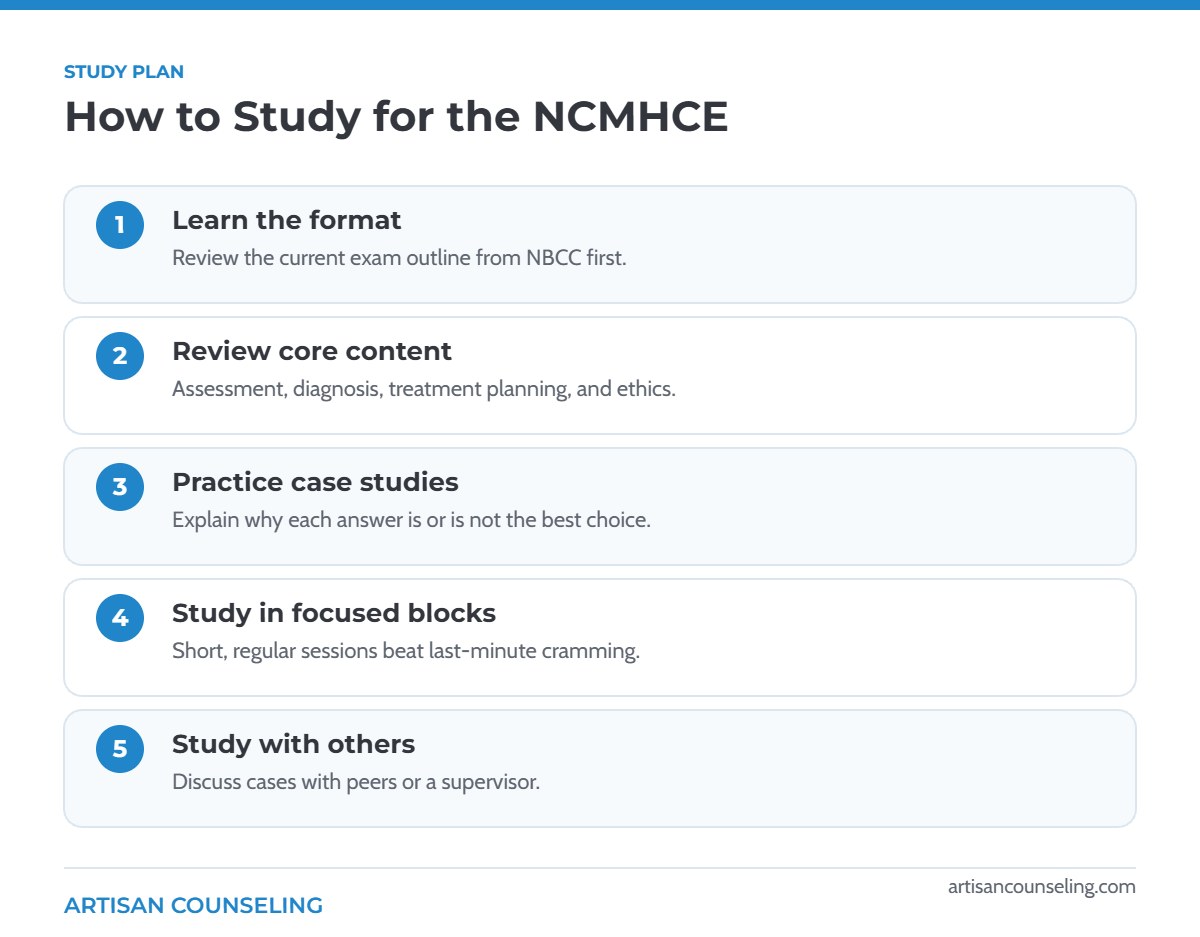
Effective preparation balances content knowledge with practice applying it. A helpful plan usually includes:
- Learn the exam format first. Review the current format and content outline from NBCC so there are no surprises on test day.
- Review core content areas. Focus on assessment and diagnosis (using DSM-5-TR criteria), treatment planning, counseling interventions, and professional practice and ethics.
- Practice with case studies. Work through realistic cases and explain to yourself why each answer is or is not the best choice.
- Study in focused sessions. Short, regular study blocks over several weeks tend to work better than last-minute cramming.
- Study with others. Discussing cases with peers or a supervisor sharpens your reasoning.
Study tip: After each practice case, write one sentence about what clue in the case pointed to the correct answer. Over time, you will start recognizing those clues quickly.
A Sample Weekly Study Rhythm
Every candidate’s schedule is different, but a sustainable week might look like this:
- Two or three short content sessions reviewing one diagnostic category or treatment area at a time
- Two case practice sessions where you work through scenarios and explain your reasoning out loud or in writing
- One review session revisiting mistakes and noting patterns in what tripped you up
- One day off to rest and avoid burnout
Building in rest is part of good preparation. Fatigue makes careful reading harder, and careful reading is central to this exam.
What Common Pitfalls Lead to Underperforming?
Capable candidates sometimes struggle for reasons that have more to do with approach than knowledge. Watch out for:
- Reading too quickly and missing key details in the case
- Answering based on personal practice habits rather than best-practice standards
- Overthinking and talking yourself out of the safest, most appropriate choice
- Overlooking safety and risk issues that should be addressed first
- Poor time management or test-day fatigue
- Studying only content without practicing case application
A useful habit is to keep an error log. Each time you miss a practice question, note whether it was a content gap, a reading error, or a judgment call. If most mistakes come from rushing, slow down. If they come from content gaps, target those areas. This turns every wrong answer into useful information.
Another pitfall is studying alone for too long. Explaining your reasoning to a peer often reveals gaps you did not know you had, and hearing how others approach a case can sharpen your own thinking.
Which Test Strategies Improve NCMHCE Scores?
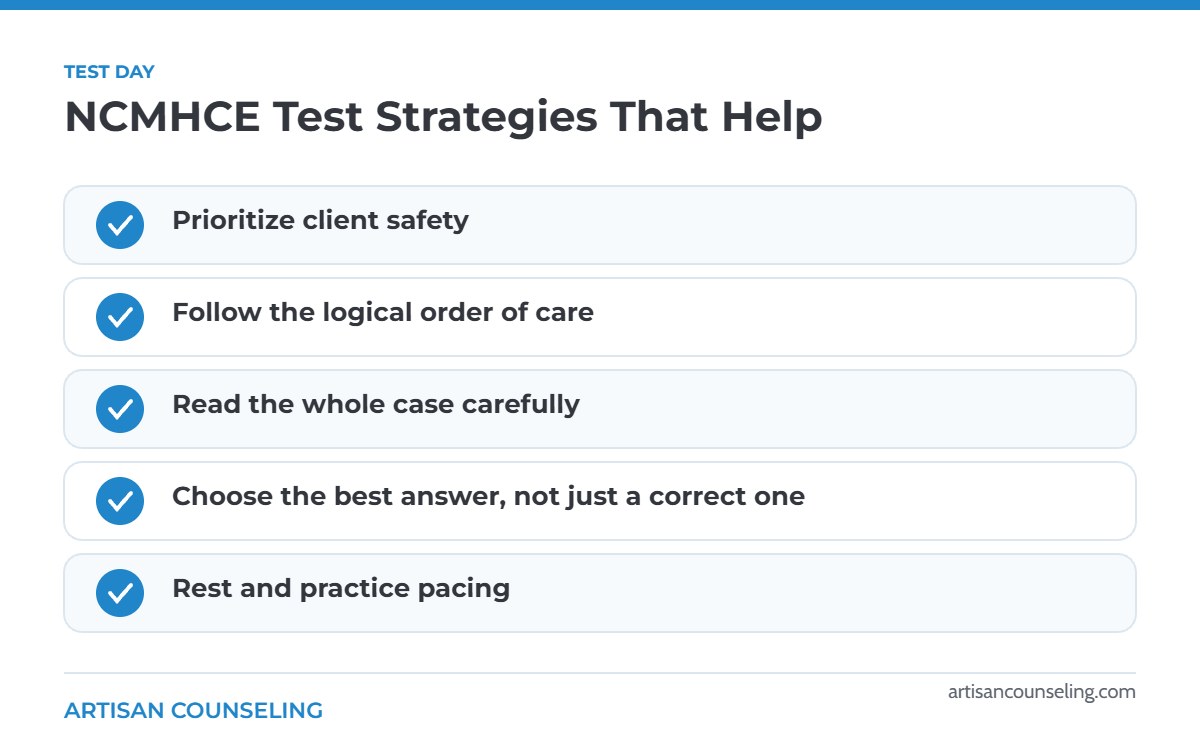
A clear strategy keeps you steady when a case feels confusing. Useful habits include:
- Prioritize client safety. When risk is present, addressing it usually comes first.
- Follow the logical order of care. Assessment generally comes before diagnosis, and diagnosis before treatment.
- Read the whole case. Note symptoms, duration, history, and context before answering.
- Look for the best answer, not just a correct one.
- Prepare for exam day. Rest, plan your travel and timing, and practice pacing with full-length cases.
Managing Test Anxiety
Even well-prepared candidates feel nervous. Many of the same tools counselors teach clients can help on exam day:
- Slow breathing: a few slow breaths with a longer exhale can calm your body between cases.
- Grounding: notice your feet on the floor and the chair beneath you to return to the present.
- Balanced self-talk: replace “I am going to fail” with “I have prepared, and I can work through this one case at a time.”
- Simulated practice: rehearsing under realistic conditions makes the real day feel more familiar.
If anxiety about the exam is affecting your sleep, work, or confidence, talking with your supervisor or a counselor of your own can help. Counselors benefit from support too, and individual counseling is a healthy part of professional self-care.
About Artisan Counseling’s NCMHCE Training
Artisan Counseling developed an NCMHCE training led by Ben Newman, LPC, CSAC, CSOTP, and Tierra Ruffin. The training was designed to empower residents in counseling and master’s students by providing an overview of test content areas and strategies specific to excelling on the exam. Participants also practiced applying those strategies to several case study examples, using the Kahoot app for interactive practice.
The training goals were for attendees to:
- Learn foundational strategies to navigate the unique format, content, and structure of the NCMHCE
- Learn how and what to study for the NCMHCE
- Learn common pitfalls that lead to underperforming
- Learn strategies that improve test scores and prepare them for exam day
- Gain a tried-and-true test strategy designed to help residents in counseling pass the NCMHCE
To ask about future training opportunities, please contact Artisan Counseling. You can also learn about our community involvement and the counselors on our team.
Frequently Asked Questions
Is the NCMHCE required for LPC licensure in Virginia?
The NCMHCE is used in Virginia as one of the prerequisites for LPC licensure. Confirm current requirements with the Virginia Board of Counseling, since rules can change.
How long should I study for the NCMHCE?
It varies by person, but many candidates benefit from steady study over several weeks rather than cramming. Build in plenty of practice with case studies.
What is the best way to practice for the NCMHCE?
Work through realistic clinical cases and review why each answer is best. Practicing with peers or a supervisor can strengthen your clinical reasoning.
Who administers the NCMHCE?
The exam is administered by the National Board for Certified Counselors (NBCC). Check NBCC for the current format, scheduling, and candidate handbook.
What should I do if I do not pass on my first attempt?
Not passing is disappointing, but it is not a measure of your worth as a counselor. Review your results, identify the areas that need work, and adjust your study plan. Check with NBCC and the Virginia Board of Counseling for current retake policies, and lean on supervisors and peers for support.
Can I prepare for the NCMHCE while working full time?
Yes, many residents do. Short, consistent study sessions spread across the week tend to be more realistic than long weekend cram sessions. Protect your sleep and plan your study time around your work schedule.
Connect With Artisan Counseling
Artisan Counseling is a group practice serving clients in Newport News and Suffolk, and through telehealth across Virginia. We are committed to supporting the next generation of counselors as well as the clients we serve. Explore more resources on the Artisan Counseling blog.