Key Takeaways
- What many people call a “generational curse” is often a learned behavior passed down through what we observe and experience growing up.
- Learned behaviors work like a “go to” response, shaped by family, culture, faith, and coping habits.
- Some learned behaviors helped you survive; others may now hold back your growth or relationships.
- If a behavior was learned, it can be unlearned with time, awareness, and support.
- Counseling offers a safe place to sort through your experiences and practice new patterns.
As a child, I enjoyed observing cyclical patterns within families. What did that look like? It looked like me reading biographies and autobiographies, with an ulterior motive: understanding how the decisions of parents shaped their children and grandchildren.
That fascination began when I first heard the phrase “generational curse.” It was usually tied to a “bad behavior” that seemed to pass down through a family. In this post, I share how I think about generational curses versus generational learned behaviors, how these patterns form, and why I believe they can be broken.
What Is a Generational Curse?
People often use “generational curse” to describe a pattern that repeats across generations, such as anger, addiction, unhealthy relationships, or money struggles. The phrase can make the pattern feel fixed or inevitable, as if it is simply handed to you.
Although there are times when there is a spiritual component, it is my belief that most of the time, what one may view as a generational curse is truly a learned behavior passed along through the generations.
Why does the word we use matter? Because words shape how we see ourselves. When something feels like a curse, it can feel like it is happening to you, and there is not much you can do about it. When you see it as something you learned, you start to see choices. That shift alone can bring a lot of relief.
What Is a Generational Learned Behavior?
A generational learned behavior (at least, that is what I like to call it!) is something a person learns as they interact with the world. Follow me here: a learned behavior is picked up through our experiences or our observations.
An Everyday Example
Imagine you watched your mother respond to frustrating situations with verbally aggressive sarcasm, day after day. If you observed that behavior regularly, you may pick up similar habits. Without ever deciding to, you might find yourself using the same sarcasm when you feel stressed.
How These Patterns Form
As you look at your own behaviors, remember that a generational learned behavior is similar to a trait. It is your “go to” response in a negative or positive situation. These behaviors are shaped by:
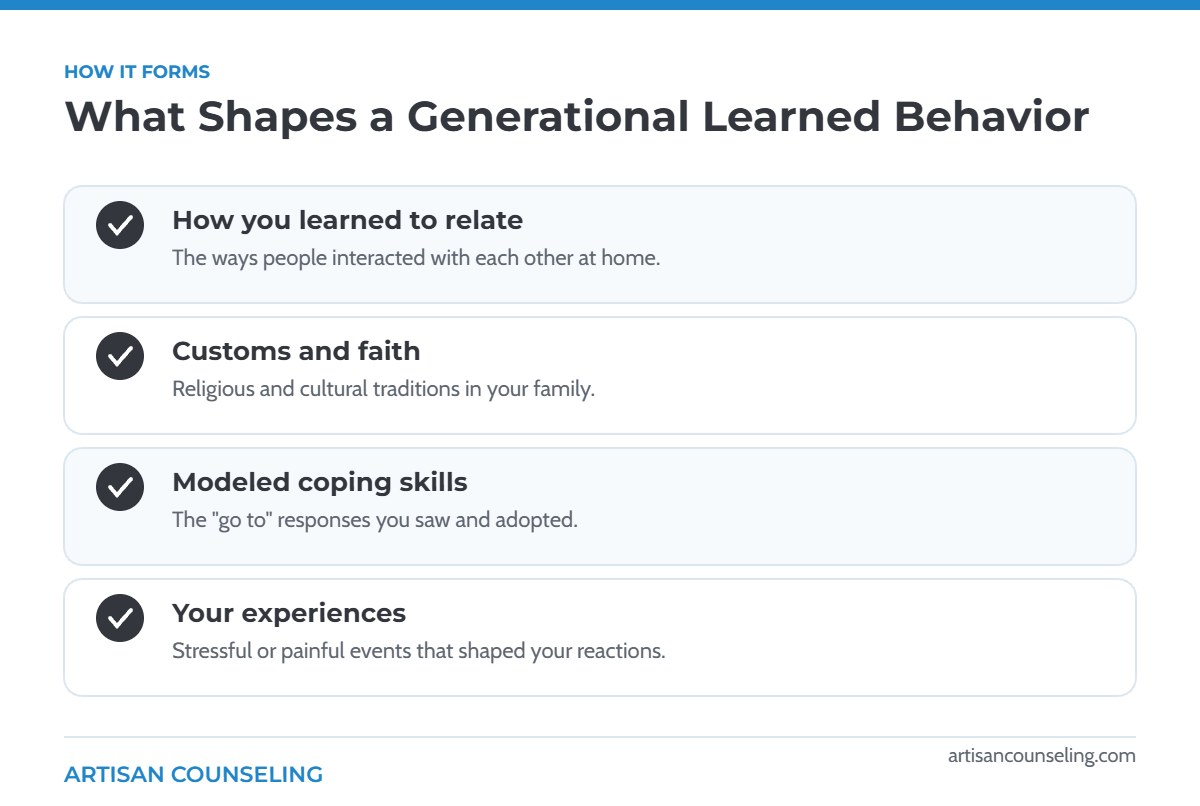
- How you learned to interact with others growing up
- Your family’s religious and cultural customs
- The coping skills you saw modeled and came to rely on
- Your own experiences, including stressful or painful ones
Patterns like these can show up in how we parent, argue, handle money, and set limits. Our article on how childhood experiences can affect you decades later explores some of these effects.
Common Patterns I See Passed Down
Over the years, certain patterns come up again and again. Here are a few you may recognize:
- “We don’t talk about it.” Families that avoid hard topics often raise children who struggle to name their feelings or ask for help.
- Love shown through doing, not saying. A parent may have worked long hours to provide but rarely said “I’m proud of you.” As an adult, you may find it hard to express affection with words.
- Yelling as the way to be heard. If raised voices were how things got resolved at home, you may notice your volume rising before you even realize it.
- Money as stress or secrecy. Growing up with constant worry about money can lead to overspending, hoarding savings, or avoiding the topic altogether.
- Putting everyone else first. If you watched a parent take care of everyone but themselves, you might have learned that your needs come last.
None of these make a family “bad.” They are simply patterns, and patterns can be looked at with honesty and care.
Helpful Patterns vs. Harmful Patterns
Not every learned behavior is negative. Some of what you learned helped you survive. Others may now hinder your growth or relationships.
For example, staying quiet during conflict may have kept you safe as a child, but as an adult it might keep you from voicing your needs. Being extremely self-reliant may have been necessary once, but it can make it hard to accept support today. Recognizing why a pattern started can soften the shame around it.
Questions to Ask Yourself
When I sit with clients who are curious about their own patterns, I often invite them to reflect on questions like these. You might want to journal about them:
- When I am stressed, what is the first thing I do? Who else in my family does that?
- What was I praised for as a child? What was I punished for?
- What was never talked about in my home?
- What do I want my children, or the people closest to me, to learn from watching me?
- Which family traits do I want to keep and pass on?
That last question is important. Looking at your family history is not only about finding what went wrong. It is also about naming the strengths, like resilience, faith, humor, or hard work, that you want to carry forward.
“But I’ve Been Like This My Whole Life”
As a therapist, I have heard people say, “But I’ve been like this my whole life. I can’t change.” I often encourage clients to consider this: if the behavior was learned, then it can be unlearned.
It just takes time, and linking arms with someone who can help you sort through your experiences.
How Can You Break a Generational Pattern?
Unlearning a pattern is a process, not a single decision. These steps can help you begin.
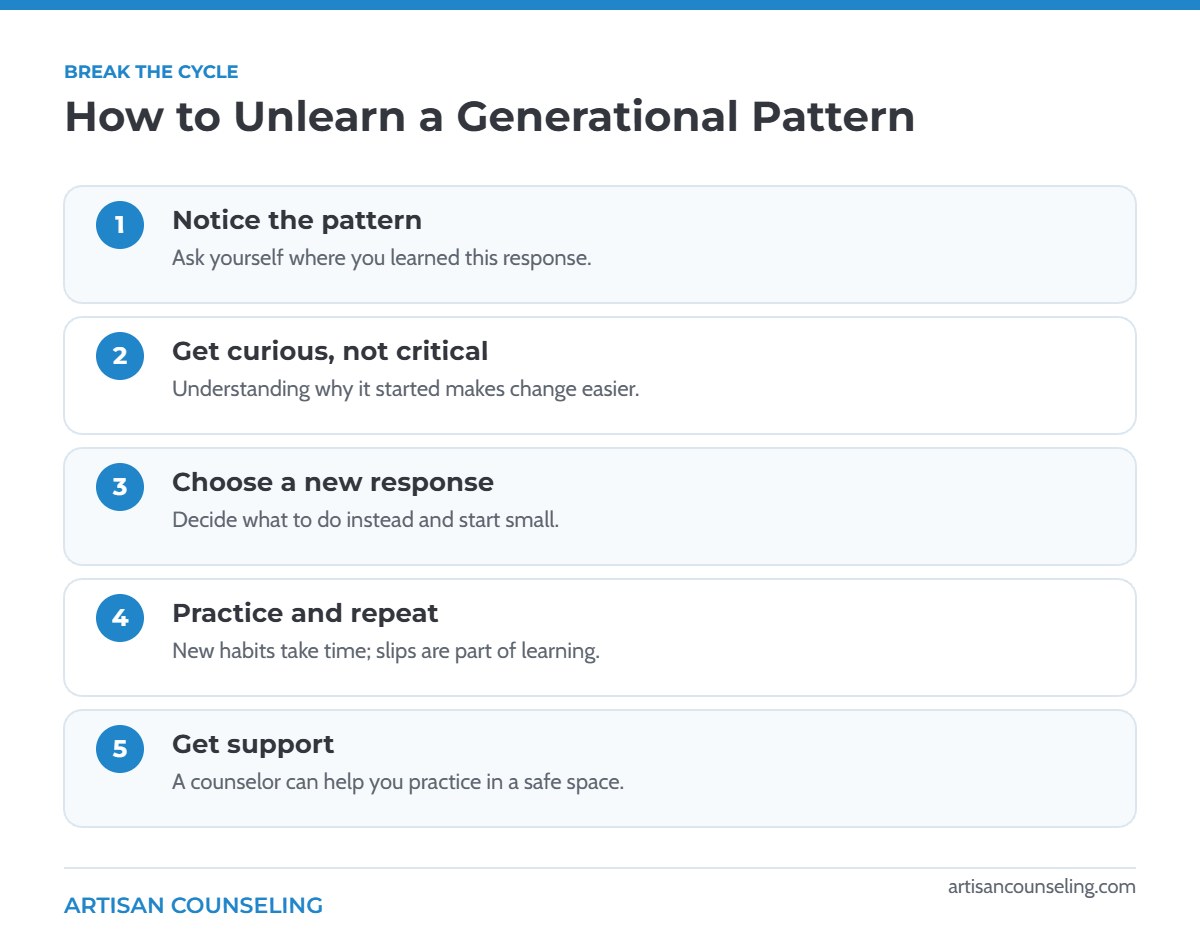
- Notice the pattern. Pay attention to moments when you react in a familiar way and ask, “Where did I learn this?”
- Get curious, not critical. Understanding why a pattern developed makes it easier to change.
- Choose a new response. Decide what you want to do instead, and start small.
- Practice and repeat. New habits take time to feel natural. Slipping back is part of learning.
- Get support. A counselor can help you explore your history and practice new patterns in a safe space.
What This Can Look Like in Real Life
Let me go back to the example of the mother who used sarcasm when she was frustrated. Say her daughter is now a parent herself. Her son spills juice on the couch, and she feels the sharp comment rising: “Oh great, that’s just perfect.”
Breaking the pattern does not mean that feeling never shows up. It means she notices it, takes a breath, and chooses something different: “Okay, accidents happen. Let’s grab a towel together.” Some days she will catch it in time, and some days she will not. When she does not, she can go back and repair: “I’m sorry I snapped. That wasn’t fair to you.” That repair is a powerful new pattern on its own, because her son learns that mistakes can be talked about and fixed.
Remember: Breaking a pattern is not about blaming your parents or grandparents. Many of them were doing their best with what they learned. You can honor where you came from while choosing something different.
Approaches such as Internal Family Systems (IFS) and family counseling can be especially helpful for looking at patterns that run through families.
What Does Counseling Look Like for Generational Patterns?
I want to demystify this part, because many people wonder what actually happens. In counseling, we usually begin by getting to know your story, including your family, your culture, your faith, and the experiences that shaped you. Some counselors use tools like drawing a family tree together to spot patterns across generations.
From there, we work on noticing your patterns as they happen in daily life, understanding what need each pattern was meeting, and practicing new responses. If painful or traumatic experiences are part of your history, approaches like trauma-informed therapy can help you process them at a pace that feels safe.
It may be a good time to reach out if a pattern is hurting your relationships, affecting your parenting, showing up as substance use, or leaving you feeling stuck no matter how hard you try. You do not have to wait until things feel unbearable.
If you are in crisis: If you are having thoughts of harming yourself, call or text 988 to reach the 988 Suicide & Crisis Lifeline. If you or someone else is in immediate danger, call 911.
There Is Hope
So whether you call it a generational curse or a generational learned behavior, it can be broken. Trust me, there is hope. Just because you have been a certain way for several years does not mean it has to stay that way.
What are your thoughts? Is it a generational curse or a learned behavior?
Frequently Asked Questions
What are examples of generational patterns?
Common examples include yelling or harsh criticism, avoiding conflict, difficulty showing affection, unhealthy relationship dynamics, substance misuse, and patterns around money or work. These often feel “normal” because they were familiar growing up.
Can generational trauma be healed?
Yes. Many people make meaningful changes with awareness, support, and practice. Trauma-informed counseling can help you process painful experiences and build healthier ways of coping and relating.
Do I need family counseling to break a generational pattern?
Not necessarily. Many people start with individual counseling. Family counseling can help when several family members want to change how they relate to one another.
Is it disrespectful to my family to change these patterns?
No. Choosing a new way of doing things is not a rejection of your family. You can love and honor the people who raised you while deciding that some habits stop with you, and keeping the strengths you want to pass on.
Working Through Family Patterns at Artisan Counseling
If you are interested in getting paired with a therapist, we are here to help. Learn more about individual counseling, meet our counselors, or contact us at Artisan Counseling, where we are dedicated to the craft of therapy.
Respectfully,
Tierra W. Ruffin, LPC