

Key Takeaways
- Recurring arguments usually signal unmet needs or lasting differences, not a lack of love.
- Many relationship conflicts are perpetual, so the goal is often to manage them well rather than eliminate them.
- Talking about recurring issues when calm, finding the need underneath, and making specific agreements can break the cycle.
- Repair after an argument matters as much as the argument itself.
Some couples can predict their next fight word for word. It might be about chores, money, in-laws, screen time, or how you spend weekends. The details shift, but the argument feels the same, and nothing seems to change.
If this is affecting your relationship, couples counseling at our Newport News and Suffolk offices can help you and your partner work through it together.
If that sounds familiar, you are not alone, and your relationship is not broken. In this article, you will learn why the same arguments keep coming back, how to tell solvable problems from lasting differences, and step-by-step strategies to finally break the cycle.
Why Do Couples Keep Having the Same Argument?
Recurring arguments are rarely about the surface topic alone. They keep returning because something underneath has not been addressed.
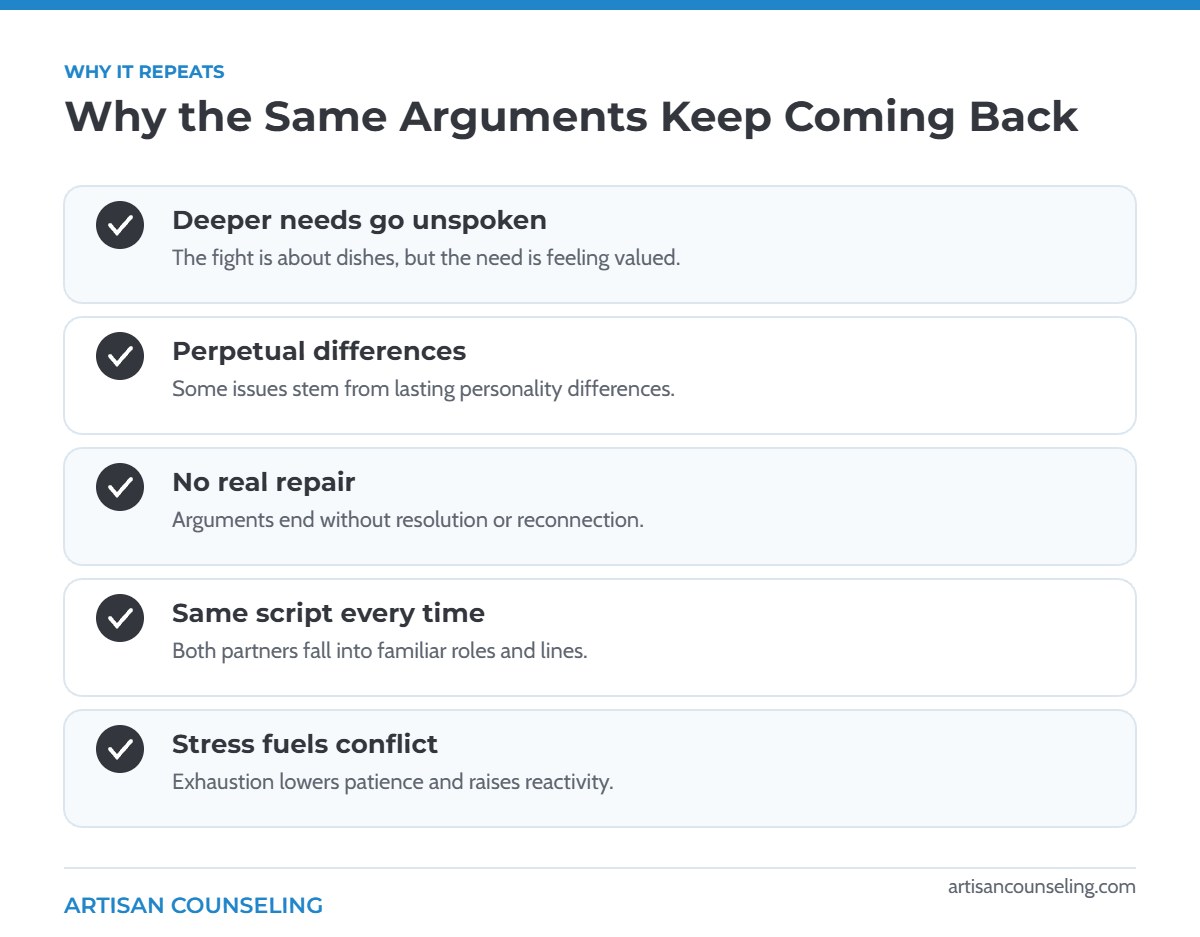
The Real Need Goes Unspoken
An argument about dishes may really be about feeling respected or like an equal partner. Until that need is named, solving the dishes will not end the fight.
Some Differences Are Lasting
Relationship researcher John Gottman found that many couple conflicts are “perpetual,” rooted in lasting differences in personality or values. These issues do not disappear, but couples can learn to discuss them with humor and understanding.
Arguments End Without Repair
If arguments end with someone walking away or a quick “fine,” the hurt stays. Next time, it adds fuel.
You Both Follow a Script
Over time, each partner develops predictable lines and roles. Once the script starts, it plays out automatically.
What This Looks Like in Real Life
For example, imagine Sam comes home and sees dishes piled in the sink again. Sam says, “I guess I’m the only one who cleans around here.” Jordan hears criticism, gets defensive, and points out everything they did that day. Within minutes, both are arguing about who works harder, and the dishes are still in the sink.
Underneath, Sam wants to feel like a teammate, and Jordan wants to feel appreciated for their effort. Neither need gets named, so the same fight is waiting for next week. Most recurring arguments follow a pattern like this: a trigger, a familiar opening line, a defensive reply, and an ending that leaves both people feeling unheard.
Is This a Solvable Problem or a Perpetual One?
Knowing which kind of problem you are facing changes your approach.
- Solvable problems are situational and can be resolved with a practical plan, like who handles a specific chore.
- Perpetual problems come from lasting differences, like one partner valuing spontaneity and the other valuing planning. The goal is ongoing dialogue and compromise, not a final solution.
Treating a perpetual problem as solvable leads to frustration. Accepting that some differences will remain can actually lower the temperature.
A Quick Self-Check
Before your next conversation, each of you can think through these questions on your own:
- When did this argument first start showing up in our relationship?
- What am I most afraid of if nothing changes?
- What would my partner say this issue means to them?
- Is there a version of this I could live with, even if it is not my first choice?
- Does this argument remind me of anything from my family growing up?
If your answers point to a value, a fear, or a part of who you are, you are probably dealing with a perpetual problem. If they point to logistics, it is likely solvable with a clear plan.
How Can You Stop Arguing About the Same Things?
These steps help couples move from repeated fights toward real understanding.
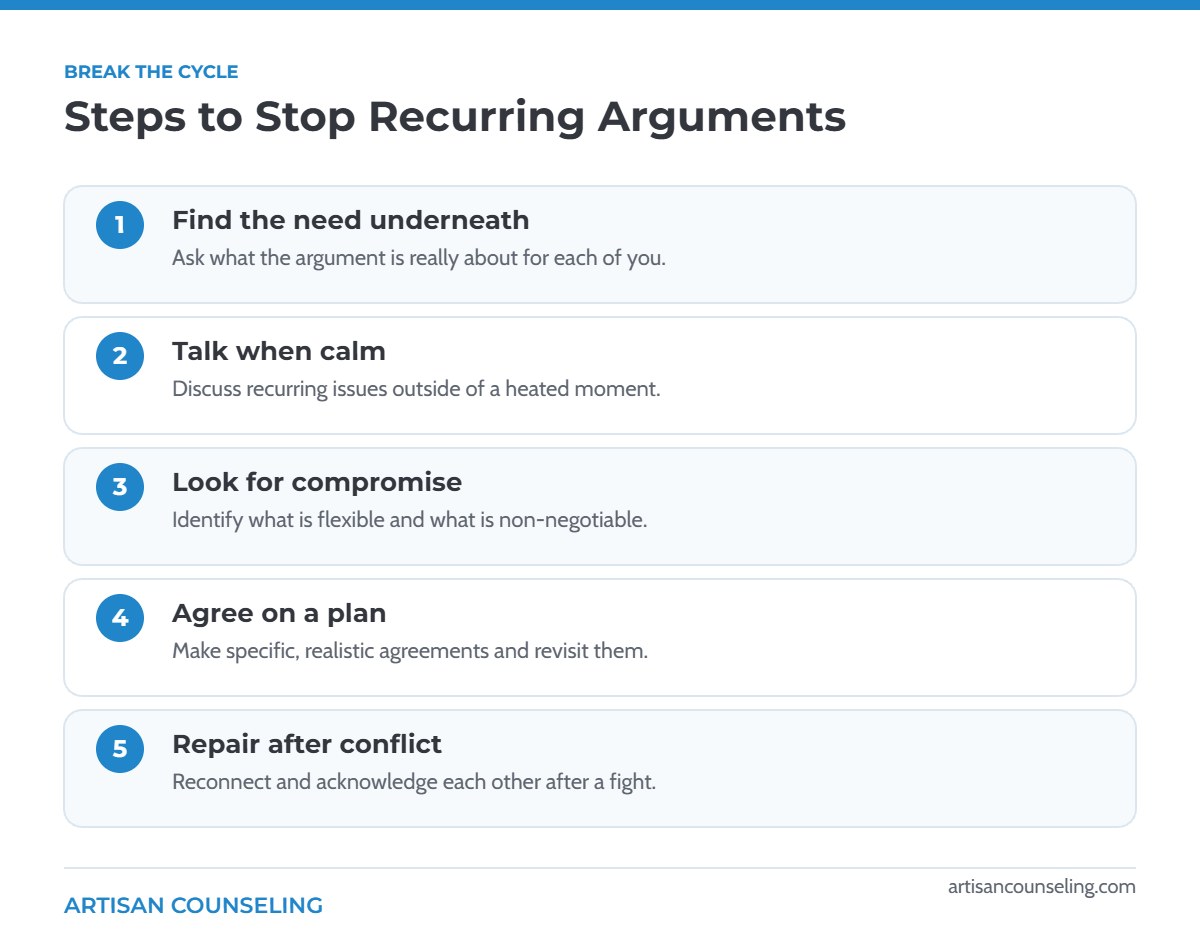
Step 1: Find the Need Underneath
Ask yourself and your partner: “What does this issue mean to you? What are you afraid will happen?” Often you will discover a need for security, respect, freedom, or closeness.
Step 2: Talk When You Are Both Calm
Recurring issues are best discussed at a planned time, not in the middle of a flare-up. Choose a moment when neither of you is tired, hungry, or rushed.
It can help to open the conversation in a way that signals teamwork. You might say, “Can we find 20 minutes this weekend to talk about how we split the evenings? I want us both to feel good about it.” Setting a time limit keeps the talk from feeling endless, and naming a shared goal makes it less likely to feel like an ambush.
While your partner talks, focus on understanding before responding. Try summarizing what you heard: “So it sounds like when plans change, you feel like you don’t matter. Is that right?” Your partner gets to feel heard, and you get to check that you understood.
Step 3: Identify What Is Flexible
Each partner can name their core need (non-negotiable) and the areas where they can bend. This makes compromise feel fair rather than like losing.
Step 4: Make Specific Agreements
“I’ll help more” is vague. “I’ll do the dishes Monday, Wednesday, and Friday” is clear. Agree to revisit the plan in a few weeks.
Step 5: Repair After Every Conflict
A sincere apology, a touch, or a simple “I know we’ll figure this out” helps both partners feel safe again. Learn more about repair in what makes relationships emotionally safe.
Try a softer start: Begin with “I” statements and a specific request. “I feel stressed when plans change last minute. Could we check in by Thursday about the weekend?” is easier to hear than “You always do this.”
What Can You Say When an Old Argument Starts Again?
Even with good intentions, you will sometimes feel the familiar script start up. These short phrases can help you step out of it in the moment:
- “I can feel us heading into the usual fight. Can we slow down?”
- “I’m getting flooded. I want to keep talking, but I need 20 minutes first.”
- “I don’t want to win this. I want to understand what’s going on for you.”
- “You’re right about part of that.”
- “Let’s come back to this tonight after the kids are asleep.”
When you take a break, tell your partner when you will return, then come back as promised. Use the time to calm your body, such as walking, breathing slowly, or listening to music, rather than rehearsing your next point. Some couples agree on a simple code word ahead of time so either partner can call a pause without it feeling like a rejection.
What Should You Avoid During Recurring Arguments?
- Bringing up every past mistake (“kitchen-sinking”).
- Using words like “always” and “never.”
- Contempt, sarcasm, or mocking.
- Continuing when one of you is overwhelmed. Take a 20-minute break and return.
- Trying to win instead of trying to understand.
For more on these patterns, read why communication breaks down in relationships. Clear limits also help; see why healthy relationships need healthy boundaries.
When Can Couples Counseling Help?
If you have tried to break the cycle and still feel stuck, a counselor can help. In couples counseling, you will learn to identify your patterns, understand the needs beneath them, and practice new ways of talking. Methods like the Gottman Method are designed specifically to help couples manage conflict.
Early sessions usually focus on understanding your history as a couple and mapping the cycle you get caught in. From there, your counselor may slow down a real argument in the room, help each of you name what you feel and need, and coach you through new responses. Between sessions, you might practice a specific skill, such as a planned weekly check-in.
It may be time to reach out if:
- You have the same fight weekly or more, and it is getting more intense.
- Arguments end with long stretches of silence or distance.
- One of you has started to avoid bringing up issues at all.
- Contempt, name-calling, or threats to leave have become common.
- You are unsure whether the relationship can recover.
If you are wondering whether counseling can still make a difference, read can couples counseling save a relationship.
Your safety comes first: If arguments involve fear, intimidation, threats, or physical harm, that is not a communication problem to solve together. Reach out for individual support and safety planning, and call 911 in an emergency.
Frequently Asked Questions
Is it normal to have the same argument over and over?
Yes. Many couples have recurring conflicts, often rooted in lasting differences. What matters is whether you can discuss them respectfully and feel understood.
How do you resolve a recurring argument?
Start by identifying the need underneath, talk when calm, look for flexible areas, and make specific agreements. For perpetual issues, aim for ongoing understanding rather than a one-time fix.
What are perpetual problems in relationships?
Perpetual problems are conflicts that stem from lasting differences in personality, values, or preferences. Couples manage them through dialogue, humor, and compromise rather than solving them completely.
When should a couple seek counseling for constant arguing?
Consider counseling if arguments are frequent, hurtful, or leave you feeling disconnected, or if you have tried on your own without progress.
Is it healthy for couples to never argue?
Not necessarily. Avoiding all conflict can mean important feelings go unspoken. The goal is not zero arguments but disagreements that stay respectful, stay on topic, and end with some repair.
Working Through Conflict With Artisan Counseling
Breaking an old cycle is easier with support. Our licensed counselors help couples in Newport News and Suffolk communicate with more understanding. Reach out today to schedule a session.